Review
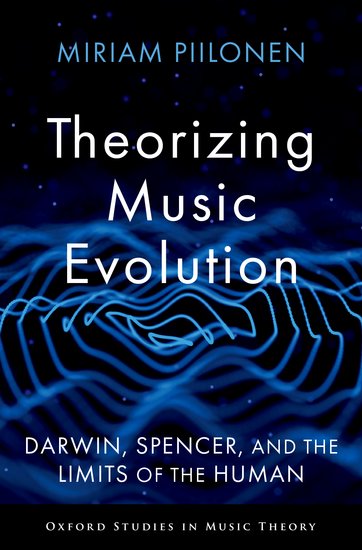
Theorizing Music Evolution: Darwin, Spencer, and the Limits of the Human
Miriam Piilonen
Oxford University Press, 2024, 168pp
Table of Contents
Having spent some time in the field of music evolution, I now see it—and I mean this in the most favorable terms—as a kind of interdisciplinary playground. It is a place for “Big Question” thinking, the kind that is often discouraged when one is trained in a specific discipline and asked to take on manageable research projects. It demands imagination and creativity, as there are inevitably many blanks to fill. Even if you happen to study very concrete aspects of human prehistory (the human skeleton, for example), you still have to do a lot with very little. This first became evident to me while writing my master’s thesis (Shilton 2017); see Shilton (2019) for the study’s conclusions. The subject was the evolution of language, with a focus on the prehistoric site of Gesher Benot Ya’aqov. Although the site spans one hundred thousand years of intermittent human settlement and produced a treasure trove of stone tools and animal bones, not a single human bone was recovered. To tackle aspects of prehistoric human lives that are much less concrete yet no less consequential—how humans communicated, socialized, and made sense of the world—is almost quixotic. Because intuitions in these types of discussions are bound to take an outsized role, it makes a difference where the researcher comes from: their education and training, as well as their cultural background and intellectual inclinations. It is not a totally unconstrained field: accounts of human evolution are grounded in evidence obtained according to the best practices of each related discipline, and they still must meet some acceptable standards. For more on the latter, see Anton Killin’s (2017) discussion of “lineage explanations.”
Music evolution also demands interdisciplinary collaboration. The fact that there is no definite paradigm controlling that interstitial space is yet another reason for more liberated thinking. Some forms of collaboration, however, are bound to be exceptionally challenging, since it is no mere disciplinary divide that separates fields like musicology and cultural anthropology from fields like psychology and evolutionary biology: it is the widening chasm between C. P. Snow’s (1959) “two cultures,” between experimental and interpretive methods, between understanding (verstehen) and explaining (erklären). It is this chasm that sometimes transforms music evolution’s interdisciplinary playground into a turf war.
The same sort of tension clearly motivates and animates Miriam Piilonen’s Theorizing Music Evolution: Darwin, Spencer, and the Limits of the Human. The book furthers Bennett Zon’s research on the intricate relationship between nineteenth-century evolutionary theory, especially its non-Darwinian manifestations, and Victorian musical culture (Lightman and Zon 2014, 2020; Zon 2017). While the book’s main characters—Spencer, Darwin, and Gurney—will be familiar to Zon’s readers, Piilonen considers each in much greater detail, giving readers a better understanding of each author’s arguments and their intellectual influence on one another. Considering the number of references to Darwin in over twenty-five years of music evolution research, a detailed examination of Darwin’s actual claims is a welcome contribution not only to musicology, but also to the field of music evolution. The latter will also profit from Piilonen’s lengthy engagement with Herbert Spencer, who has been largely ignored in contemporary music evolution research, despite having a much greater influence than Darwin on Victorian musicology (Zon 2014).
The book problematizes the theories of Spencer, Darwin, and Gurney, arguing that they were influenced by prevalent Victorian conceptions of Empire, the Sexes, and the Great Chain of Being. It shows music to be an extraordinarily pliable subject, reflecting cultural prejudices and personal tastes alike. Piilonen argues that music is “neither an easy nor a coherent subject of evolutionary theorization” (14), and I think most people who take it on as a subject will agree.
Theorizing Music Evolution is organized into five chapters, flanked by an introduction and a concluding section. The introduction contextualizes the book in relation to the present fascination with music’s prehistoric origins and the growth of evolutionary musicology. Chapters 1 (“Herbert Spencer Writes to Alfred Tennyson”) and 2 (“Charles Darwin vs. Herbert Spencer on the Origins of Music”) draw out contrasts between Spencer’s and Darwin’s theories of music evolution. For Darwin, music is primal and animalistic, akin to the mating calls of songbirds, gibbons, toads, and alligators. For Spencer, it is the mark of refinement and civility, the furthest point to which the inevitable progress of human intellect has reached. The relationship to language is conceived accordingly: for Darwin, music is a precursor to language, more emotional and raw; for Spencer, music is superior to language, capable of expressing greater complexity of emotion and experience.
Both Spencer and Darwin think in hierarchical terms. Organisms and behaviors are analyzed in terms of superior and inferior, higher and lower, complex and simple. Problematic as it may be, we should not forget that complexity is the main explanandum of evolutionary theory and why it made such a significant impact on Western thought. Evolution explains how complexity can emerge naturally, without divine intervention. It therefore dismantles an important and convincing argument for the existence of God (Moore 1979; Brown 1986). As such, one can understand why complexity plays such a dominant role in nineteenth-century evolutionary writings. The trouble begins when complexity is confounded with value-laden terms to which they are not convertible. To know if something is “superior” to another, one must take it in context, defining specific goals and values. In relation to certain goals and values, a simple design can be superior to a more complex one. More complicated still is the proper demarcation of teleological principles in an evolutionary description of the world: where does the telos of individual organisms end, and to what extent does it provide directedness to the evolutionary process? To contemporary readers, Spencer’s and Darwin’s writings may seem to overemphasize progress. But it is important to remember both the religious worldviews of their time and the fact that scientists and philosophers are still debating the proper way to understand the directedness of the evolutionary process.
Two subsequent chapters consider Spencer and Darwin separately and in greater detail. Chapter 3, “Sound Symbolism in Spencer’s Evolutionary Thought,” considers Spencer’s theory of the progressive evolution of vocal expression and its relation to feeling, as outlined in his “The Origin and Function of Music” (1857). The theory builds on the assumption that there is a natural relation between feeling, muscular action, and, by extension, vocalization. Spencer argues that the modification of five basic features of vocal expression—loudness, timbre, pitch, intervals, and rate of variation—has a natural relation to feeling. From this germ of innateness, the entire technical body of musical artifice unfolds, and culturally designed traditions of composition and performance are considered “intensifications” of basic natural relations. Spencer adapts the three-stage model prevalent in the nineteenth century to the human voice, swapping the primitive, barbarian, and civilized for the speaking, recitative, and singing voice. For more on the history of three-stage models since the nineteenth century, see Geroulanos (2024). Piilonen rightly points out, here and elsewhere, the tension between instinct and habit in these nineteenth-century theories, and how music is conceived at once as natural, innate, and animalistic while also involving learning and enculturation.
Chapter 4, “The Darwinian Musical Hypothesis,” takes on Darwin’s theory of sexual selection, confronting some of its assumptions with the much lesser-known writings of Antoinette Brown Blackwell, specifically The Sexes Throughout Nature (1875). Blackwell argues against Darwin’s recurrent emphasis on male superiority. A diagram from her book, entitled “Tabular View of Equations in Organic Nature,” explicitly tries to even the score in this battle of the sexes. Organized into two columns, male and female, it lists various traits (e.g., size, strength, and endurance), designates a male or female “winner” for each, and summarizes each tabulation with a neat “=” sign between the sexes. To give a better sense of Blackwell’s tabulation and some of its peculiarities: for the human species, men exhibit superiority in “sexual love” and “amount of circulation,” while women rate more highly in “parental love” and “direct insight of relations.” Blackwell’s argument has clear political motivations, and her conclusions may therefore seem more forced than those presented in works that do not reflect on how political biases may inform theory. Thus, we are inclined to read Spencer and Darwin as more objective, even though they could, in theory, be no less biased than authors who explicitly discuss the political element of their work. This is obviously not the only case where this happened in the history of science, and certainly not in the history of evolutionary theory. Further consideration of Blackwell and other authors like her from this angle will likely prove fruitful.
In the same chapter, Piilonen considers two examples of contemporary research inspired by the sexual selection hypothesis, and rightly criticizes their poor reasoning. Considering the centrality of adaptation in evolutionary musicology, Piilonen points to the growth of music cognition since Leonard Meyer, especially during the 1970s and ’80s, as one important reason. It is important to note, however, that Chomsky’s cognitive theory of language and its “notions of universal grammar” (112) were decidedly anti-evolutionist and anti-adaptationist. It was evolutionary psychology researchers who put natural selection and adaptation at the center of their theories; notably, Steven Pinker and Paul Bloom (1990) argued against Chomsky’s anti-adaptationist position on language. Notice, too, that adaptation is a non-issue in the field of language evolution, but it has been practically the only issue in music evolution (Shilton 2022). Thus, the centrality of adaptation is not only due to evolutionary psychology (rather than cognitive science more generally), but it is also the result of some peculiarities of music which I discuss later in this essay.
Chapter 5 shifts the focus to Edmund Gurney. Its title references “Gurney’s Darwinian Music Formalism,” but I found the connection between the two, as well as the connection between Gurney and Spencer, somewhat tenuous. Gurney does reference Darwin’s idea that vocalization was associated with courtship in human evolutionary history, and he even suggests that such primeval associations could influence the emotional response of contemporary humans to the production of “striking sound, especially by a single individual” (1880, 117). But apart from these connections, little in his theory relies on evolutionary theory or on accounts of human evolutionary history. Gurney, like Spencer and Darwin, echoes ideas prevalent in Victorian England, and he too describes cultural preferences of the time as natural. But unlike Spencer and Darwin, I cannot quite see how his music formalism can inform our understanding of contemporary music evolution research.
The final chapter, “Conclusion: Post-Darwinian Music Theory,” considers how music theory can move past what Piilonen sees as the problematic legacies of Victorian evolutionary thought. She argues against the superficial use of Darwin as an authority figure rather than as a source of intricate, historically situated scholarship. Yet Piilonen herself might attribute too many of the problems of contemporary music evolution research to Darwin. What she calls the “Darwin-ization” (138) of music should actually be called the “neo-Darwinization” of it. The reason music evolution does not seriously engage with Darwin’s work is that it is the offshoot of neo-Darwinism, and more particularly, part of a tide of neo-Darwinian theories of mind and culture emerging since the 1970s: sociobiology, cultural evolution, human behavioral ecology, and evolutionary psychology. Neo-Darwinism is not a continuation of Darwin’s theory, but rather its integration and hybridization with the theories of Gregor Mendel, August Weissman, and population genetics—known since the 1940s as “the modern synthesis.” For more details on the history of “the modern synthesis,” see Corning (2020).
Piilonen concludes by posing various questions that music evolution researchers should ask themselves, broadly related to how musical origins are framed, how music is constructed, how musical beings are conceptualized (and who is excluded from such conceptualizations), and what political values might underlie evolutionary claims. I, too, would encourage reflection along those lines, especially for people coming from the sciences. I would also warn against excessive self-reflection insofar as it prevents us from studying the world around us or expressing and trying out our ideas.
At various points, Piilonen’s critique of Spencer and Darwin includes accusations of racism, referring to Spencer’s “racist music theory” (64) and Darwin’s “racist theorization of music” (108). In most cases, the word is not properly qualified, and reads as an anachronistic condemnation of nineteenth-century scholars. Several of the quotes drawing Piilonen’s reproach are quite mild—certainly not shocking to a practiced reader of nineteenth-century scholarship—and even surprisingly relativistic. Some of the terms used (e.g., “primitive,” “savage,” and “Hottentot”) sound horrifying today, but were common currency at the time. For an example of how the appropriateness of words can transition and why these changes sometimes do not make sense, see Elizabeth Marshall Thomas’s (2006, 43–47) discussion of the various names given to the “Bushmen” of the Kalahari. Insofar as they betray a sense of cultural superiority, we should note that it is very common for people everywhere to consider their culture as superior to others. I am thinking, for example, of one community of Central African Mbendjele, an unusually egalitarian society, who reportedly used to call their villager neighbors gorillas for their crude and aggressive behavior (Lewis 2002, 210). As for the actual claims made by Darwin in two of the quotes Piilonen mentions (14; 108), they read to me as quite relativistic. In the first, Darwin says that tastes differ between cultures: we (e.g., English, Europeans, Westerners) dislike the music of “savages,” but these “savages” also dislike our music, finding it “hideous and unmeaning.” “So different is the taste of the different races, that our music gives not the least pleasure to savages, and their music is to us hideous and unmeaning” (Darwin 1871, 1:333). In the second, Darwin states that everyone has some musical talent, and people of all ethnicities can become excellent musicians. “We see that the musical faculties, which are not wholly deficient in any race, are capable of prompt and high development, for Hottentots and Negroes have become excellent musicians, although in their native countries they rarely practise anything that we should consider music” (Darwin 1871, 2:334). Elsewhere in the same book, Darwin argues convincingly against the idea that humans are naturally separated into different and distinct races; he claims that races “graduate into each other” and mocks polygenists (Kant included) for the arbitrariness of the supposed number of races. “But the most weighty of all the arguments against treating the races of man as distinct species, is that they graduate into each other, independently in many cases, as far as we can judge, of their having intercrossed. Man has been studied more carefully than any other animal, and yet there is the greatest possible diversity amongst capable judges whether he should be classed as a single species or race, or as two (Virey), as three (Jacquinot), as four (Kant), five (Blumenbach), six (Buffon), seven (Hunter), eight (Agassiz), eleven (Pickering), fifteen (Bory St. Vincent), sixteen (Desmoulins), twenty-two (Morton), sixty (Crawfurd), or as sixty-three, according to Burke. This diversity of judgment does not prove that the races ought not to be ranked as species, but it shews that they graduate into each other, and that it is hardly possible to discover clear distinctive characters between them” (Darwin 1871, 1:226).
Piilonen treats Spencer, Darwin, and Gurney with care, and devotes a reasonable amount of space to conveying their original arguments. However, there is something about the occasional reprimand, especially when compounded with her overall critical approach, that made me doubt whether her treatment of these nineteenth-century thinkers is entirely fair. In the field of the history and philosophy of science, at least as I know it, it is considered methodologically unsound to approach the history of ideas with an attitude of intellectual or moral superiority. Although our current conventional knowledge might disagree with that of past scholars, reading their work as less intelligent or morally dubious for that reason fails the basic task of understanding. It also overvalues our contemporary theories and cultural norms. If we indeed reject nineteenth-century progressivism, then we should also admit that we are not the pinnacle of scientific and moral development: who knows which of our ideas or customs future generations may find shocking or ridiculous?
Piilonen’s book is very critical of contemporary music evolution research. The issues that Piilonen raises are real, and they should be discussed more often, as should the intellectual history of the field. But I would still like to defend contemporary research. It is not only that I think researchers should indulge in bigger questions and riskier speculation from time to time—provided the appropriate caveats, and that they try not to deceive the less knowledgeable. Nor is it simply the fact that music, blurry edged as it may be, does justify theorizing in an evolutionary timescale and using the tools of evolutionary theory. On the issue of blurry edges, it should be mentioned that it is shared by many other important concepts. For a few examples relevant to evolutionary biology, see the discussion of genes, individuals, and species in Godfrey-Smith (2014). Among other reasons, music is ancient (over forty thousand years old and probably much older), appears in practically all human populations, animates vital aspects of social life (bonding groups and connecting humans to the “supernatural”), and produces strong effects on the human psyche. Cross (2016), Mehr et al. (2021), and Shilton (2022) discuss these and other considerations. Beyond these considerations, I see a political value in the attempt to connect music and evolutionary theory. This is because music has proven itself a particularly subversive and liminal subject, presenting a persistent challenge to evolutionary theory and to overarching conceptions of human nature and sociality.
Politics may subtly influence scientific theory in various fields, but with evolutionary theory—and theories of human evolutionary history in particular—that influence seems almost inescapable. Humans are both “political animals,” according to Aristotle ([1932] 1944, 11), and a species with an evolutionary history. Our political behavior is guided by our understanding of ourselves, and it is impossible to make sense of ourselves without saying something about our own evolution. Theories of our evolutionary history, however, are inevitably influenced by political realities, leading to a circular, dialectic process (Sahlins 1976). Lysenkoism is one extreme example of politics forcing the hand of evolutionary theory, but a more subtle bidirectional process is always in play. As it turns out, the core principles of natural selection have tended to sit well with right-wing ideologies. Up to the Second World War, adaptation and the struggle for existence have been used to justify and naturalize the violence of colonial expansion, eugenics, and ethnic cleansing (Geroulanos 2024). In the last few decades, evolutionary theories like sociobiology and evolutionary psychology have been associated with possessive individualism and neoliberalism (Sahlins 1976; McKinnon 2005). But there is more to evolutionary theory than natural selection and the modern synthesis. Different evolutionary processes involving epigenetic, developmental, and cultural dimensions play an important role, and attempts to integrate them into an extended evolutionary synthesis are ongoing. In their recent book, Evolution Evolving, Lala et al. envisage a more complex evolutionary process, in which “genomes and robust parental effects (over hundreds to thousands of generations), cultural knowledge (over tens of generations), epigenetic modifications (over a handful of generations), other parental effects (over a single generation), and phenotypic plasticity (in the current generation) collectively contribute to adaptive evolution” (2024, 167). These attempts to probe and challenge the consensus also have a political dimension, and the choice of certain researchers to pursue these directions scientifically is perhaps not completely unrelated to politics and values. This assumption should not discount theories as strictly or mainly political; its proponents are as committed to science as those who reject it, and they can only be accepted on scientific grounds.
With this in mind, consider the past twenty-five years or so of researchers grappling with music as an evolutionary subject. It began with a proponent of evolutionary psychology, Steven Pinker. Pinker and his colleagues argued for a mind comprised of mental modules designed by natural selection in vaguely determined ancestral environments. Linguistic communication relied on mental modules designed for language. By contrast, music did not have corresponding mental modules: it relied on modules serving other naturally selected functions (Pinker 1997). In Pinker’s picture of the human mind, music had no place. It was deemed useless.
This marked the beginning of a discourse haunted by the question of function. It started two years after Pinker’s provocative discussion of music with the publication of the edited volume The Origins of Music (Wallin et al. 1999), and continues to this day. The current debate is well portrayed by the two target articles and sixty commentaries published on the subject in 2021 in Behavioral and Brain Sciences (Savage et al. 2021; Mehr et al. 2021). Sexual selection has since played a minor role, and Piilonen’s emphasis on it misrepresents the field. More well-accepted theories focus on group solidarity and infant care, assuming either that music supports social bonding in both instances, or functions as credible displays of commitment to groups or parental investment. For more on these theories, see Savage et al. (2021) and Mehr et al. (2021).
It took some time for the response to Pinker to not only criticize his assumptions about music’s uselessness (which reflected Western conceptions of music-as-sound, as opposed to music-as-interaction), but also his evolutionary approach (Killin 2016; Tomlinson 2015). Behavioral phenomena like music or language need not be categorized as either adaptation or byproduct: we oversimplify evolutionary processes and the human mind by thinking in those terms. Gary Tomlinson’s (2015) critique and alternative vision, in particular, is well deserving of the section devoted to it in Piilonen’s book. The alternative view has continued to develop since then, involving developmental plasticity, cultural modes of inheritance and persistence, niche construction, and genetic accommodation (Killin 2017; Podlipniak 2017; Savage et al. 2021; Shilton 2022). To this we can add Cecilia Heyes’s (2018) theory of “cognitive gadgets,” which argues that mental modules develop during ontogeny based on more general-purpose associative learning and social motivation, and therefore challenges the notion of innate brain regions specialized for language or music evolving as adaptations. Moreover, Ian Cross’s (2022) theory of music as a form of affiliative interaction overlapping significantly with phatic speech challenges any neat distinction between music and language, and shifts our focus to general-purpose behavioral traits that are arguably more fitting for evolutionary study. Taken together, these theoretical contributions help music evolution theories mature into an explanatory framework that is in no way oversimplified, and that even challenges us to refine existing theories of human psychology, sociality, and evolution.
It is not coincidental that the subject of music—with its liminal, elusive, and subversive nature—triggered these challenges to evolutionary psychology and adaptationism. I take inspiration here from Ted Gioia’s (2019) overarching historical thesis in Music: A Subversive History. Its strong influence on the human psyche remains a puzzle, and it seems to persistently lie outside normal human conduct and rationality. For example, when Bruno Nettl (2015) discussed music’s ultimate function, adopting utilitarian evolutionary terms, he suggested a decidedly non-scientific answer: music’s function is to mediate between humans and supernatural beings. In a recent cross-cultural study I co-authored with Aniruddh D. Patel, Kim Hill, and Chris von Rueden, one which stemmed from work in evolutionary musicology but opted for a contextualized and historical approach to each society considered, religion emerged as an undeniably important factor in understanding the relative prevalence of collective music-making (Shilton et al. 2025). It seems that any general scientific theory of music and its evolution must confront complex issues of meaning, agency, and ontology that go beyond established scientific paradigms.
One particularly intriguing section of Piilonen’s book demonstrates music’s potential as a subversive subject for philosophical contemplation. It concerns an interesting discussion of earworms found in Spencer’s collection of leftover short essays, Facts and Comments (1902), enigmatically titled “A Problem.” Spencer is annoyed by musical tunes that get stuck in his head. They are so unrelenting, he writes, that they persist during his sleep and are the first thing he becomes conscious of when he awakes. But these earworms not only disturb his peace: they violate supposedly “unassailable” metaphysical dogmas about the self. He wonders:
What then is the mode of existence of this organized set of tones, so coherent that when partly repeated it insists on completing itself, and then after an instant recommences? In what way does this rebellious portion of consciousness stand related to the rest? We can hardly include it in what we call the Ego seeing that the Ego continually tries to repress it and fails. And yet if it is not a part of the Ego what is it? (1902, 9)
The earworm has the coherence of an agent, but it is to a degree separate from the self, and even antagonistic to it. It therefore confronts Spencer with the “porousness of the Ego,” as Piilonen puts it (24). Is this phenomenon not related to the “social bonding” effects of music, so often discussed in the field of music evolution but receiving little additional reflection—as if the operation of seeing oneself as continuous or identical with abstract entities is self-explanatory? Is it not also related to the association between music-making and the communication with supernatural beings, the same function emphasized by Nettl, but not easily treated with the standard scientific toolkit?
So we come again to the inescapable interdisciplinarity of music evolution, and in particular to the need to collaborate across the science-humanities divide. As it turns out, intellectual history is a very good place for humanists and scientists to convene. No one feels totally at home there: a person thoroughly knowledgeable in contemporary scientific paradigms might have little knowledge of their histories and broader context, while a person excelling in the latter could still miss important aspects of that history due to an insufficient understanding of present-day scientific knowledge and methods. Piilonen’s work in this area is insightful, compelling, and opens many doors for further discussion: I hope people from both sides of the divide join it, in the serious spirit of play.
Works Cited
Aristotle. [1932] 1944. Politics. Translated by Harris Rackham. Harvard University Press.
Brown, Frank Burch. 1986. “The Evolution of Darwin’s Theism.” Journal of the History of Biology 19 (1): 1–45.
Corning, Peter A. 2020. “Beyond the Modern Synthesis: A Framework for a More Inclusive Biological Synthesis.” Progress in Biophysics and Molecular Biology 153: 5–12. https://doi.org/10.1016/j.pbiomolbio.2020.02.002.
Cross, Ian. 2016. “The Nature of Music and Its Evolution.” In The Oxford Handbook of Music Psychology, 2nd ed., edited by Susan Hallam, Ian Cross, and Michael Thaut, 3–18. Oxford University Press. https://doi.org/10.1093/oxfordhb/9780198722946.013.5.
Cross, Ian. 2022. “Music, Speech and Affiliative Communicative Interaction: Pitch and Rhythm as Interactive Affordances.” Preprint, PsyArXiv, May 9. https://doi.org/10.31234/osf.io/tr9n6.
Darwin, Charles. 1871. The Descent of Man, and Selection in Relation to Sex. 2 vols. John Murray.
Geroulanos, Stefanos. 2024. The Invention of Prehistory: Empire, Violence, and Our Obsession with Human Origins. Liveright.
Gioia, Ted. 2019. Music: A Subversive History. Basic Books.
Godfrey-Smith, Peter. 2014. Philosophy of Biology. Princeton University Press.
Gurney, Edmund. 1880. The Power of Sound. Smith, Elder, and Company.
Heyes, Cecilia. 2018. Cognitive Gadgets: The Cultural Evolution of Thinking. Harvard University Press.
Killin, Anton. 2016. “Rethinking Music’s Status as Adaptation Versus Technology: A Niche Construction Perspective.” Ethnomusicology Forum 25 (2): 210–33. https://doi.org/10.1080/17411912.2016.1159141.
Killin, Anton. 2017. “Plio-Pleistocene Foundations of Hominin Musicality: Coevolution of Cognition, Sociality, and Music.” Biological Theory 12 (4): 222–35. https://doi.org/10.1007/s13752-017-0274-6.
Lala, Kevin N., Tobias Uller, Nathalie Feiner, Marcus W. Feldman, and Scott F. Gilbert. 2024. Evolution Evolving: The Developmental Origins of Adaptation and Biodiversity. Princeton University Press.
Lewis, Jerome. 2002. “Forest Hunter-Gatherers and Their World: A Study of the Mbendjele Yaka Pygmies of Congo-Brazzaville and Their Secular and Religious Activities and Representations.” PhD diss., University of London.
Lightman, Bernard, and Bennett Zon, eds. 2014. Evolution and Victorian Culture. Cambridge University Press.
Lightman, Bernard, and Bennett Zon, eds. 2020. Victorian Culture and the Origin of Disciplines. Routledge.
McKinnon, Susan. 2005. Neo-Liberal Genetics: The Myths and Moral Tales of Evolutionary Psychology. Prickly Paradigm Press.
Mehr, Samuel A., Max M. Krasnow, Gregory A. Bryant, and Edward H. Hagen. 2021. “Origins of Music in Credible Signaling.” Behavioral and Brain Sciences 44 (60): 23–39. https://doi.org/10.1017/S0140525X20000345.
Moore, James R. 1979. The Post-Darwinian Controversies: A Study of the Protestant Struggle to Come to Terms with Darwin in Great Britain and America, 1870–1900. Cambridge University Press.
Nettl, Bruno. 2015. The Study of Ethnomusicology: Thirty-Three Discussions. 3rd ed. University of Illinois Press.
Pinker, Steven. 1997. How the Mind Works. Norton.
Pinker, Steven, and Paul Bloom. 1990. “Natural Language and Natural Selection.” Behavioral and Brain Sciences 13 (4): 707–27. https://doi.org/10.1017/S0140525X00081061.
Podlipniak, Piotr. 2017. “The Role of the Baldwin Effect in the Evolution of Human Musicality.” Frontiers in Neuroscience 11 (542). https://doi.org/10.3389/fnins.2017.00542.
Sahlins, Marshall D. 1976. The Use and Abuse of Biology: An Anthropological Critique of Sociobiology. University of Michigan Press.
Savage, Patrick E., Psyche Loui, Bronwyn Tarr, et al. 2021. “Music as a Coevolved System for Social Bonding.” Behavioral and Brain Sciences 44 (59): 1–22. https://doi.org/10.1017/S0140525X20000333.
Shilton, Dor. 2017. “The Communication Technology at the Acheulian Site of Gesher Benot Ya’aqov.” Master’s thesis, Tel Aviv University.
Shilton, Dor. 2019. “Is Language Necessary for the Social Transmission of Lithic Technology?” Journal of Language Evolution 4 (2): 124–33. https://doi.org/10.1093/jole/lzz004.
Shilton, Dor. 2022. “Sweet Participation: The Evolution of Music as an Interactive Technology.” Music and Science 5: 1–15. https://doi.org/10.1177/20592043221084710.
Shilton, Dor, Aniruddh D. Patel, Kim Hill, and Chris von Rueden. 2025. “Why Collective Music-Making Is Sometimes Rare: A Study of Four Indigenous Societies.” Evolution and Human Behavior 46 (4): 106695. https://doi.org/10.1016/j.evolhumbehav.2025.106695.
Snow, C. P. 1959. The Two Cultures and the Scientific Revolution. Cambridge University Press.
Spencer, Herbert. 1902. Facts and Comments. Williams and Norgate.
Thomas, Elizabeth Marshall. 2006. The Old Way: A Story of the First People. Farrar, Straus and Giroux.
Tomlinson, Gary. 2015. A Million Years of Music: The Emergence of Human Modernity. Zone Books.
Wallin, Nils L., Björn Merker, and Steven Brown, eds. 1999. The Origins of Music. MIT Press.
Zon, Bennett. 2014. “The ‘Non-Darwinian’ Revolution and the Great Chain of Musical Being.” In Evolution and Victorian Culture, edited by Bernard Lightman and Bennett Zon, 196–226. Cambridge University Press.
Zon, Bennett. 2017. Evolution and Victorian Musical Culture. Cambridge University Press.