Table of Contents
I. Introduction
The date is January 28, 2001. The Baltimore Ravens have just defeated the New York Giants in Super Bowl XXXV. The CBS screen fades to black as you hear a familiar voice introducing 16 new castaways for the second season of Survivor. The voice, belonging to Jeff Probst, narrates their journey, riding in a 38-squadron Caribou DHC-5 military aircraft on loan from the Royal Australian Air Force. They are about to be stranded in the middle of the Australian Outback. Visually, something is already different: the lush tropical backdrop familiar to season 1 viewers has faded into a flat, arid, sparsely vegetated desert. Even if you shut your eyes, however, something is still different. As the theme song starts, the first sound—which then persists the whole time—is a didgeridoo. Even with the melody, harmonies, tempo, form, and dynamics all the same, this orchestrational choice completely changes your imagination of where the season is located. CBS has already said that this next season’s cast will be different, and the visual differences are striking. It is clear that the theme music is shifting to emphasize this changing narrative. Little do you know, this location-based transformation of the theme music will continue throughout Survivor’s (to date) 26-year tenure and move beyond simple orchestrational shifts, with some of the seasons changing the rhythm and metrical structures. This article examines these and other variations in the Survivor theme music and how they reflect aspects of the show’s production in a broader media landscape.
Despite Survivor’s attempt at authentically replicating the diverse musical traditions of the regions featured in their first 26 seasons, there is a clear metric stereotyping present in their final renditions. During Russ Landau’s tenure heading the orchestration, recording process, and production of the theme songs, the show actively engaged local musicians when traveling to a new location. The employment of local musicians would appear to dismiss any accusations of truly appropriating these representative cultures. However, due to each season’s final version being edited by an American not entirely familiar with these musical traditions, there was a noticeable homogenization of metricity based on geographic location. In this paper, I look at the beginning- and end-accent paradigms, the use of tresillos and small-scale metrical dissonance, and the overall metricity to the introduction sections of each theme. I employ prior scholarship on hypermetrical accenting, metric dissonance, and music perception by Cooper and Meyer (1960), Cone (1968), Lerdahl and Jackendoff (1983), Krebs (1987, 1999), Cohn (2016), Murphy (2016), and Mirka (2021) to quantify and access each of these metrics. In two of these metrics, similar geographic regions are grouped together, suggesting a cross-musical similarity. However, this similarity does not stem from any explicit musical connection between these areas. In the worst case, some later themes merely imitate a stereotypical “island” sound, having no connection to any of the myriad musical styles of the filming areas at all. This homogenization, whether intentional or not, based on where each season is filmed, questions the entire “authenticity” of the music being presented. The American viewership will likely assume the music heard is an authentic cultural representation, so a discrepancy here is particularly harmful. This issue with Survivor’s music also reflects broader issues in media representation, where complex cultural identities are often distilled into simplistic, familiar tropes.
II. History and Significance
The Introduction Sequence
Both the cast introduction sequence and the theme song to Survivor, titled “Ancient Voices,” Russ Landau, Ancient Voices: The Survivor Themes (Soundtrack from the TV Show), Landau Music Group, 2003. have been present in almost every season since its first episode on May 31, 2000. Survivor: Borneo (season 1), episode 1, “The Marooning,” May 31, 2000, CBS. Originally, Russell Landau composed it with the assistance of executive producer Mark Burnett and David Vanacore, head of the music production department. “About,” Russ Landau, updated 2026, https://russlandau.com/about/. The theme incorporates a Russian folk song “Пойду-выйду на улицу” [Poydu-vïydu na ulitsu], typically translated as “I’ll Go Outside.” Marina Devyatova, “Poydu-vïydu,” released August 1, 2013, posted July 29, 2024, YouTube, https://www.youtube.com/watch?v=xyL2jII0Td8. As I will discuss later, the composers selected this particular folk melody for its melodic and harmonic ambiguity, even when viewed in videos featuring native folk performers. See the performances by Krasnoyar’ye and YAR (https://www.youtube.com/watch?v=3t2UEgzsG70) and the Fyodorov Sisters (https://www.youtube.com/watch?v=UBRr5WFHLls). On tonal ambiguity in Russian music, see Bakulina (2014). The composers and producers appear to have intentionally chosen a theme that lacks strong musical directionality. In its pure, non-orchestrated form, the theme projects a strong sense of musical stasis, which contrasts with the strong call to action.
The function of the theme song is primarily to provide background music for the cast introduction sequences that occurred in every season from 1 to 36 and from 45 to the present. The production team also created and published online versions for seasons 37 and 38. These intro sequences are designed to fulfill two requirements: introduce the cast, as shown in Example 1, and establish the location. Every cast member receives two to four seconds during the intro sequence for action shots in challenges or at their camp on location, accompanied by their name and occasionally their tribal affiliation for the game. Many of these shots also help to introduce the personality of the cast, featuring more aggressive shots for assertive personalities and laughter shots for comic characters. These qualities are shown in Example 1 as well. While not explicitly mentioned in any interviews or other sources, the independence of episodes is likely to increase the week-to-week viewership. This format allows viewers to watch any episode independently, as no prior knowledge of the cast is required, making the show episodic in nature.
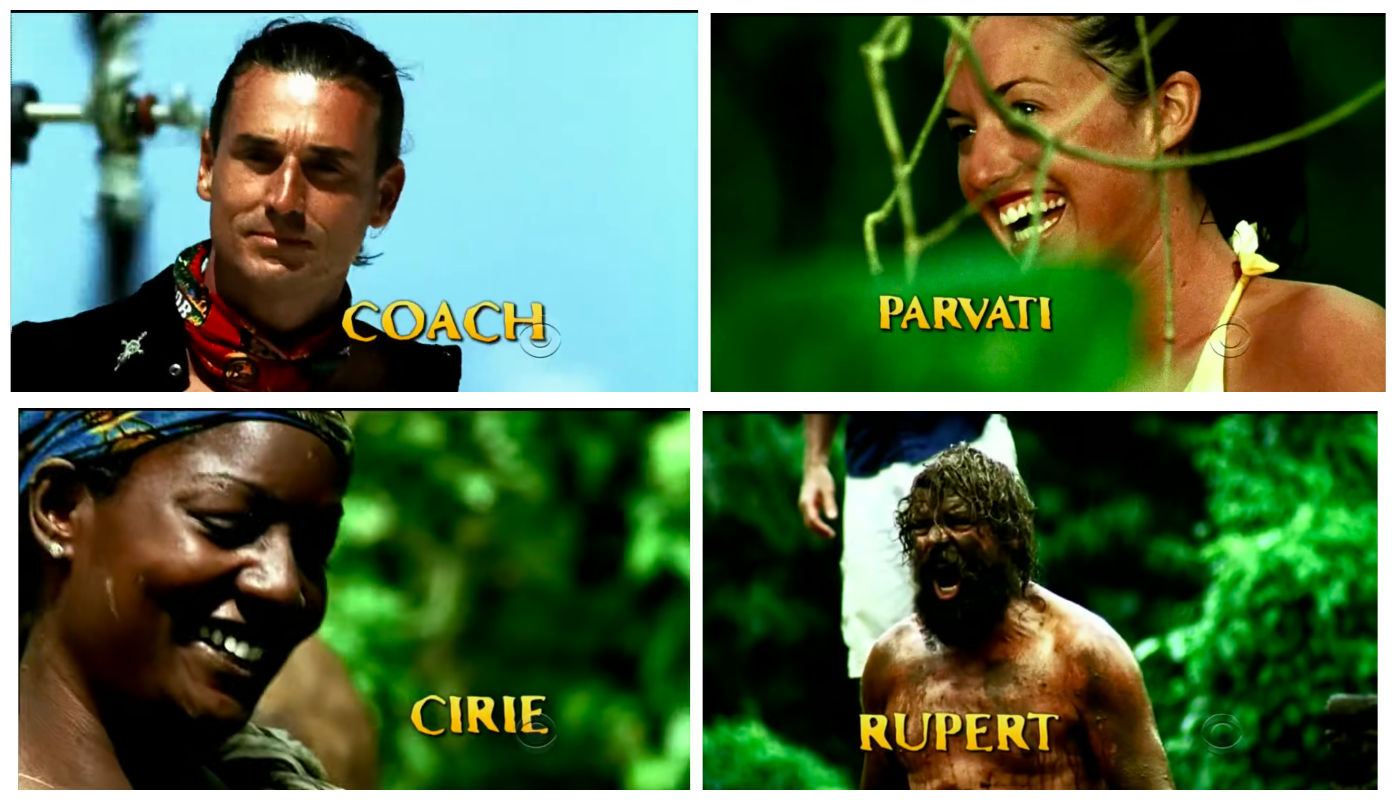
Another primary element in the introduction sequences is the establishing shots of the filming locations. For much of the show’s history, the filming location changed every season or two, and, for many of the seasons discussed in this paper, the filming location often lent its name to the season. Location is stated at the beginning of every season. For example, when Survivor first filmed in the Philippines, the season was aptly named Survivor: Philippines (season 25). Until season 19, every season would have its own location and would be titled accordingly. Thereafter, seasons were filmed in pairs. For example, seasons 27 and 28, Blood vs. Water and Cagayan, were both filmed on Palaui Island, Santa Ana, Cagayan, Philippines (Dehnhart 2013). Paired seasons remained until season 33, when the show moved to the Mamanuca Islands in Fiji, where it has remained until the present. Aerial shots of the filming location, images of local plants and animals, people native to the filming location, and local art and handicraft are interspersed with the shots of cast members in these sequences. Examples of each are illustrated in Example 2.

"Ancient Voices"
“Ancient Voices” serves as a distinct form of ritual in Survivor, especially in the first 26 seasons. Just as the cast changes each season, the theme music shifts to explore thematic narrative elements (Landau 2015). Many aspects of Survivor are known for their ritual aspect, with the phrase, “This is the ritual of Tribal Council, where fire represents your life. When your fire is gone, so are you,” being said at the first few tribal councils of every season. For instance, Survivor: Borneo (season 1), episode 1, “The Marooning,” May 31, 2000, CBS; Survivor: The Australian Outback (season 2), episode 1, “Stranded,” January 28, 2001, CBS; Survivor: Africa (season 3), episode 1, “Question of Trust,” October 11, 2001, CBS. Episodes begin with the high-energy theme “Ancient Voices,” and end with a contestant being voted out, the extinguishing of their life-symbolizing torch, and the phrase “the Tribe has spoken” concluding that episode’s ritual. The gradual descent of this narrative valence, from an optimistic intro sequence showing the whole cast at their best to someone losing their chance at the $1,000,000 prize, speaks to the ritual of Survivor’s thematic arc for viewers in each episode. The ritual of “Ancient Voices” thus serves as a marker for each individual season, but also as a bookend for every individual episode. The audience understands that despite the high-energy, entertaining start, each episode concludes with a cast member being voted off the island.
Narrowing of the Corpus
As the location changed each season, so did each version of “Ancient Voices.” Just as the establishing shots visually place the audience in the filming location, each version of “Ancient Voices” attempts to provide a musical palette featuring local musical styles, folk songs, and instruments (Landau 2015). Although Landau and Vanacore were both crucial to the development of the original theme, Landau was the primary composer and arranger of the “Ancient Voices” known today. Landau emphasized recording local musicians and dancers to incorporate into each version of the theme. At CBS, his primary job on Survivor was to write, orchestrate, and record each season’s theme, as well as create dynamic music for the challenges and camp life scenes. Vanacore, on the other hand, was responsible for composing and recording all the other incidental music and the music from each episode’s Tribal Council. This division of responsibilities meant that Landau composed more of the show’s “action” music, while Vanacore composed more of the ambient and passive tracks.
Leading into season 27, Survivor: Blood vs. Water, Landau left the show due to pressure of composing and a desire for new challenges (Landau 2015). After Landau’s departure, Vanacore and his company took over all musical responsibilities for Survivor, including new versions of “Ancient Voices.” At this point, all new recordings of versions of “Ancient Voices” stopped. It is unclear whether this change resulted from Vanacore’s preference or a shift in the production team’s focus. Either way, Landau’s departure meant a loss of the originally composed themes the audience had become accustomed to. Since Blood vs. Water, every new version of “Ancient Voices,” whether used in an aired intro sequence or solely released online, has been written using pre-recorded material from the first 26 seasons. The themes are no longer written with season locations in mind; they are merely spliced and reordered versions of Landau’s previous work.
This creates many problems when trying to understand metrical elements of this era of the show’s music. You may have two layers of the theme that fundamentally disagree with each other, such as an instrument from China playing one rhythmic layer and accent pattern against an instrument from Nicaragua doing something else entirely. This splicing that occurs in the more recent themes completely erodes any semblance of rhythmic or metric cohesion; even if a workable recording is produced, the fundamental musical performances and pulses are functionally and culturally different. Due to Landau’s departure and the subsequent decision not to record new material for later versions of “Ancient Voices,” this paper will focus exclusively on the first 26 seasons and their themes. This corpus of 26 represents three qualities central to this study: orchestrations with the location and theme actively in mind, interaction with the culture of the filming location, and intentioned representation of culture in the recording and production process.
III. Theme and Orchestrations
Base Theme Analysis
The shell of the theme remains fairly consistent from season to season, with structural elements staying generally unchanged, as shown in Example 3. It is a twenty-two-measure composition comprised entirely of the white-note diatonic collection. It is not initially clear whether this theme is in C major or A minor. Depending on the listener’s focus on different portions of the theme, its overall centricity can be seen to shift, though A minor will eventually win out. The initial vocal line that starts most of the themes is a melody using only the pitches E–D–C–B, with the structural notes outlining a E–D–C–B–C pattern. The resolution to C in this pattern might seem to emphasize C as the centric note. However, the chord progression is F major, G major, and A minor throughout this theme, with the final A minor chord typically being held for twice as long as the others. The progression seen here and its harmonic emphasis is labeled and discussed in detail as the “aeolian cadence” by Nicole Biamonte (2010). This, coupled with a melodic emphasis on A, fully suggests A centricity. The initial tonal ambiguity does, however, become altered in some reorchestrations for harmonic complexity.
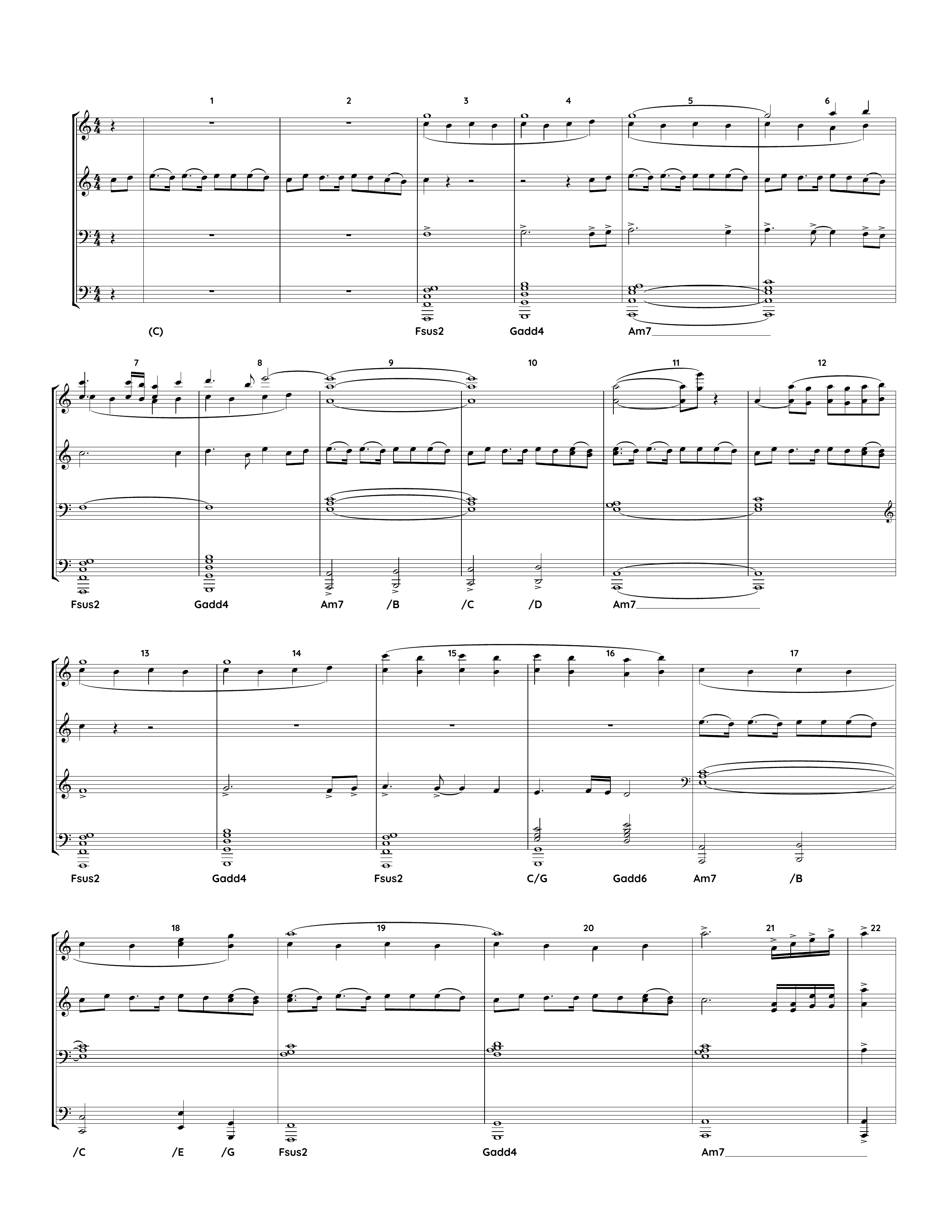
Example 3 provides a melodic and harmonic analysis of the theme. To facilitate analysis without a written score (likely due to one not even existing), the source theme to Survivor: Borneo (season 1) was placed into a digital audio workstation (DAW) and equalized through the attenuation of specific decibel ranges. This method may not yield a wholly accurate representation of the written notation presented to the musicians, but it does capture the audible notes and levels from the original recording. All reductions and score analyses in this paper are the sole work of the author.
Turning to the rhythmic and metrical aspects of the themes, most of the versions have a tempo of around 100 beats per minute, though the tempo can vary significantly both between and within versions. Each version consistently begins outright with a one-beat pickup consisting of two eighth notes, preceded by a variable upbeat of 1–3 measures to be discussed later. Each version features a unique section, distinct in melody, harmony, and rhythm, referred to as an upbeat “space.” Due to its distinctiveness and lack of metricity throughout the corpus, this section is termed a “quasi-metric space” in this study and is not included in the reductions.
A few structural aspects of the base theme can be seen in the grouping analysis shown in Example 4. The entire passage predominantly features a 2-bar hypermeter. This hypermeter remains consistent throughout the theme, with the exception of a 2-bar hypermetrical extension in mm. 11–12 and the final measure, m. 22. Although the second pulse of the 2-bar hypermeter is accented, it resonates minimally, serving as a stinger for the piece’s end. To achieve full hypermetrical closure, however, the final note or stinger would typically appear on the first hyperbeat, not the second. This could have occurred in m. 21, or potentially in a hypothetically weakened m. 23. This makes the end feel like it comes late, creating a surprising effect for the listener. All levels of the hypermeter are seemingly resolved at m. 21, so m. 22 imbues a sense of unease by disrupting the hypermetrical closure. The stinger exists outside the rest of the hypermetrical space, and can be seen as a bookend to the “quasi-metric upbeat space” that begins the piece. In sum, the end is, on most hypermetrical levels, “non-metric,” mirroring the confusion and lack of clear metricity at the start.
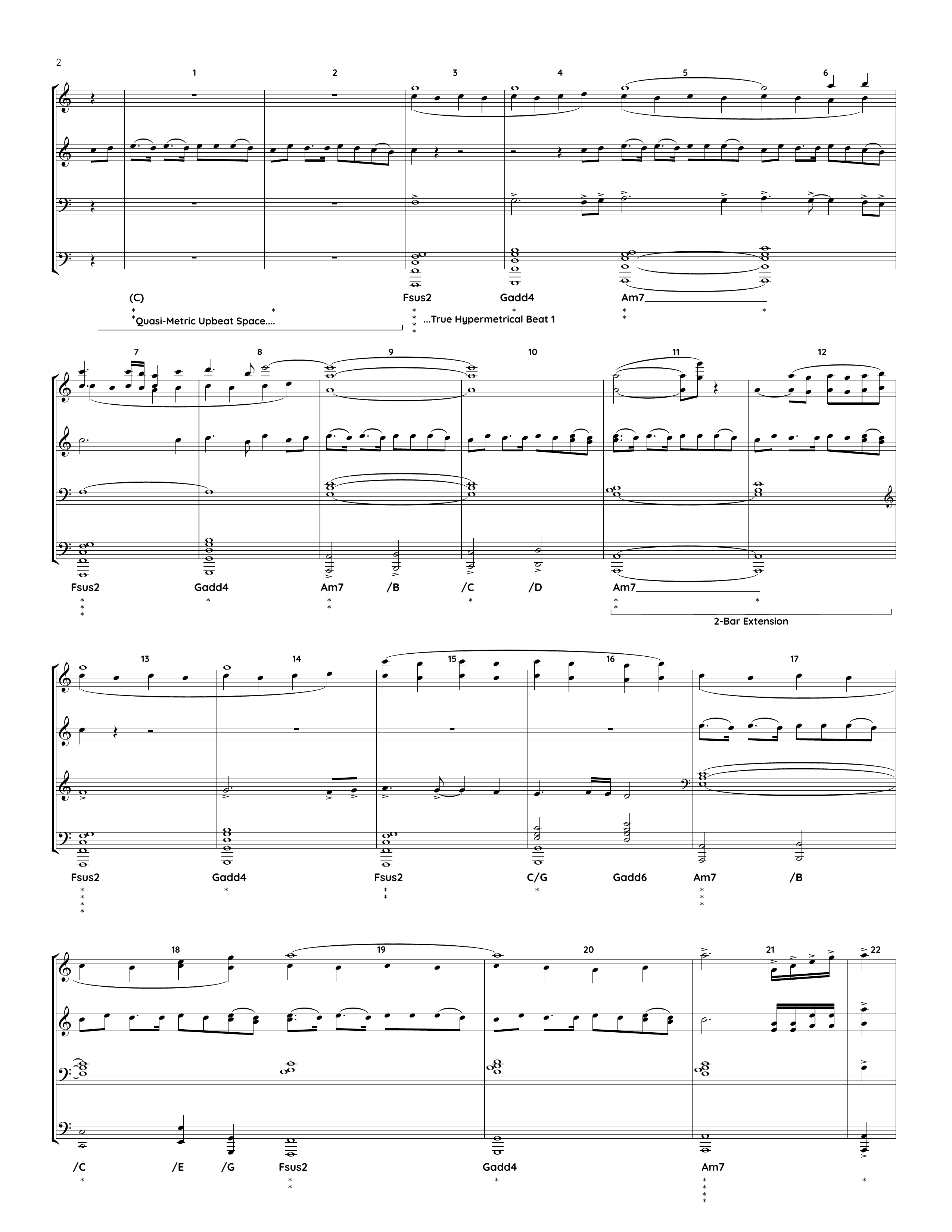
The main motive is heard in the first four beats, beginning with the two-eighth-note pickup and leading to beat 3 of m. 1. This four-beat group initially occurs out of phase with the theme’s other metrical structures. The line, typically sounding as a vocal line in the actual recordings, appears initially as a metrical upbeat. However, beginning in m. 17, the two-eighth-note pickup is omitted from this melody, realigning this particular grouping to be in phase. This motivic realignment signifies a general motion from confusion to stability, from out-of-phase to in-phase alignment within the theme. Given the lack of clear harmonic or rhythmic centricity of “Ancient Voices,” this realignment in the base theme provides the clear sense of metrical progression in the piece. Dynamic and phenomenal accents also support this interpretation. The base theme of “Ancient Voices” generally increases in volume and register throughout the course of the work, but the tension and resolution caused by the vocal line becoming in phase is palpable.
Orchestrational Considerations and Cultural Engagement
Since the filming location changed each season or two during the first 26 seasons, reorchestrations of “Ancient Voices” were written to fit each season musically within the culture or history—or, as will be discussed later, the perceived culture or history—of the filming area. For example, in the second season, Survivor: The Australian Outback, the show was filmed in the Australian Outback. The version of “Ancient Voices” in Survivor: The Australian Outback is mostly unchanged from Survivor: Borneo, except for the addition of a didgeridoo to its instrumentation. This Aboriginal instrument is globally recognized as a sonic symbol of Australia, so including this sound alone adds an Australian “flavor” to the theme. While this could be perceived as bordering on cultural or musical appropriation, Russ Landau endeavored to make incorporating local musicians a requirement on the production side during his tenure. This recording of “Ancient Voices” features an unidentified Australian musician playing the didgeridoo and, seemingly, representing their culture. The process of incorporating local musicians and styles to make the show feel more “authentic” to each location’s culture was how these sonic palettes shifted so intentionally in the first 26 seasons. Whether incorporating an instrument, musical style, or a dance style, Landau was intent on ensuring that these themes neither explicitly appropriated nor poorly imitated the culture of any country or people.
Nevertheless, there is something to be said about the line between cultural representation and appropriation in “Ancient Voices.” Russ Landau’s intention with the early seasons was to honor the cultures of the world in as authentic a way as possible (Landau 2015). This idea loses some merit when considering that the theme being reorchestrated each season is not authentic to any of the cultures represented throughout the show’s history. As Steven Feld (1988) discusses, whether intentional or not, trying to bring a style of music to a place inorganically inherently creates an issue of politicization and appropriation. Exacerbating the issue, the reliance on an American to “sign off” on the local performers’ music in the final rendition of each theme adds a layer of inauthenticity greater than the lack of cultural connection to the melody. If a music production company, or, in this case, a television production company, polices what music will be palatable or acceptable to an audience, it inherently loses any level of authenticity it may have had. At best, Feld says, it becomes a “rip-off” of the original music; at worst, it becomes a case of hegemony. Record companies trying to commodify an “African popular music” sound would lose that sound when they controlled the song choices and performances. A corollary to this is evident in the production of these Survivor themes: despite the intent to incorporate musicians and musics, the control that the network maintained inherently led to an inauthentic performance. Under a strict interpretation of this lens, the only way for a truly authentic theme or orchestration to exist would be to entirely surrender the thematic material to the local musicians and allow them to represent their own music and culture.
Furthermore, there are a few seasons filmed in locations chosen merely because they held historical significance for the American viewership, with music that bears little or no resemblance to the music of the location itself. Survivor: Pearl Islands (season 7), a season centered around exploration and pirates, named the participants’ tribes after the explorers Francis Drake, Henry Morgan, and Vasco Núñez de Balboa. This version of “Ancient Voices” did not try to incorporate music of the Pearl Islands, but rather it attempted to evoke the feel of “pirate music.” This theme bears more resemblance to an action movie soundtrack, with swelling strings and booming percussion, than to any of the other “Ancient Voices.” In Survivor: Palau (season 10), military drums, trumpets, and cannons were added to the orchestration, reflecting the association of Palau with numerous World War II battles for many Americans. Evident from its title, Survivor: Guatemala—The Maya Empire (season 11) focused primarily on the history of Guatemala and the Maya more than the current-day culture. This version of “Ancient Voices” adopts a rustic feel, intentionally imitating an archaic “Mayan” or stereotypical Central American music style. Survivor: All-Stars (season 8) and Survivor: Heroes vs. Villains (season 20) did not attempt to sonically reflect their filming locations. Instead, they just incorporated a few elements from previous seasons to create a musical mash-up of the previous version of “Ancient Voices,” reflecting the cast that was a sort of mash-up of previous seasons.
Despite the lack of “authentic” representation in these themes, the fact remains that Landau incorporated local musicians, along with their instrumental, music, and dance styles. Example 5 shows all 26 versions of the theme, categorizing the audible musical elements from each culture. This table results from ethnomusicological research into the areas where filming occurred and a comparison of the sonic properties of each season’s version. No public records detail the specific musical stylings represented in each season. All decisions regarding which musical tradition most closely resembled each particular “Ancient Voices” were made by the author. All seasons’ themes were viewed in their full state as shown in the first episode and analyzed as such. Some themes use shortened versions in successive episodes.
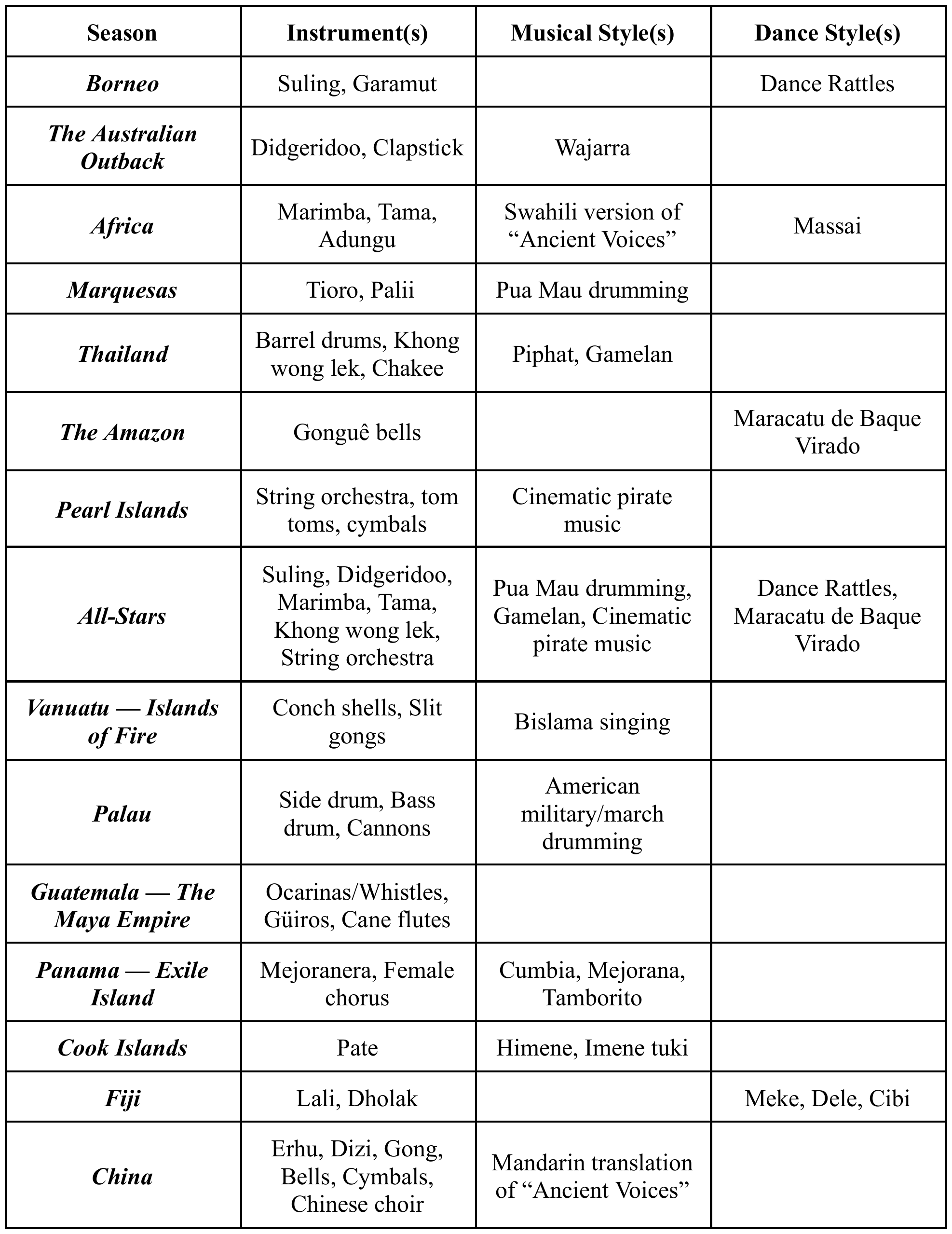
Beginning with Survivor: Samoa (season 19), each consecutive pair of seasons was filmed back to back at the same location. This is reflected in the musical stylings of the final six seasons, as the themes within each pair increasingly resemble each other. Similar timbral elements are present in these versions, indicating the use of comparable instruments and musical styles.
IV. Hypermetrical Shifts
Having accounted for the basic aspects of the source theme, we will now move to the rhythmic aspect of these reorchestrations. The incorporation of the musical styles from Example 5 influences how the theme sounds. Certain instrumentations and dances necessitate different rhythmic profiles, potentially shifting the lower-level rhythmic and hypermetrical perceptions. Here I will analyze three qualities of themes from the first 26 seasons of Survivor in relation to the listed musical styles and geographic locations to determine the impact, if any, of the incorporated instruments and styles on the metrical and rhythmic qualities of each “Ancient Voices”: (1) beginning- vs. end-accented themes (Cooper and Meyer 1960); (2) use of tresillo and small-scale metric dissonance (Krebs 1999; Cohn 2016; Murphy 2016); and (3) metricity of the upbeat space.
Beginning- vs. End-Accented Themes
The relative strength and directionality of a meter significantly affect its perceptual impact. One way to view this is through whether a theme is beginning- or end-accented (Cooper and Meyer 1960). Beginning-accented themes have primary emphasis on the earlier architectonic (or hierarchical) levels, such as beats 1 and 3 in a 4/4 bar. This extends to higher levels of the hypermeter, meaning hyperbeats 1 and 3 of a 4-bar hypermeter. End-accented themes accent the later beats at every hypermetrical level, like beats 2 and 4. These accents are established with phenomenal accents and confirmed through continuing implied metrical accents. For example, a beginning-accented theme, particularly one that remains beginning-accented at higher architectonic levels, has a significant feeling of stasis rather than forward propulsion. Each downbeat has, on some level, a sense of finality, imbuing a level of strength or certainty. However, an end-accented theme, especially at smaller metrical levels, drives the energy forward, propelling the music toward the next beat or hyperbeat all the way to the final portion of the theme. The seemingly minor shift between placing the accents on beats 1 and 3 or on beats 2 and 4 can have a drastic impact on listeners’ perception (Mirka 2021).
A prime example of a beginning-accented “Ancient Voices” is Survivor: Samoa (season 19), where the incorporated pseudo–Siva Tau dance necessitates strong downbeats for feet placement (Example 6). Both the rhythmic ostinato and the added vocal bass ostinato place strong downbeats on beats 1 and 3 of each measure. This makes each level of rhythmic accent more beginning-accented.
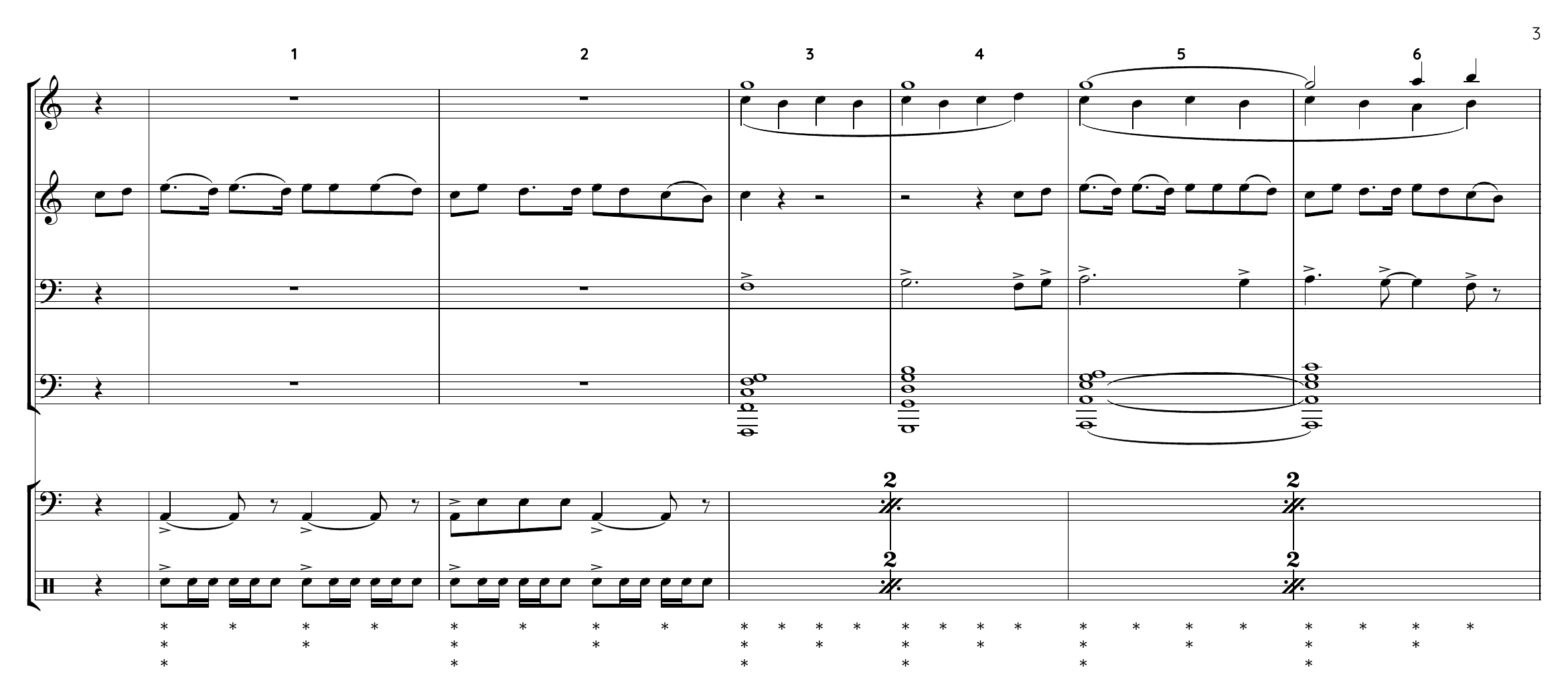
Survivor: Thailand (season 5) features the opposite primary-accent character (Example 7). The eighth-note pulse accents each offbeat, and there is an ostinato appearing only in every other measure starting with measure 2. This gives the theme a strongly end-accented character. As this initial rhythmic impression shapes perception, listeners are likely to perceive hypermetrical accents on progressively larger architectonic end pulses.
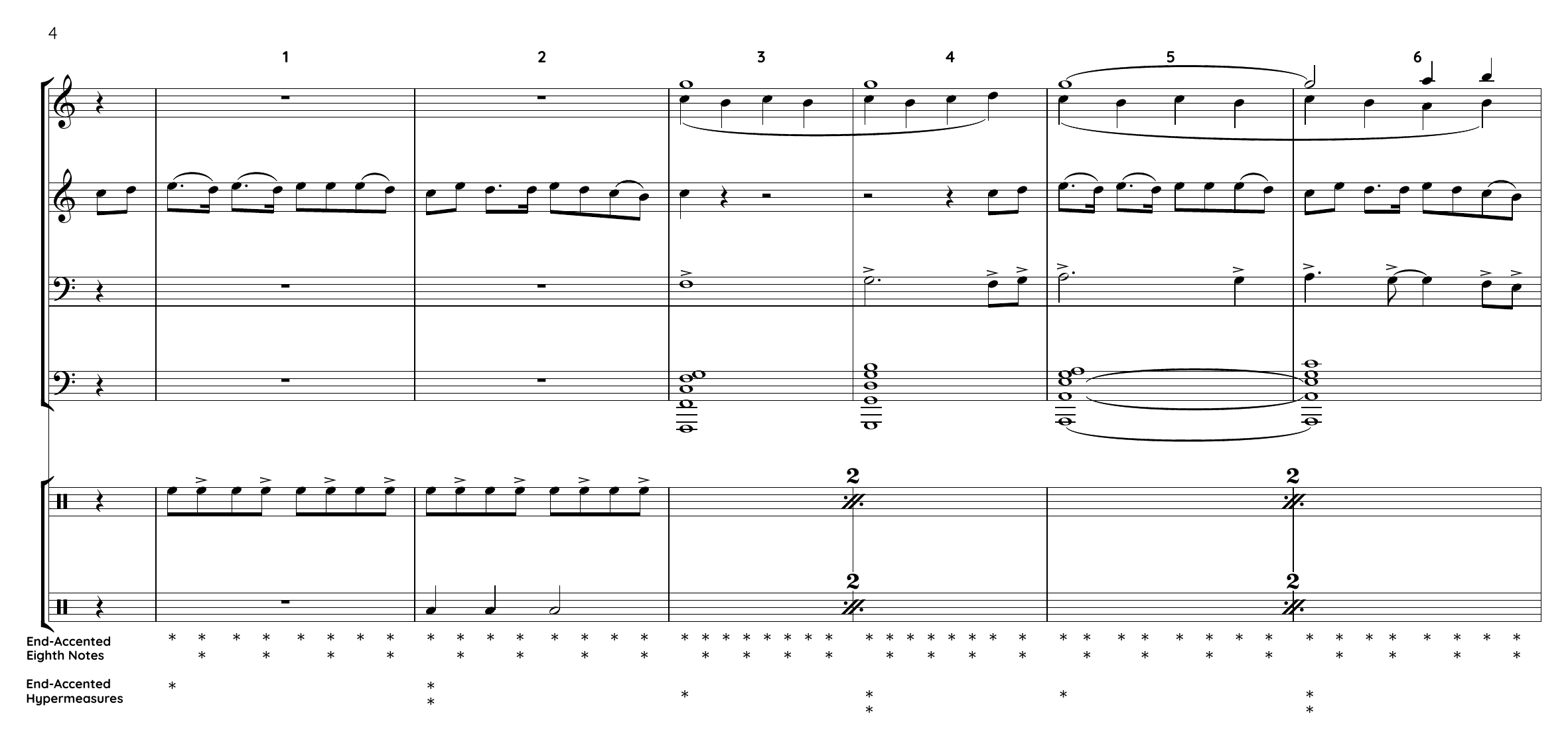
Many “Ancient Voices” themes adhere entirely to one of these two patterns. Often, one or two instruments in the orchestration create and maintain a distinctly beginning- or end-accented ostinato, thereby recontextualizing the surrounding melody within one of these two paradigms. However, the dichotomy between beginning- and end-accented themes is not as clear cut as it often appears. Along with the harmonic and metric ambiguity that “Ancient Voices” presents in some settings comes an ambiguous accent pattern. This ambiguity manifests itself either as an ostinato that dissolves into a less defined pattern or as an ostinato with an unclear primary accent preference. Rather than opting for a strong beginning-accented pattern or a driving end-accented one, some “Ancient Voices” themes use more of a blended form of these two accent patterns, further contributing to musical ambiguity. Example 8 presents a reduction of the base theme from Survivor: Borneo, including the transcribed rhythmic layers.
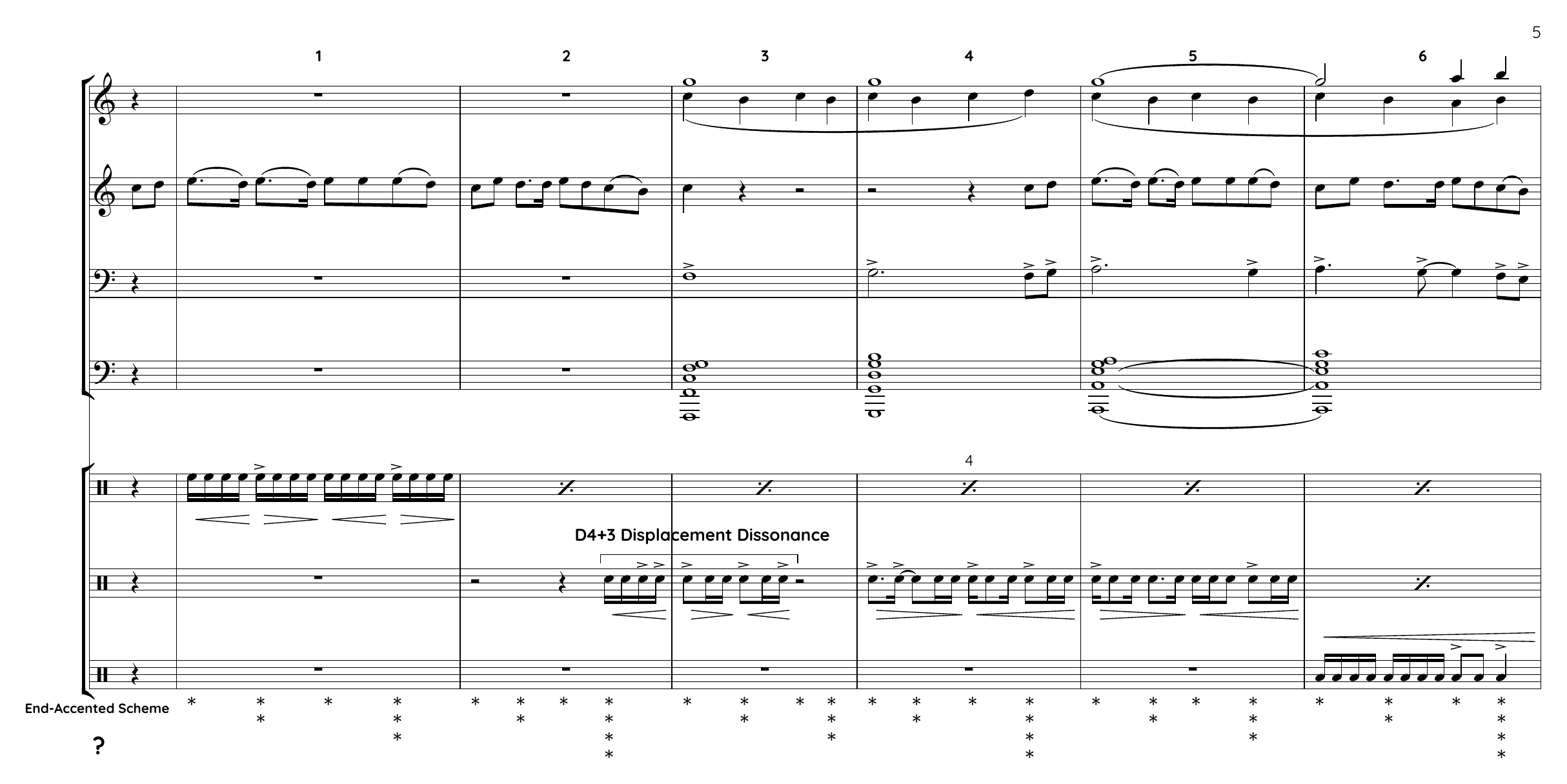
The initial ostinato in m. 1 suggests a strictly end-accented theme, yet the other rhythmic voices entering later do not clearly support this interpretation. While abundant in syncopated patterns and offbeats, they do not explicitly indicate a beginning- or end-accented theme. Example 9 lists each season’s “Ancient Voices” with its corresponding primary accent pattern, categorized as beginning-, end-accented, or ambiguous. This is primarily focused on the beat and hyperbeat levels.
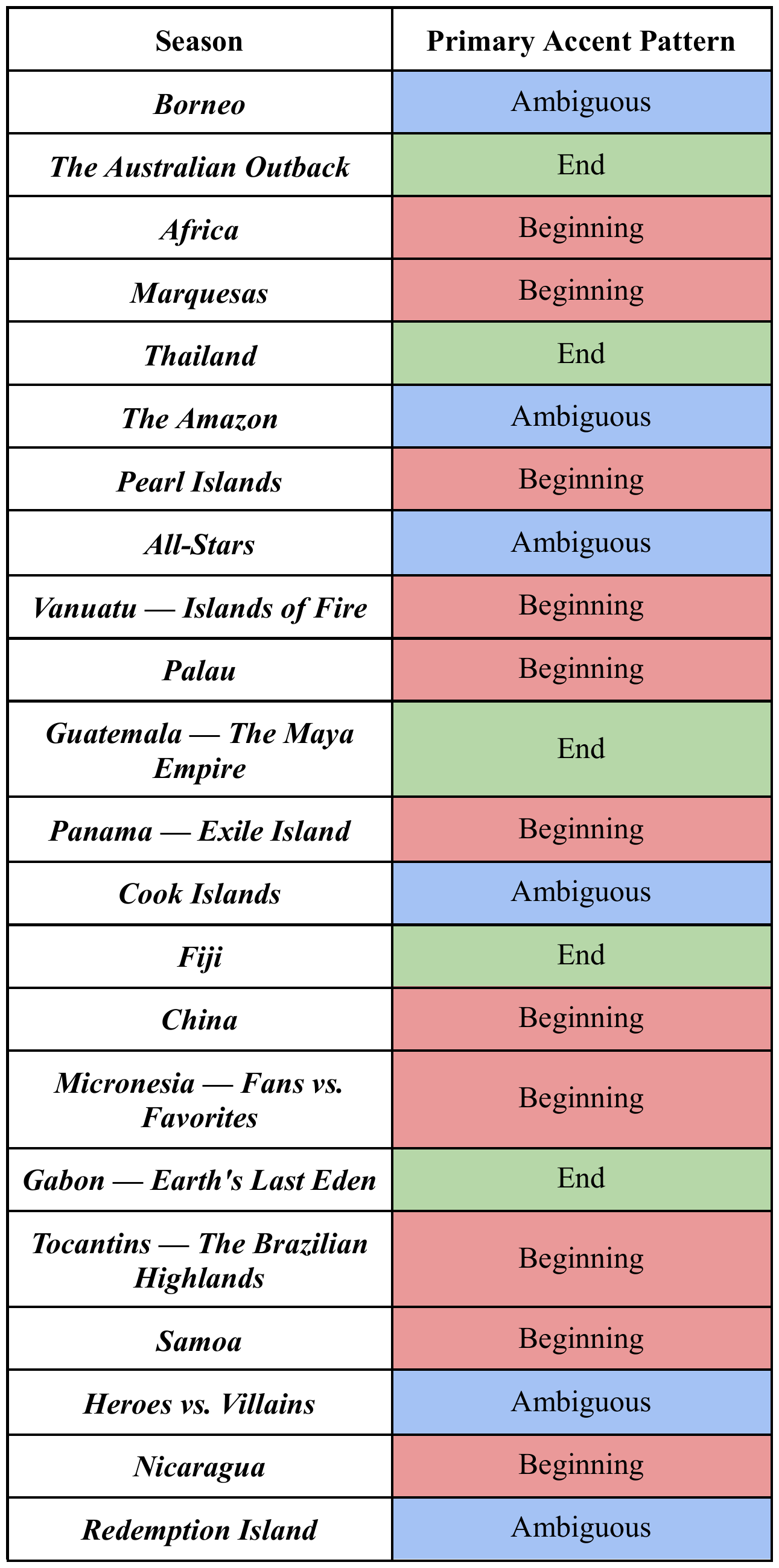
The majority of the themes, 14 out of 26, are beginning-accented. Seven out of 26 are ambiguous, and the other five are end-accented. There is a noticeable increase in beginning-accented themes in the later seasons, accompanied by a marked decline in end-accented themes. Whether this was to create “stronger” themes based on their accent patterns or merely a preference of the producers, this tripartite division of primary accent patterns indicates a slight shift in Landau’s compositional and orchestration preferences during his final seasons.
Use of Tresillo and Small-Scale Metric Dissonance
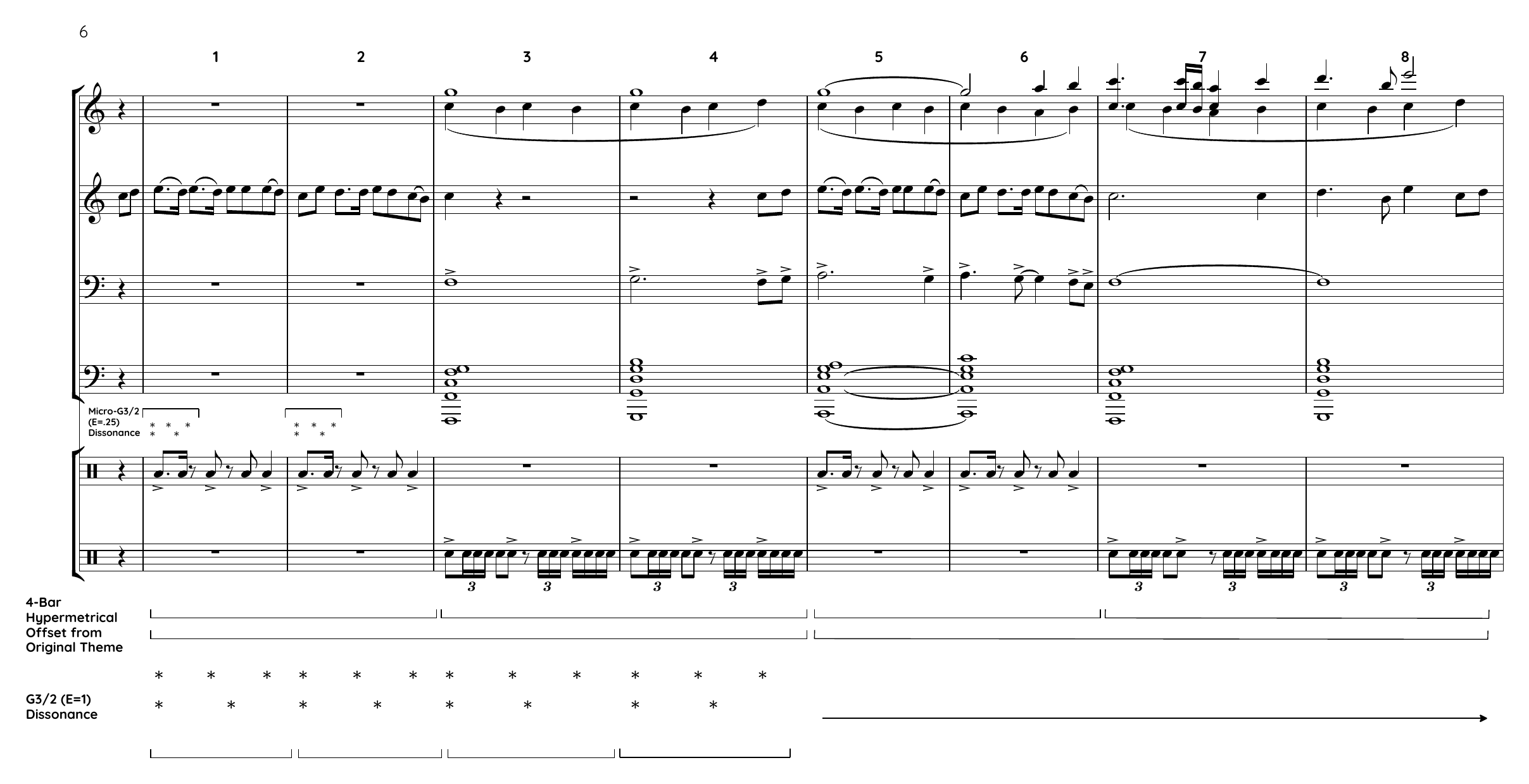
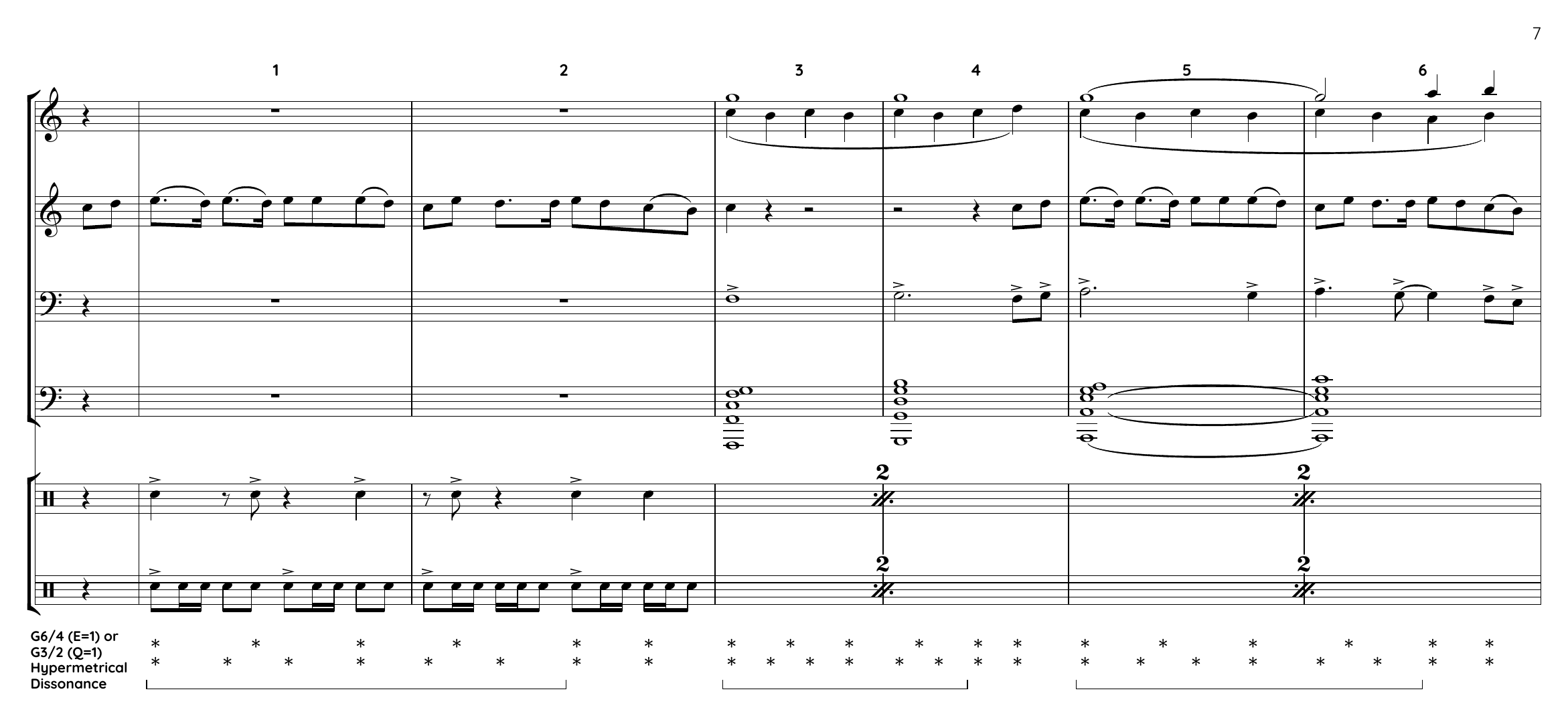
The tresillo rhythm is a microcosm of large-scale grouping dissonance (Krebs 1999; Cohn 2016; Murphy 2016). For the first portion of a tresillo, a grouping of 3 occurs where there is a metrically implied grouping of 2, creating what could be referred to as a 3/2 grouping dissonance. This dissonance is immediately resolved by the third pulse of the tresillo, which lasts for only the expected duration, but this small bit of dissonance gives the tresillo a very strong valence, a strong push forward. The dissonance of the first two pulses gets resolved in the third. However, the listener doesn’t perceive the resolution until the next tresillo starts. Moreover, the resolution of this dissonance also introduces a slight issue in the sound, as listeners expect similarity and continuity. This shift on the third pulse creates a perceptual issue for the listener. I believe this creates the effect of tresillos giving some of the strongest forward momentum possible, especially at faster tempos. This expectation of resolution, occurring precisely when an established pattern breaks, continuously propels the music forward. Therefore, employing tresillos in different versions of “Ancient Voices” can create a sense of forward momentum, especially when combined with end-accented primary accent patterns, such as in Survivor: Guatemala (season 11), Survivor: Fiji (season 14), and Survivor: Gabon (season 17).
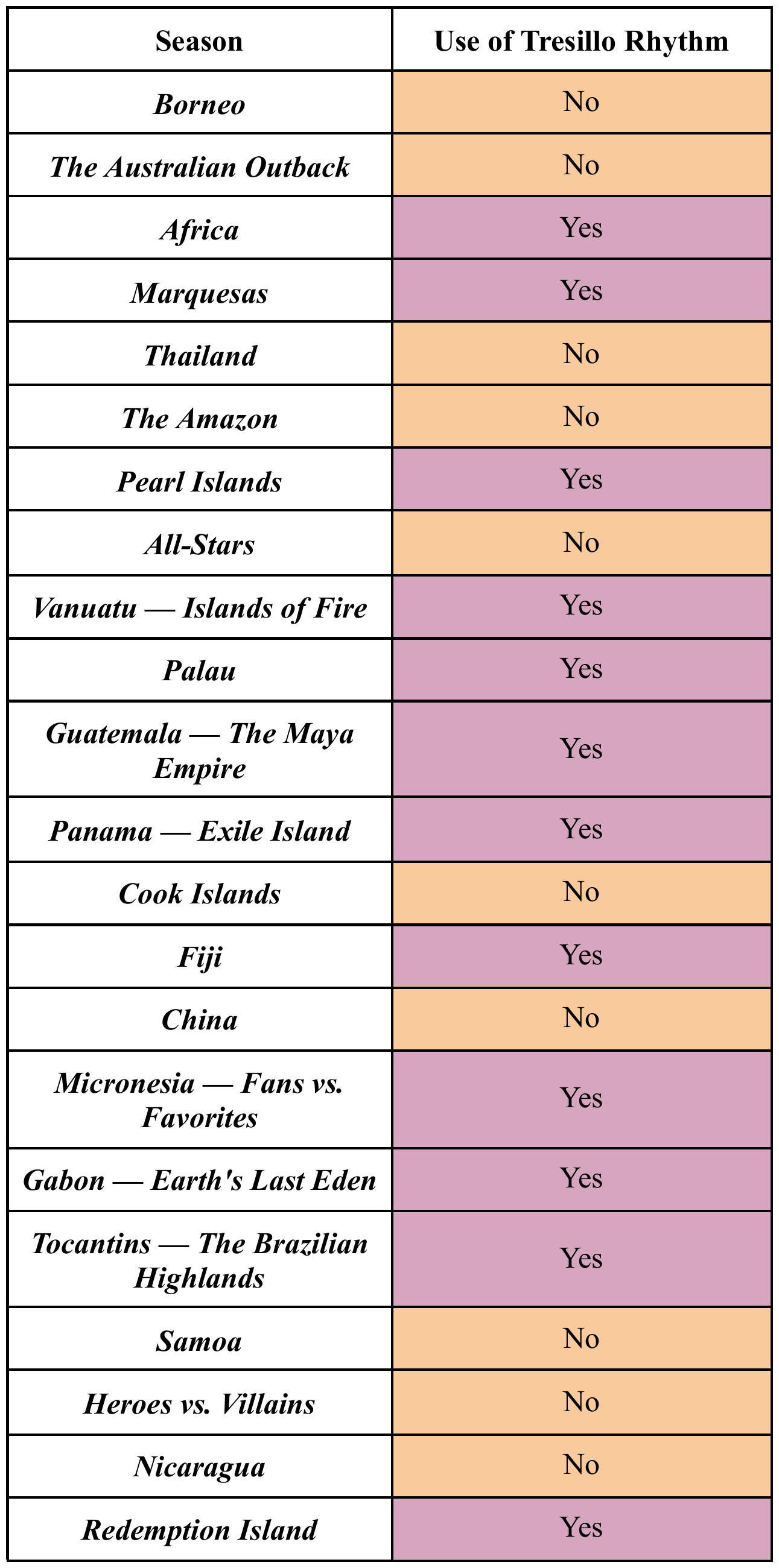
Examples 10 and 11 present reductions of the “Ancient Voices” themes from Survivor: Palau (season 10) and Survivor: Fiji (season 14), employing a single and double tresillo respectively. The pronounced snare drum entrance in m. 1 of the “Ancient Voices” in Survivor: Palau also has an offset to the typical hypermeter. In this case, m. 1 sounds like the hypermetrical downbeat, as opposed to the expected m. 3. Example 12 lists each season, indicating the presence or absence of the tresillo rhythm. Chronologically, there is no discernible pattern. While this may not be the strongest pattern, it does seem as if the earlier half of the corpus had more seasons with prominent tresillo usage, and the latter half has fewer. Admittedly, this seems to vary from season to season, so this chronological pattern will not hold.
Metricity of the Upbeat Space
The most prominent metrical feature of the “Ancient Voices” themes not yet discussed is the use of quasi-metric upbeats that precede the two-eighth-note pickup. Each theme begins with approximately 3–10 seconds of a metrical space, typically in A minor or another mode with A centricity. Just before the two-eighth-note pickup, a prominent melodic A is typically held for about one second, creating a brief pause before the theme proper begins. So far, the focus has been on the theme’s metric considerations, but the metricity of this hypermetrical “upbeat space” also affects our perception of the intro sequence. This is examined by analyzing the level of metricity in each upbeat space and its relationship, if any, to the theme’s meter. There are three forms that this upbeat space can take: “metric” upbeat space, “non-metric” upbeat space, and “differently metric” upbeat space.
“Metric” upbeat space is an introduction to the theme proper that is fully in tempo and meter. It typically consists of 2–3 measures fully in 4/4 time at approximately 120 bpm, without noticeable skips or pauses in the tempo. Put simply, if a metronome were set at the start of such a space, the beat would seamlessly continue into the theme. Survivor: Pearl Islands (season 7) provides the clearest example of this (Example 13).
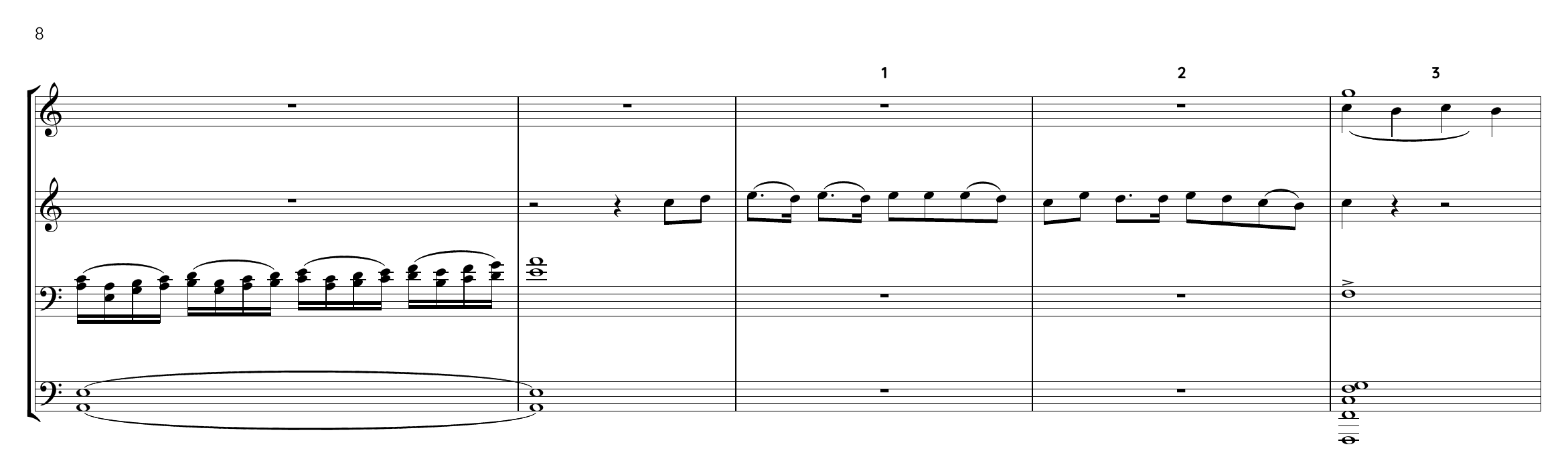
The sixteenth notes in the strings at the beginning establish the pulse, and, despite the three beats with no attacks in the bar prior to the “true” measure 1 of the theme, the metricity itself is constant. This creates a palpable sense of cohesion between upbeat space and the theme of “Ancient Voices.” They flow together unabated, with the upbeat space providing a natural directionality for the theme proper to start.
“Non-metric” space occurs when the upbeat space lacks clear perceptual metric elements, such as when pitches are sustained such that they disrupt the meter, or when fully unrelated recordings are layered on top of one another. In these spaces, melodic lines and rhythms occur without any noticeable interrelation. This occurs in the base theme itself, as illustrated in Example 14. Each A is approached by a melodic fragment and sustained for a seemingly random duration. This creates a strong sense of anticipation for the theme to begin. For those unfamiliar with the theme, this suspended energy creates a desire for release, as any rhythm almost seems to disappear. Even familiar listeners may find that the non-metric space evokes a sense of anticipation. While “metric” upbeat spaces impart directionality, “non-metric” spaces evoke a sense of wanting.
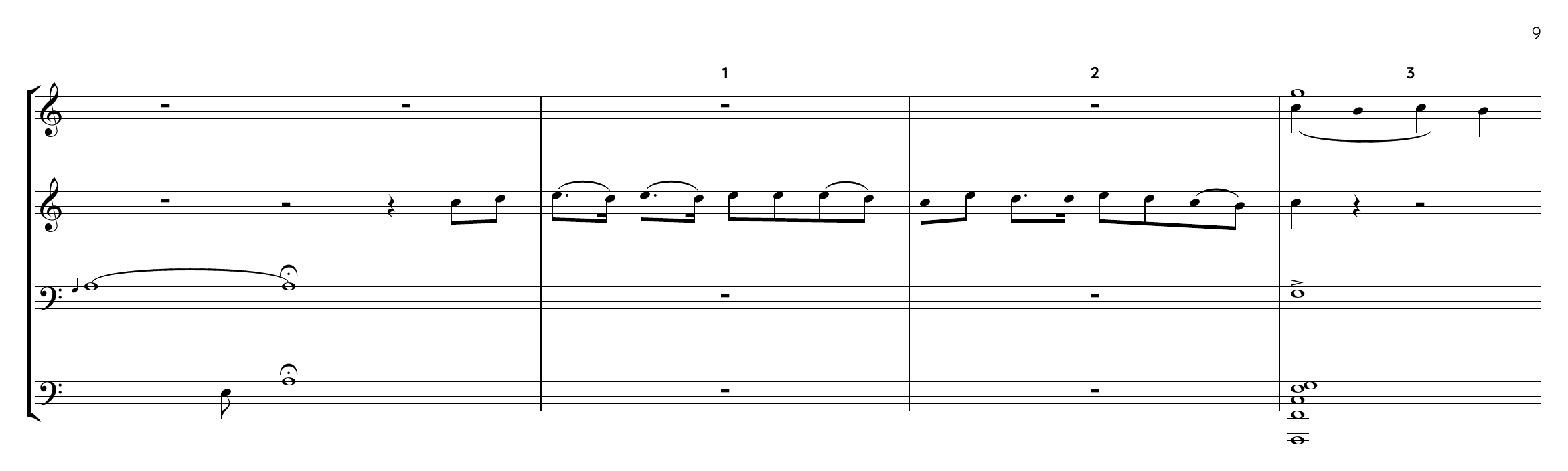
The final option for these quasi-metric upbeat spaces is the “differently metric” upbeat space. In this type, the metricity or tempo of the upbeat space significantly differs from that of the main theme. An example of this is seen in Example 15.
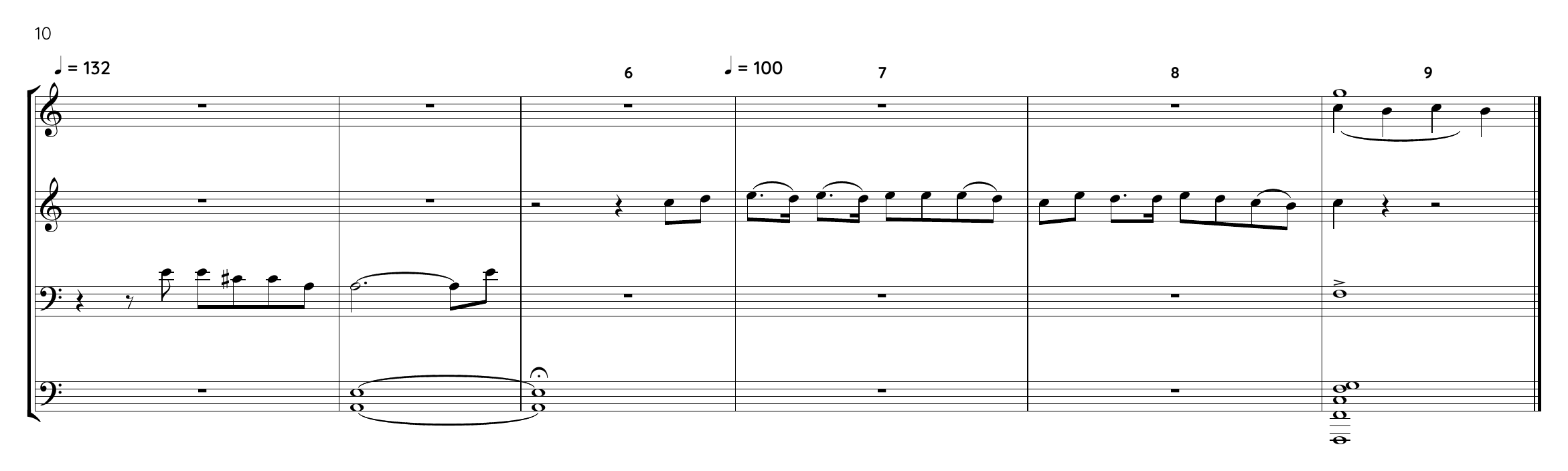
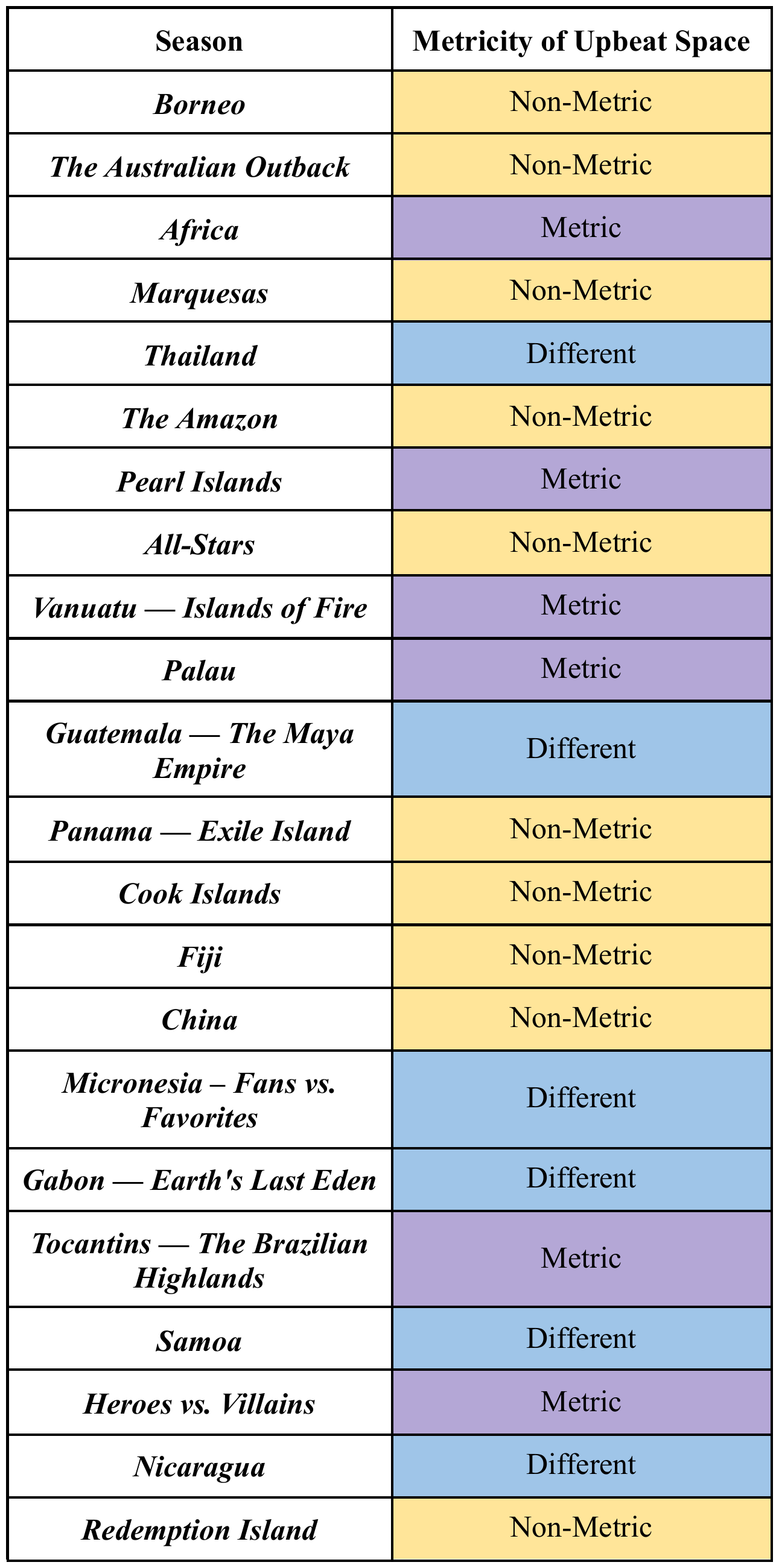
This example highlights the noticeable tempo change between the three measures of upbeat space and the main theme. One might suggest analyzing this section through varying note lengths or as a tuplet passage. However, the first three measures line up perfectly in tempo if listened to by themselves, implying a true tempo change afterward. The fermata in the third measure indicates that the change is not precisely on the downbeat of the actual m. 1. A slight extension, approximately the length of a sixteenth note in the original tempo, disrupts the fluidity of the tempo shift. Though this might impart a slightly unmetered feel to the transition between these sections, the sections before and after are both strictly metric, meaning a “non-metric” labeling would not be quite adequate. Other “differently metric” upbeat spaces alter metrical elements as well, such as the theme from Survivor: Nicaragua (season 21), which includes a clear 3/4 bar and a tempo change in its upbeat space. Example 16 lists each season along with the metricity of its upbeat space, providing a detailed overview of this aspect across the various “Ancient Voices” themes.
V. The "Americanization" of the *Survivor* World
As observed in Example 12, and potentially noticeable in Example 16, there is no clear chronological pattern in the metrical aspects of these “Ancient Voices.” There is no evidence to suggest that the use of tresillo or specific types of metric upbeat spaces became more or less common throughout the show’s run. Only a geographical analysis reveals any emerging pattern.
To establish a baseline of a more “random” collection of points, let us examine the geographic distribution of beginning- vs. end-accented themes. Example 9 already indicated that beginning-accented themes became slightly more prevalent in later years.
Example 17 depicts the three different primary accent patterns, with red markers indicating beginning-accented, green for end-accented, and blue for ambiguous patterns. Given that these data are attributed to chronological rather than geographic factors, the geographic distribution appears random, as expected. While some other, more minor patterns could be hypothesized, any clustering by region or continent is disrupted by the presence of different accent patterns.
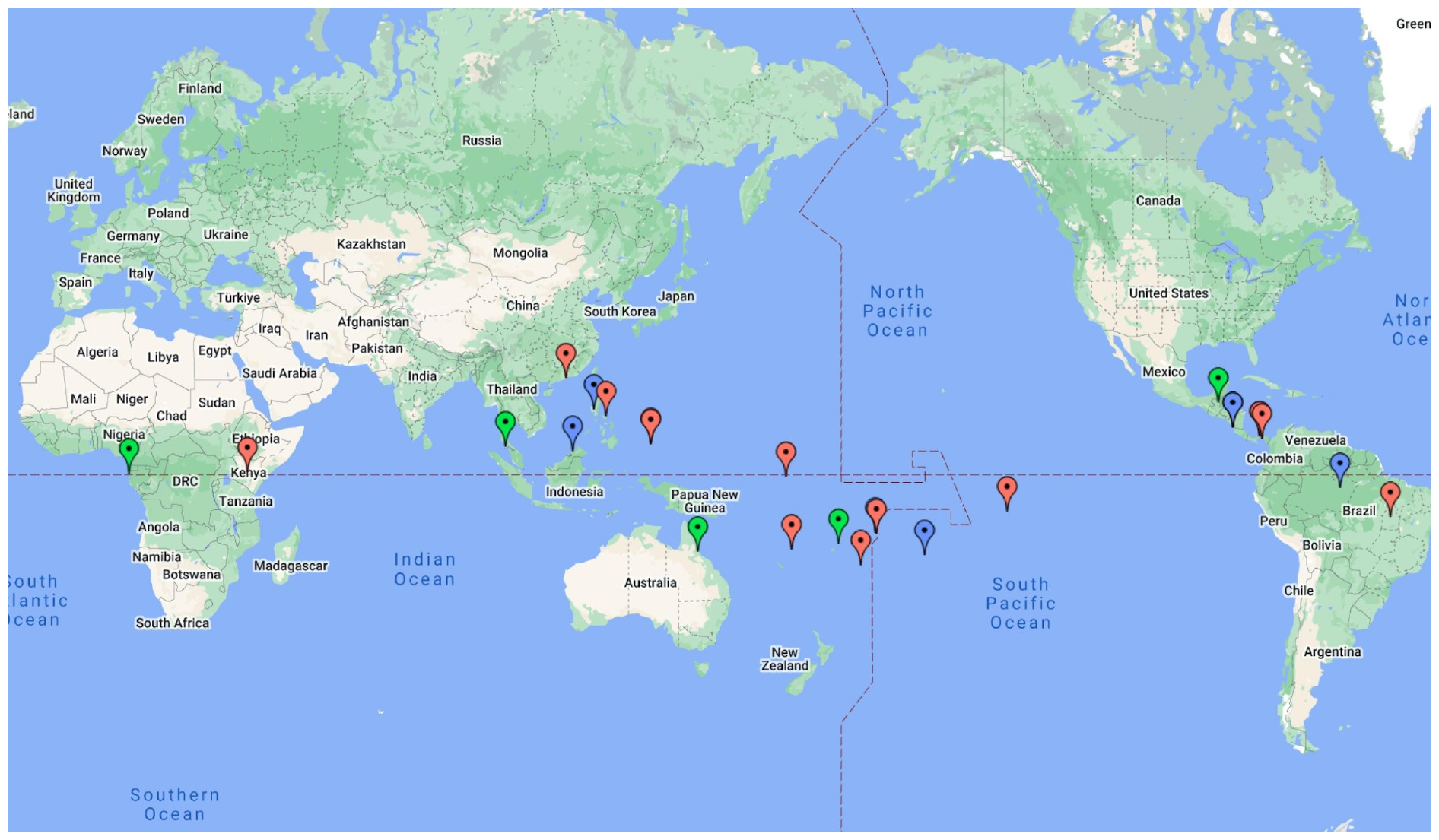
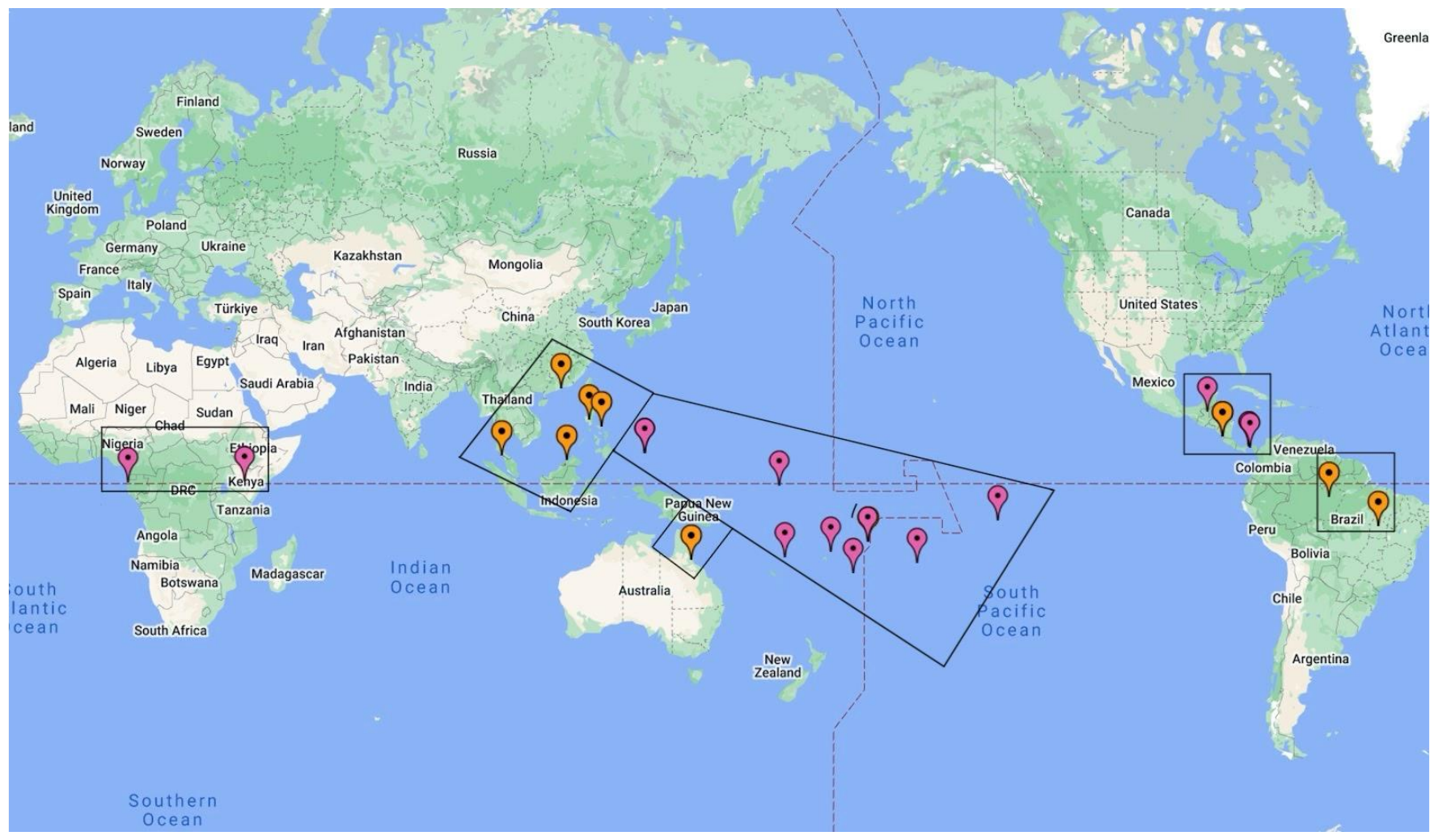
Example 18 illustrates the geographic clustering of tresillo usage in each theme. Orange indicates the absence of tresillos, while magenta signifies their presence. Aside from one outlier of Survivor: Nicaragua (season 21), a non-tresillo “Ancient Voices” in Central America, these themes can be categorized by region: Africa, Southeast Asia, Australia, Oceania, Central America, and South America/Brazil. Example 19 displays this regional division. As Example 5 showed, multiple authentic instruments, musical styles, and dance styles were included to make each of these themes, so this pattern is not as simple as an American simply stereotyping, nor is it as simple as these areas being musically similar. More likely, however, is that an American composer, with his American music team and producers, let subconscious expectations of these areas influence the compositional process. It is obviously not the case that Oceania exclusively uses tresillos while Southeast Asia does not. Oceania is made up of thousands of islands and has hundreds of musical traditions. While culturally related, they are not homogenous.
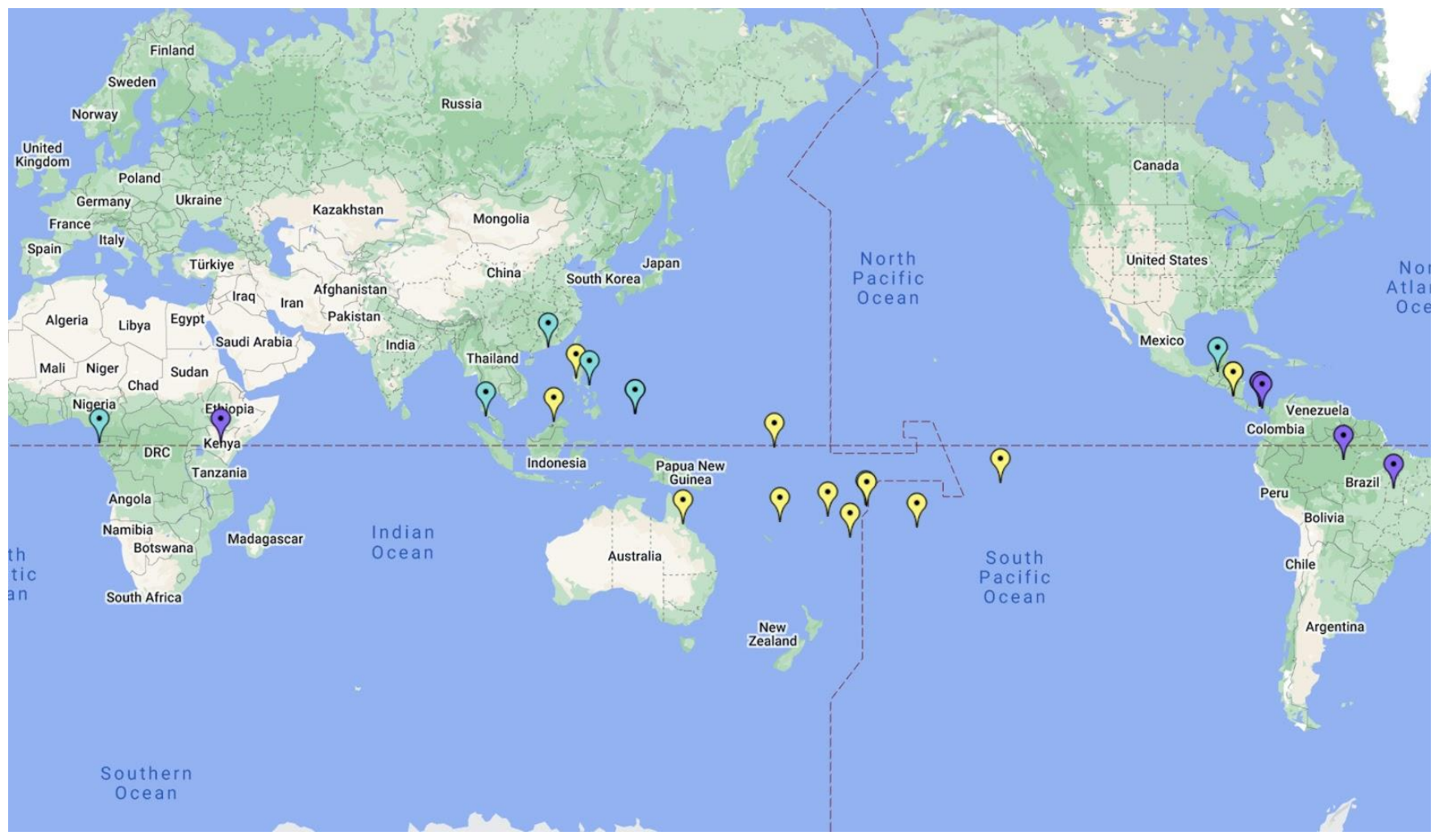
Another noticeable, albeit weaker, grouping emerges in the metricity of the upbeat spaces. A significant grouping is still evident around Oceania: while other locations show more variation, Oceania uniquely appears as a cluster of non-metric spaces (see again Example 19).
This brings us to the crux of this “Americanization” of the version of “Ancient Voices.” For the second consecutive metric analysis, Oceania has been grouped as a single cluster, despite the varied musical styles present in this area. Both seasons in Brazil were also similarly metric, though this is less significant given that only two seasons were filmed there. The expected musical styles of Oceania do not inherently suggest an overall “non-metric” nature. Many of the musical examples for these versions of the theme are extremely metric, with clapsticks, slit gongs, or similar percussive instruments keeping a metronomic pulse. In the arrangement and production process of these themes, a sense of non-metricity has been introduced at the beginning. It seems that a subconscious element in the composition or finalization of the recorded tracks led to the decision and implementation of the non-metric upbeat space. These versions are more metric in many ways overall, so I believe that the upbeat space was freer to compensate for this. The shared rhythmic elements in these versions of “Ancient Voices” suggest a musical linkage specific to Oceania.
I want to make it clear that I am not saying there was an intentional homogenization of the sounds within these themes, nor do I believe that anyone involved in Survivor’s production actively considers these musical styles to be the same. Instead, I am highlighting the trend of a seemingly inadvertent push for versions of “Ancient Voices” to fit viewer expectations. Among the areas that Survivor has filmed in, the specific locations in Oceania are likely the least familiar to Americans. I suggest that, due to a lack of familiarity with Oceanic music among many Americans, these “Ancient Voices” versions represent a generic “island” sound. This perceived homogenization arises because, to many Americans, the music from these areas may be indistinguishable. The rich histories of Oceanic music have likely not made it to the homes of Americans, and are thus less familiar even than, say, elements of traditional Chinese, West African, or Brazilian music.
While not part of this corpus explicitly, it should be noted that newer seasons of Survivor support this homogenization and “Americanization” of the sound. At the time of writing, Survivor is airing its fiftieth season. Since season 33, Survivor: Millennials vs. Gen X, the show has consistently filmed in Fiji, and the show has remained in and is likely to continue filming in Oceania. Vanacore is still in charge of the music production and theme songs for these seasons. Regarding upbeat space, each “Ancient Voices” version from seasons 33 to 45 features a “non-metric” upbeat space, giving more credence to the stereotype of the generic “island” sound. The new seasons in Fiji, in Oceania, metrically align with the patterns identified in the later seasons of the corpus of 26. They primarily use beginning-accented themes, no prominent tresillos, and a non-metric upbeat space. These static filming locations, along with the spliced versions of the original 26 themes forming these new versions, show a loss of authenticity in Survivor’s music and an unintentional perpetuation of world music stereotypes. Survivor’s “Americanized” sonic palette, its push for homogenization, and its stereotypical “island” sound suggest cross-cultural similarities in cultures unfamiliar to many Americans, potentially fostering othering against these rich musical histories.
VI. Conclusions
This exploration of “Ancient Voices,” the iconic theme of CBS’s Survivor, reveals a fascinating interplay among music, culture, and audience perception. Over the first 26 seasons, the theme has not only provided a backdrop for the visual elements of the show’s introduction, but it has also reflected a unique blend of cultural influences and musical styles. The journey from the theme’s early days, under the creative direction of Russ Landau, to its more recent iterations, following Landau’s departure from the franchise, showcases a transition from culturally rich and diverse compositions to a more uniform sound. This shift, particularly evident after Landau’s departure, signals a move away from authentic musical representations of each season’s location toward a generalized “island” sound. This evolution, or rather devolution, in the show’s musical identity could be seen as a reflection of the “Americanization” of global music perceptions, where diverse and rich musical traditions are overshadowed by a more homogenized, westernized sound.
This can be shown most quantifiably through the analysis of the theme’s rhythmic grouping, added lower-level rhythmic elements, and hypermetrical structures. However, the gradual reduction in the variety of these elements and the increasing reliance on pre-recorded material in later seasons is indicative of a broader trend in media. It echoes a global narrative whereby unique cultural identities can be diluted to establish a more universally palatable or recognizable sound. My examination of Survivor’s music underscores the importance of cultural authenticity in media production and the subtle yet significant role music plays in shaping viewers’ perceptions of different cultures. As Survivor continues to evolve, it remains to be seen whether future musical directions will further embrace this trend of homogenization or rediscover the rich tapestry of authentically intentioned cultural expressions that once defined its musical landscape.
Works Cited
Bakulina, Ellen. 2014. “The Concept of Mutability in Russian Theory.” Music Theory Online 20 (3).
Biamonte, Nicole. 2010. “Triadic Modal and Pentatonic Patterns in Rock Music.” Music Theory Spectrum 32 (2): 95–110.
Cohn, Richard. 2016. “A Platonic Model of Funky Rhythms.” Music Theory Online 22 (2).
Cone, Edward T. 1968. Musical Form and Musical Performance. Norton.
Cooper, Grosvenor, and Leonard B. Meyer. 1960. The Rhythmic Structure of Music. University of Chicago Press.
Dehnhart, Andy. 2013. “Survivor Cagayan: Paulaui Island Hosting the Show, Which Won’t Leave the Philippines.” Reality Blurred, May 8. https://www.realityblurred.com/realitytv/2013/05/survivor-blood-vs-water-cagayan-seasons-27-28/
Feld, Steven. 1988. “Notes on World Beat.” Public Culture 1 (1): 31–37.
Krebs, Harald. 1987. “Some Extensions of the Concepts of Metrical Consonance and Dissonance.” Journal of Music Theory 31 (1): 99–120.
Krebs, Harald. 1999. Fantasy Pieces: Metrical Dissonance in the Music of Robert Schumann. Oxford University Press.
Landau, Russ. 2015. “The Origin of Survivor’s Theme ‘Ancient Voices,’ and Why Its Composer Left.” Interview by Andy Dehnhart. Reality Blurred, September 23. Updated November 6, 2024. https://www.realityblurred.com/realitytv/2015/09/survivor-composer-russ-landau-interview/
Lerdahl, Fred, and Ray Jackendoff. 1983. A Generative Theory of Tonal Music. MIT Press.
Mirka, Danuta. 2021. Hypermetric Manipulations in Haydn and Mozart: Chamber Music for Strings, 1787–1791. Oxford University Press.
Murphy, Scott. 2016. “Cohn’s Platonic Model and the Regular Irregularities of Recent Popular Multimedia.” Music Theory Online 22 (3).