Table of Contents
Rational Tonal Deceptions
The opening of C. P. E. Bach’s extraordinary Symphony in D Major, Wq. 183/1, presents an unusual chain of events: a metrically ambiguous but tonally clear passage gives way to another passage that is metrically clear but tonally ambiguous.I would like to thank my students Armin Akhavian, Trevor Hofelich, and Claire Terrell for bearing with me and providing feedback as I workshopped some of these ideas in preliminary stages in a rhythm and meter course and to students and colleagues at Florida State University for their feedback on a more formal presentation. Thanks to Poundie Burstein, William Rothstein, and Jason Yust for discussing various aspects of this project at later stages. I am grateful to the team of Carl Philipp Emanuel Bach: The Complete Works for their kind permission to rely on their text and to Benjamin Schweitzer for his assistance engraving the musical examples. The Symphony Wq. 183/1 appears in Volume III/3, Orchester-Sinfonien mit zwölf obligaten Stimmen, edited by David Kidger; the Symphony Wq. 179 appears in Volume III/1, Berlin Symphonies, edited by Ekkehard Krüger and Tobias Schwinger. Last but not least, I would like to thank the two anonymous reviewers for their detailed and helpful critiques of an earlier version of this manuscript. The opening of Bach’s symphony is analyzed briefly in Yust (2018, 187–88); my article offers a complementary, informal analysis of tonality, meter, and form in this piece. When the ambiguities subside, the music is funneled through a highly conventional Prinner schema (Gjerdingen 2007) to an HC or—in neo-Kochian terms of punctuation form (Burstein 2020)—a Quintabsatz in the home key, serving as a signpost in the course of the exposition. As Burstein (2020) stresses, Koch’s (1782–93) terms such as Quintabsatz are not synonymous with HC or other modern-day cadence labels: these points of formal punctuation can be realized in a variety of ways, some of which appear non-cadential to present-day eyes. In this particular piece, all resting points also qualify as cadential under present-day definitions. This article is an analytical exploration of a single first-movement exposition. Therefore, I do not set to make sweeping theoretical claims, nor do I take a purely historically informed stance: this is an opportunity to present an eclectic, multi-parametric analysis of an idiosyncratic exposition. Some of the relations discussed below—e.g., the problem of meter finding—are likely to be perceived by listeners with less exposure to galant music, whereas others—e.g., punctuation form and galant schemata—would be more meaningful for listeners deeply enculturated in the galant style (i.e., probably a minority of listeners today). I have opted for an eclectic and ad hoc approach in an attempt to facilitate an analytical adventure for present-day readers. I argue that Bach’s fantasy-like opening proposes several ambiguities and compositional problems that are subsequently resolved as the same ideas are revisited in the more conventional sonata-like portion of the exposition. This suggests that Bach’s piece is an important precedent for better-known sonata-fantasy hybrids, such as Beethoven’s Tempest Sonata, op. 31, no. 2, in which an improvisatory opening turns out to be the proper beginning of the sonata (Hamilton 2008, 107–8; cf. Schmalfeldt 2011). As I argue, Bach’s approach to this hybridity is to take ambiguous or fantasy-like elements and reinterpret them in the remainder of the exposition in more schematic and formulaic ways.
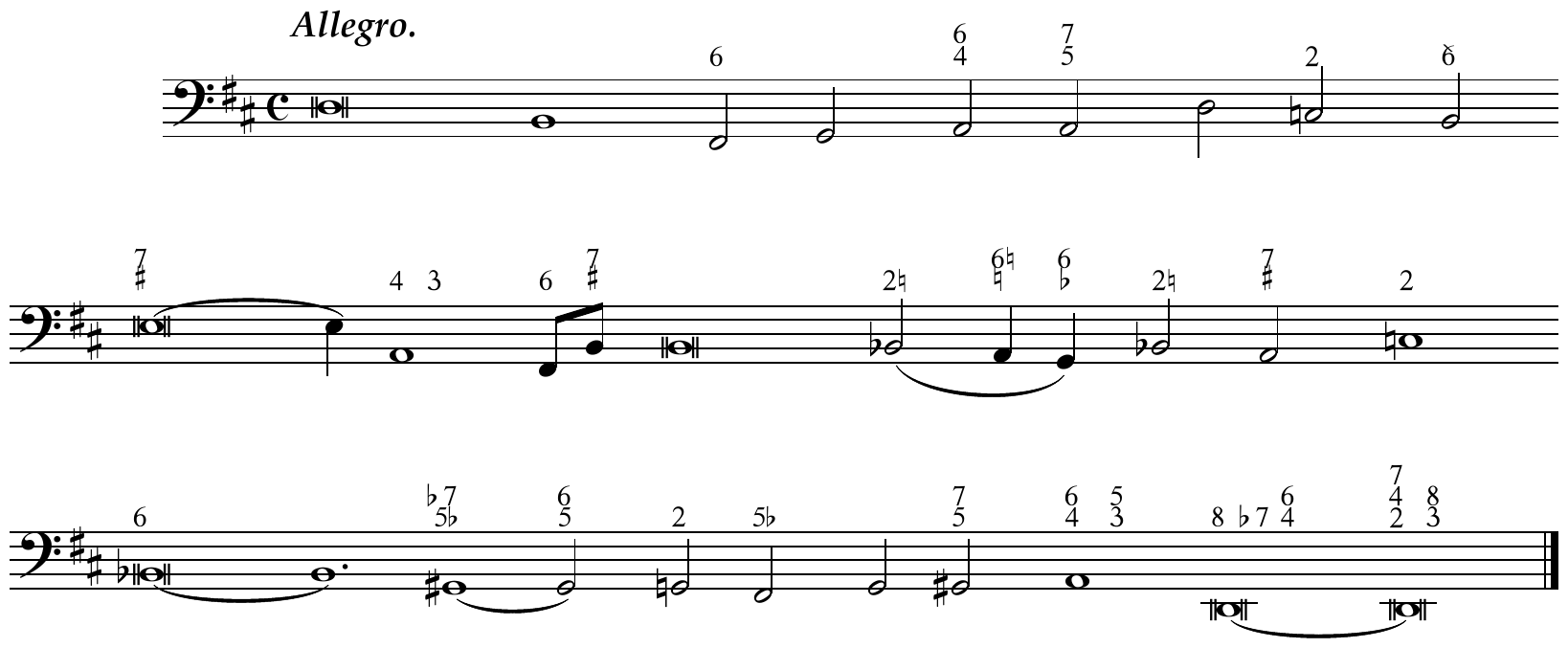
Bach famously commented on harmonic deceptions in his keyboard treatise, in a chapter on improvising a fantasy. Bach’s outline of a model fantasy is given in Example 1. Bach explains that one can create expectations of moving in a certain tonal direction, then frustrating those expectations: “It is one of the beauties of improvisation to feign modulation to a new key through a formal cadence and then to move off in another direction. This and other rational deceptions make a fantasy attractive; but they must not be excessively used, or natural relationships will become hopelessly buried beneath them” (1753–62, 2:330; 1949, 434, in Mitchell’s translation). Bach’s symphony maintains a balance between surprises and returns to convention not only in the tonal domain, but also in those of meter and form.
Example 2 shows a harmonic reduction (not to metric scale) of mm. 1–26 of the first movement of Wq. 183/1, summarizing the main tonal events in this section. After a I–vi–IV opening that clearly projects the home key of D major, mm. 19–20 unexpectedly tonicize A minor (v), mm. 21–22 tonicize B minor (vi), and mm. 23–26 tonicize an E-minor triad, which ends up serving as ii6 in the home key. One might therefore think about mm. 19–23 as a parenthetical, ambiguous insertion into the otherwise clear opening, which disrupts a 5–6 contrapuntal motion above , from IV into ii6.
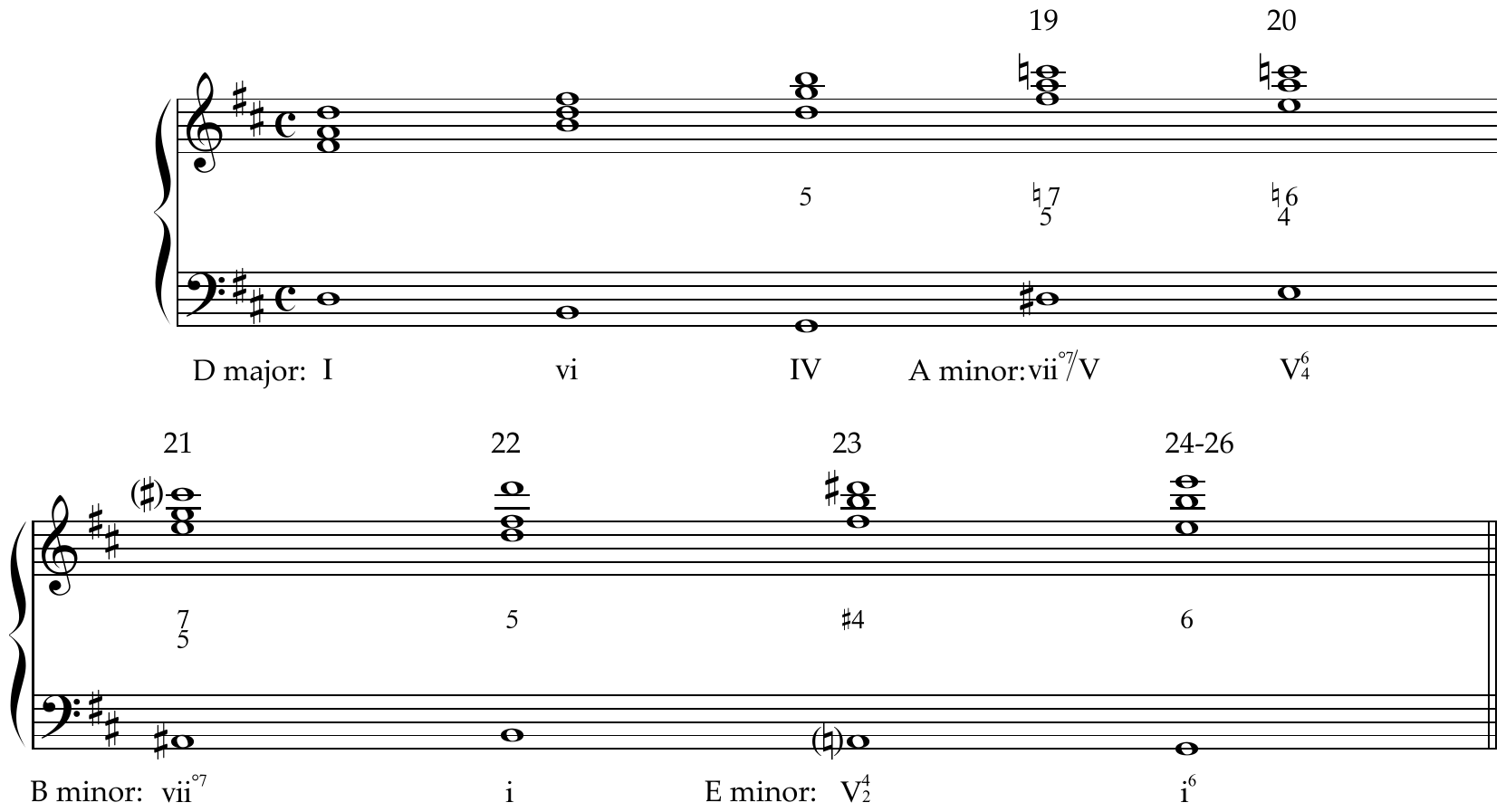
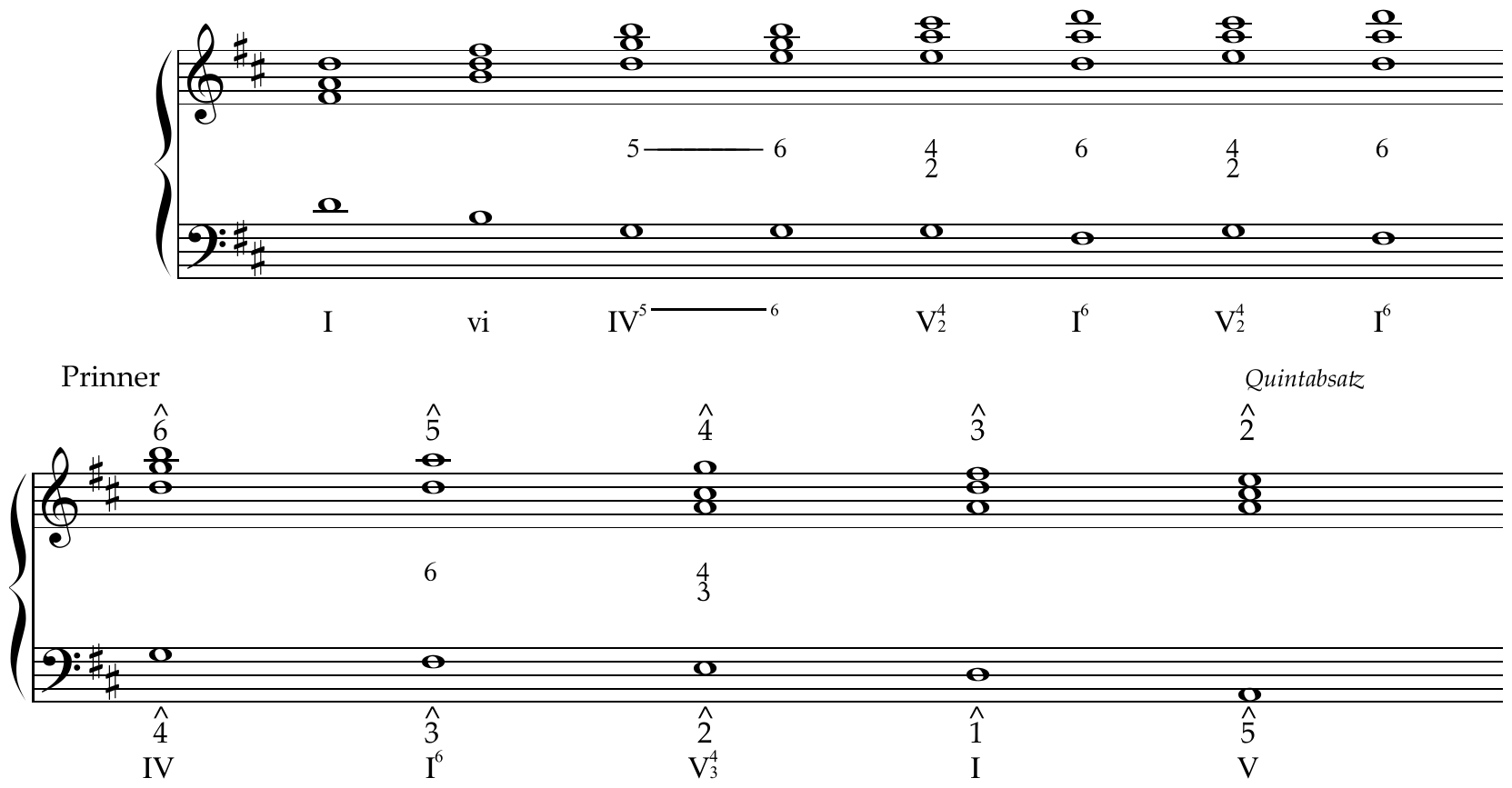
The stark shift of mm. 19–20 is unexpected, yet it has a decisive tonal implication. The succession from a diminished seventh sonority to the minor 6/4 one semitone above unambiguously implies that we have moved to the key of A minor (v); the following diminished seventh and root-position minor triad one semitone above imply a shift to B minor (vi). Tonal position finding of diminished seventh chords based on eighteenth-century usage—not on abstract properties (Browne 1981)—shows that these are not fully multivalent harmonies. In these two cases, the chordal qualities involved are tonally unambiguous. As Byros (2012, 2022) elegantly shows, the perception of tonality is influenced by musical usage and schemata. Among many theoretical concerns, Byros (2022) tracks the embedding of diminished seventh chords in figured-bass manuals. Rather than being open to enharmonic reinterpretation in every which way, diminished seventh chords in the long eighteenth century were embedded within specific patterns of resolution with specific tonal implications. When a diminished seventh sonority proceeds up a semitone in the bass to a minor 6/4, its bass is ♯ in all cases (probability of 1); when a diminished seventh proceeds up a semitone in the bass to a root-position minor triad, its bass is in all cases. These are also the two most frequent resolutions in a corpus of diminished seventh chords derived from Bach (1753–62) and Albrechtsberger ([1793] ca. 1807), strengthening the connection to practices of improvisation. Byros’s data suggest that we can unambiguously infer a local context from Bach’s two-chord successions in mm. 19–20 (A minor) and mm. 21–22 (B minor). Bach’s fantasy-like harmonic feints fail to materialize with a formal cadence. The return to the home key is further reinforced through the V42–I6 resolutions in mm. 27–30, followed by a conventional formal event to be discussed later—a Prinner (Gjerdingen 2007) leading to an HC, or Quintabsatz in neo-Kochian terms (Burstein 2020). Example 3 presents a harmonic reduction omitting the tonal deception, demonstrating what a more conventional course of tonal events might have entailed.
Bach’s fantasy-like deception may engage in a subtle polemic with Kirnberger’s views on key changes: the 1797 version of Bach’s Versuch adds a paragraph stating that one may shift quickly as well as slowly to different keys in both improvisation and composition, which is at odds with Kirnberger’s more cautious approach to key changes (Ferris 2000, esp. 72–73). In Kirnberger’s (1982, 139–40) terms, a modulation to minor v represents the first level of distant modulations. As Ferris stresses, Bach’s addition to the free-fantasy chapter marks a rare occasion in which the composer directly engaged in a theoretical polemic. I return below to the possibility that Bach’s piece is a coded commentary on Kirnberger’s emerging theories of meter. For now, it suffices to say that the tonal domain is disrupted in a surprising fashion.
It may not be a coincidence that the symphony is in the key of D major, like Bach’s model fantasy in his treatise. In addition, both pieces are based on an opening bass outline of (disrupted) D–B–G–F♯ or D–B–F♯–G. If such correspondences forge a seemingly tenuous relation, then the specific tonal manipulations that Bach discusses leave little doubt that the opening of the symphony translates aspects of the keyboard fantasy into the symphonic medium.
Rational Metric Deceptions
An Implicit Theoretical Commentary?
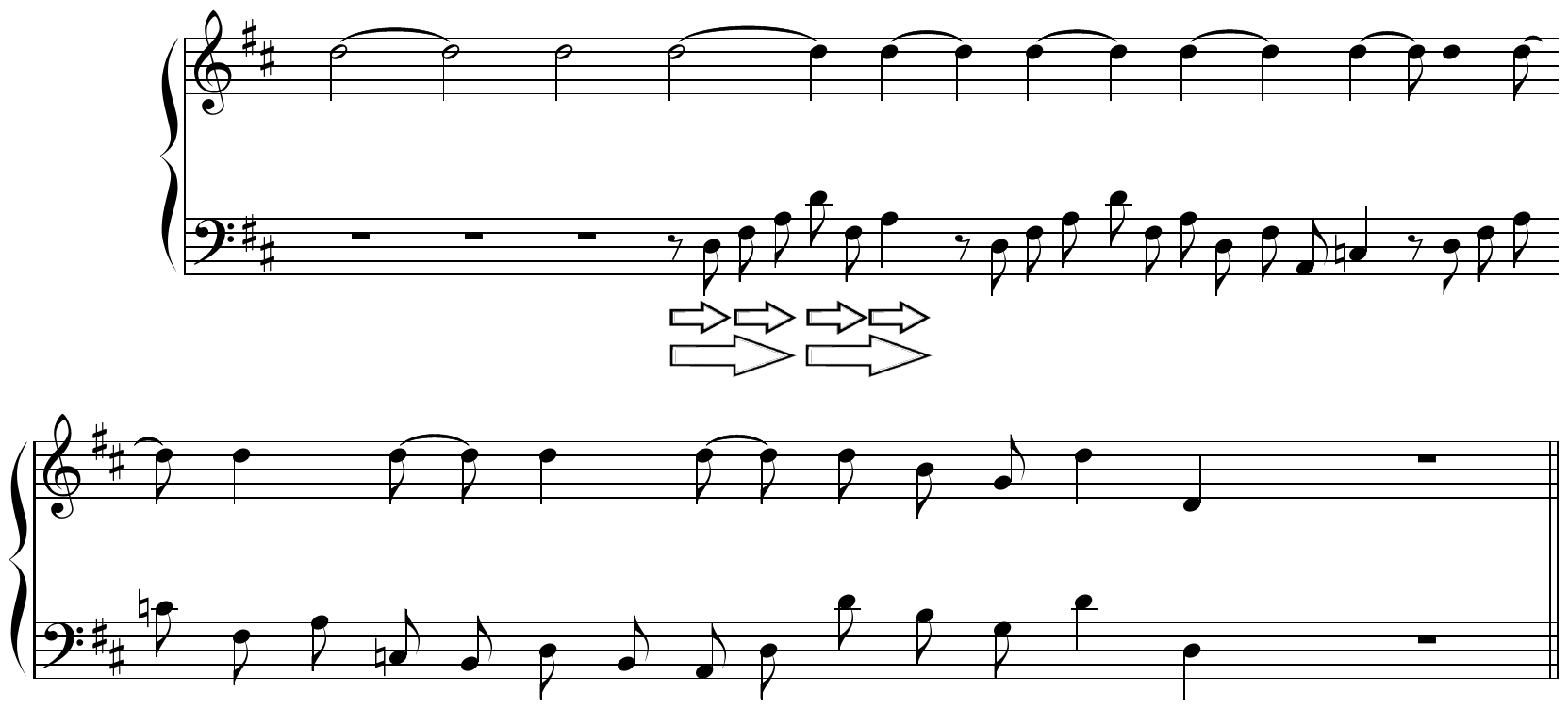
Bach’s tonal deception—something that he had described explicitly—appears in close proximity to a metric deception, a meter-finding problem (Mirka 2009): the opening of the piece superimposes a syncopated pedal point against chordal arpeggiations. Though the eighth-note subdivisions clearly establish half notes as the perceived tactus of this passage, the opening is highly ambiguous as to whether two or three half notes represent the true perceived meter. Example 4 notates the opening without beaming or bar lines, reflecting the perceived ambiguity: the procrustean bed of music notation and bar lines obscures from our view the richness of this passage for audience members who are not engaged in the highly unusual activity of listening along with a score. I will unpack below hearings of the passage “in 2” or “in 3” and expound the factors supporting either hearing. I am of course inspired here by Lerdahl and Jackendoff’s (1983, 74, 86) unbarred representations of the opening of Mozart’s Symphony in G Minor, K. 550; see also Mirka’s (2009, 49–50) survey of Koch’s discussion of metric notation. At present, Example 4 can give readers an opportunity to find a recording of the piece, avoid looking at a score, and experience this meter-finding game. I recommend the recording by Andrew Manze and the English Concert (Harmonia Mundi, 2006), which takes a somewhat hesitant, fantasy-like approach to this opening.
By referring to present-day notions of tactus (Lerdahl and Jackendoff 1983), I acknowledge that I am skirting certain complications in the historical conceptions of meter. For my present analytical purposes, the opening of the piece poses a dilemma regarding whether two or three half notes are to be grouped together in our present-day mind’s ear.
Though I skirt certain historical notions, I examine the extent to which Bach’s piece draws on metaphors in Kirnberger’s theories of meter, which emerged around the time of the composition. Of course, arguments about authorial intent—especially those communicated through music—are risky and speculative. For an entry point into discussions of authorial intent, see Haimo (1996). At the same time, it is notable that the date of the composition coincides with the emergence of new insights on pulsations in metric theory. The two musicians, Bach and Kirnberger, belonged to the same milieu, which makes such connections seem plausible. According to Clark (Bach 1997, 17n3), a letter from Bach to Kirnberger dated July 21, 1769, which mentions the latter’s composition treatise, may indicate that Bach possessed a draft of Kirnberger’s Die Kunst des reinen Satzes, whose first part was published in 1771; Bach tells Kirnberger, “You are receiving herewith your composition manual in a nutshell” (Bach 1997, 17). This is letter #22 in Clark’s numbering (1997, 17–18). Suchalla’s edition (Bach 1994, 1:177–79) has a fragmentary version of this letter, which does not include this key phrase—hence I was unable to consult the German original that underlies Clark’s translation. The letter itself mainly addresses the two musicians’ efforts to publish J. S. Bach’s chorales and discusses logistical matters. Bach rehearsed all four symphonies of Wq. 183 in August 1776; he may have composed the first two in fall 1775 and the latter two in spring 1776 (Bach 2005, vii). In other words, even if Bach could not have read the discussions of rhythm and meter in Volume 2, Part 1, of Kirnberger’s treatise, published in 1776, prior to composing the first two symphonies of Wq. 183, he would have been able to encounter such ideas about pulsations in Sulzer’s encyclopedia (Kirnberger and Schulz 1774) or through personal discussions. In Kirnberger and Schulz’s vivid language, an artisan making repeated strikes, such as a cooper making a barrel, imposes binary or ternary organization on a series of otherwise undifferentiated pulses (see Example 5). As Mirka (2009, 13–14) surveys, a foundational principle for both late eighteenth-century and late twentieth-century metric theory is the idea that regularity on two levels—a pulsation level and a slower one—is crucial for establishing meter. Kirnberger and Schulz write:
The cooper who drives a hoop [onto a barrel], [or] the coppersmith who hammers a kettle soon takes it into his head to perform his beats not singly in a completely identical way [Example 5a]; [rather] he will soon beat them [Examples 5b and 5c] in order to slightly differentiate the strength or the pitch [Ton] of the three or four beats going on one measure, so that the division of groups may become perceptible to the ear. (Kirnberger and Schulz [1794] 1967, 97, as translated in Mirka, 2009, 47) The first edition (Kirnberger and Schulz 1774) would have been available to Bach while working on the symphony. See also the discussion of subjective rhythmization in London (2012, 13–15).
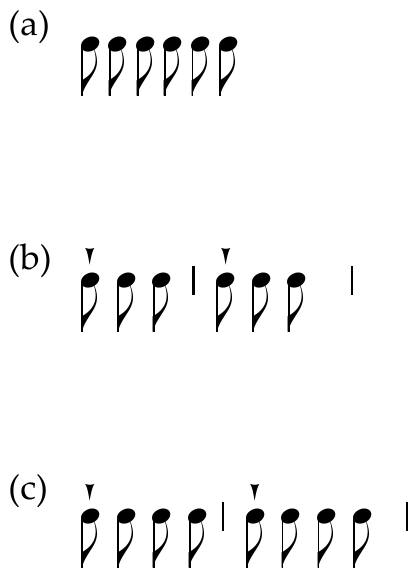
Bach’s opening musical idea bears some similarity to Kirnberger and Schulz’s example. In the lower layer of Example 4, a series of six attack points is involved in a metrically ambiguous passage, although the ambiguity in Bach’s case is not about groups of eighth-note pulses but about the number of half-note units within a perceived measure. Within the six strokes, the fourth is highlighted as a melodic peak, which is crucial for the meter-finding game of Bach’s opening.
A metaphor from Kirnberger’s Art of Strict Musical Composition also seems pertinent:
A melody that just flows along without accents resembles a continuous motion, like that created when a body falls or is thrown through the air; but an accented melody is similar to a motion divided into steps or to walking. Just as walking receives its particular character from the type as well as the speed of the steps, melody receives its character and expression in quite a similar way. (1982, 382) Bach’s up-and-down gestures resonate with Kirnberger’s metaphors: for instance, mm. 67–68 (discussed subsequently) display a continuous up-and-down motion (whose pattern conforms to the level of an entire measure); mm. 24–26 contain a free fall through pitch space as well as a bounce-back effect of a virtual moving body. This free fall would not be metrically clear were it not for the effect of a zigzagging alternation. Moreover, the turning point on the downbeat of m. 26 reinforces the meter.
Aside from these metaphors, Kirnberger (1982, 394) explicitly writes about a C. P. E. Bach symphony in 3/2 that presents an unusual subdivision into continuous thirty-second notes. David Beach and Jürgen Thym, in a translators’ note, identify this as the Symphony Wq. 179. Kirnberger writes:
3/2 meter is used very often, especially in church pieces, because of the ponderous and slow performance indicated by its note values. In the chamber style, sixteenth notes can also be used in 3/2 meter; C. P. E. Bach has even begun a symphony in this meter with many thirty-second notes in a row [recte: sixteenth notes, as noted by Beach and Thym]. With such note values, the three beats of this meter must be indicated most clearly in the other voices; otherwise the melody would remain fuzzy and incomprehensible to the listener. (1982, 394)
A brief look at the earlier symphony, Wq. 179 (1757), is instructive: measures 1–2 (Example 6a) and their recasting in mm. 26–27 (Example 6c) show some of Bach’s metric play in this earlier work. In m. 1, the up-and-down parallel gestures of the first violins subdivide the measure into two dotted half notes, obscuring the notated meter at the outset (before it has been fully established in our minds’ ears); in m. 26, by contrast, the change of direction arrives earlier to better reflect the notated meter. Measure 2 and its restatement in m. 27 support the notated 3/2 through surface gestures, including continuous up-and-down motions that create a clear parallelism of groupings congruent with the meter. Note that in mm. 21–24 (Example 6b), the bowings obscure the notated meter. Kirnberger’s discussion suggests that this earlier symphony is “fuzzy and incomprehensible” in its meter, given the subdivision into unusually short values in 3/2. I am skirting here Kirnberger’s account of the interactions among meter, tempo, character, and possible subdivisions to focus on issues more directly relevant to my inquiry.
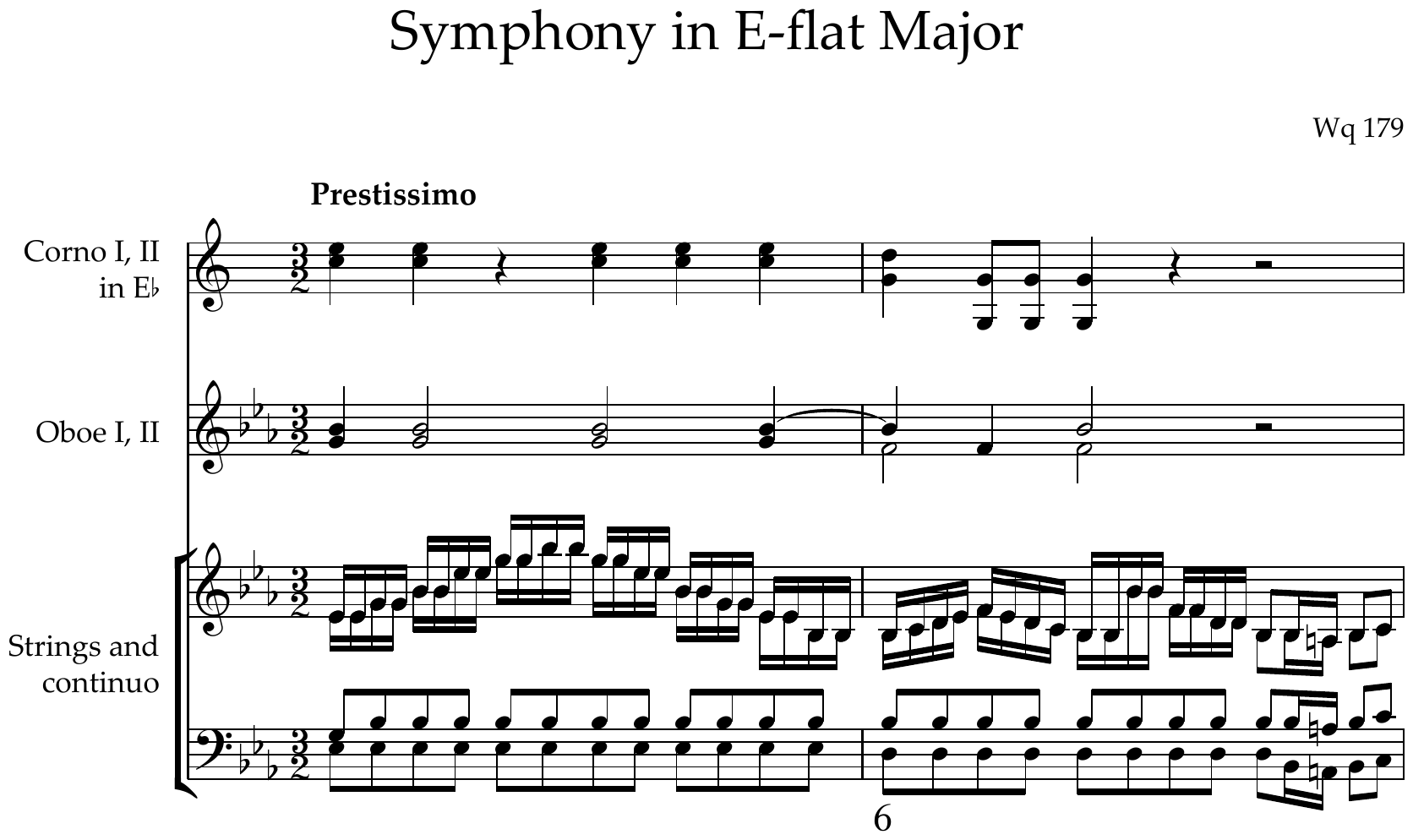
mm. 1–2.
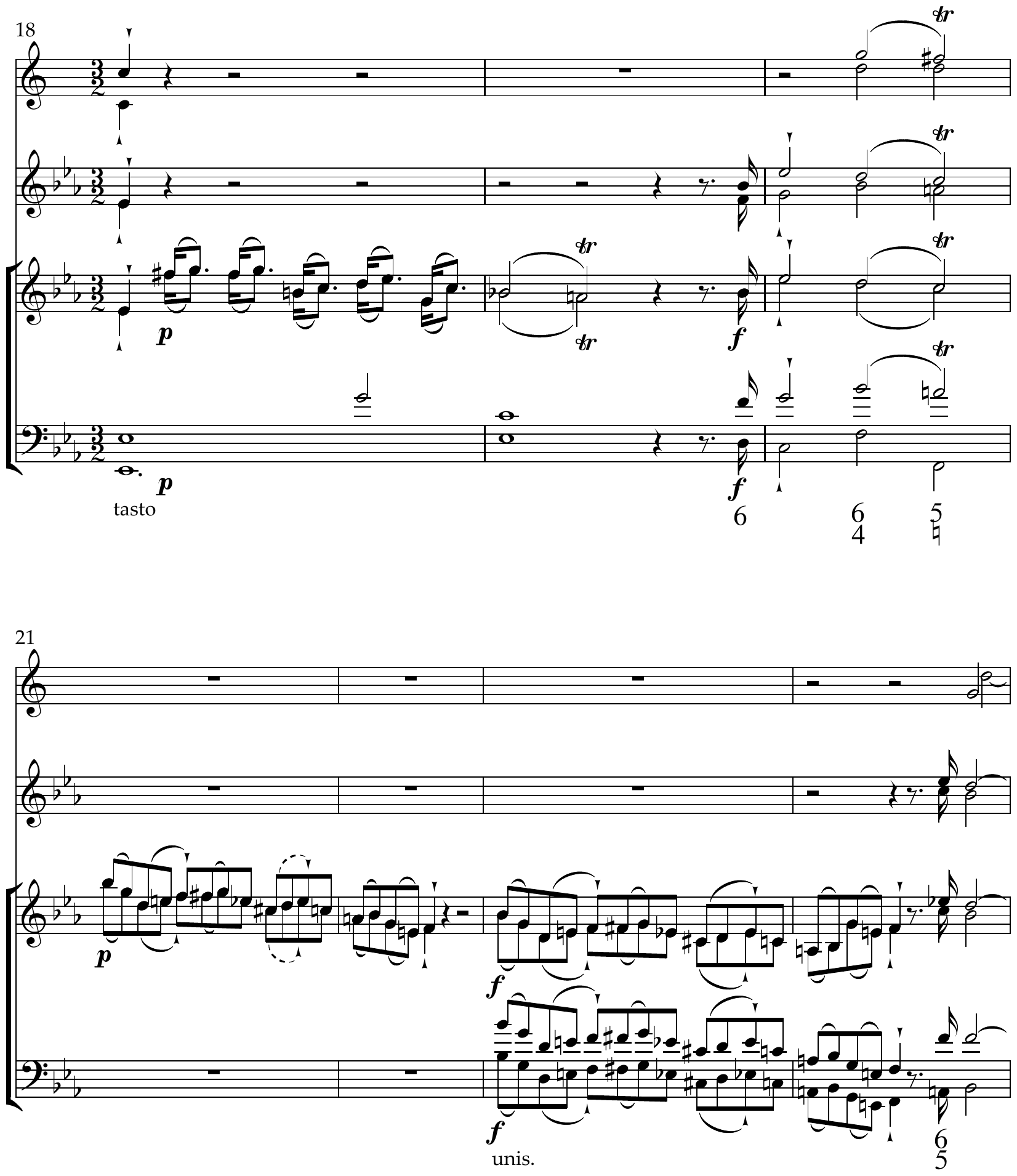
mm. 18–24.
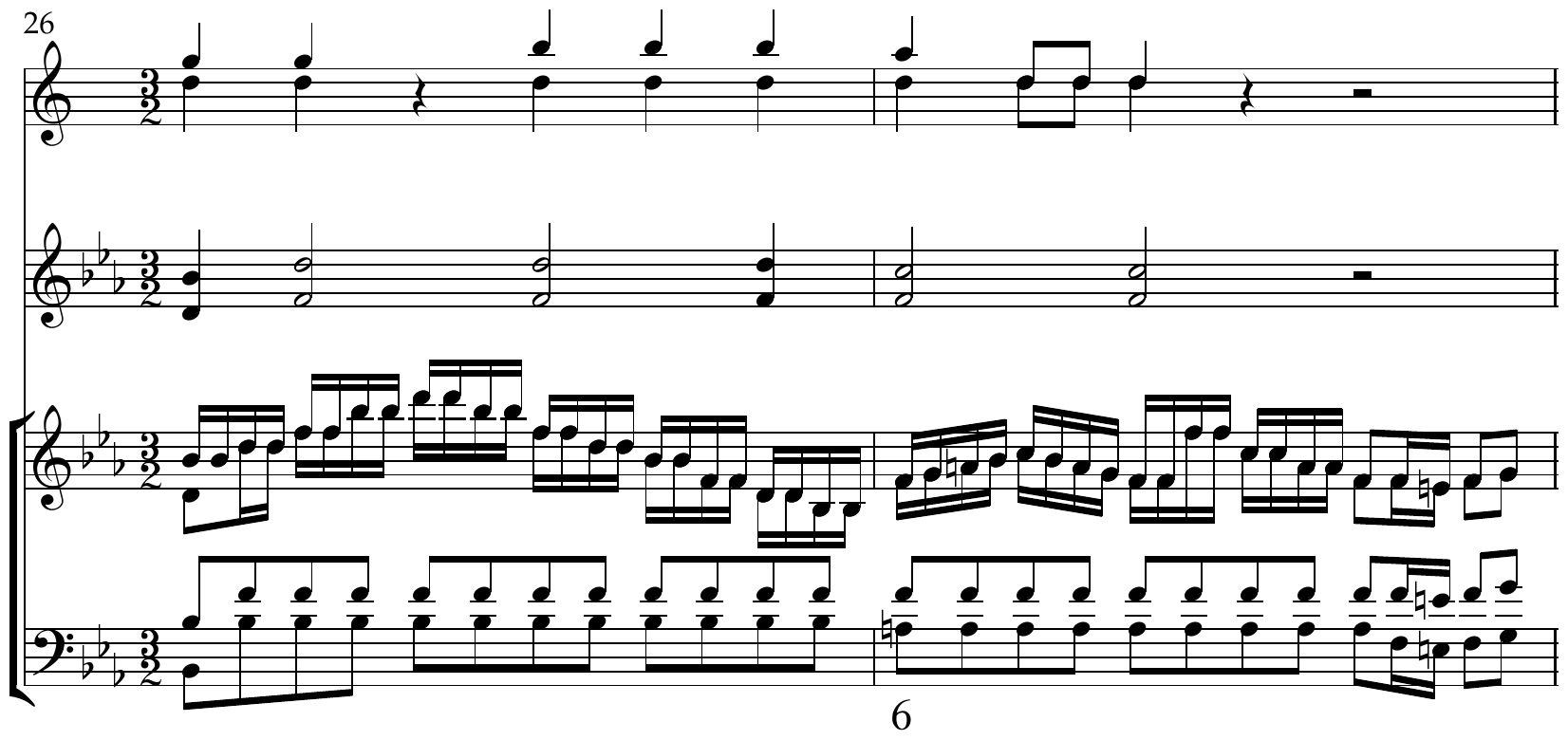
mm. 26–27.
C. P. E. Bach, Symphony in E-Flat Major, Wq. 179, first movement.
Whereas Kirnberger reacts to the unusually small subdivisions in Wq. 179, it is possible that Wq. 183/1 represents Bach’s playful reaction to Kirnberger’s prescriptions regarding the subdivisions appropriate for various meters. Wq. 183/1’s drive toward several punctuation points within the exposition is done with a compositional constraint, according to which there is a lowest-available subdivision at each point (quarter notes, eighth notes, or sixteenth notes). In particular, Bach may be reacting here to Kirnberger’s (1982, 391) distinction between “large” and “small” 4/4: See also the discussion of alla breve in Kirnberger (1982, 386–87), as well as the counterpoint-exercise-like mm. 35–48 of Bach’s symphony, discussed below. the former can be subdivided into eighth notes and isolated sixteenth notes, while the latter is faster and can be subdivided up to sixteenth notes.
Wq. 179 and Wq. 183/1 share several design features, which suggests that the composer revisited certain ideas in the later symphony. Both symphonies have tonally open movements connecting to the following movement; both first movements lack an expositional repeat and elide the final form-defining cadence of the exposition into the development section; finally, both pieces play with up-and-down gestures whose parallelism conforms to (or deviates from) the notated meter. On tonally open and linked movements in Bach’s fantasy-influenced compositions, see also Wollenberg (2007, 126–27). The tonally open ending of the first two movements and the unusual tonal relation of the inner movement (key of ♭II) certainly give Wq. 183/1 a fantasy-like character. In other words, it seems likely that Bach recycled compositional ideas between the two pieces, even if Wq. 183/1 is quite a bit more adventurous.
To summarize this survey, let us take stock of the potential evidence for a relation between Bach’s Wq. 183/1 and Kirnberger’s emerging notions of meter and broader theorizing:
-
Bach and Kirnberger belonged to the same musical-intellectual milieu.
-
It is possible that Kirnberger shared his composition treatise with Bach before its publication (or otherwise exchanged ideas with him).
-
Even if the discussion of meter in The Art of Strict Musical Composition was unavailable to Bach while working on Wq. 183, he would have been able to read Kirnberger and Schulz’s encyclopedia article.
-
Bach explicitly wrote about rational tonal deceptions in his keyboard treatise; Wq. 183/1 utilizes such tonal deceptions in close proximity to a metric deception.
-
Bach’s tonal deception is at odds with Kirnberger’s more cautious approach to key changes, connecting to a rare area in which Bach engaged in an overt polemic with Kirnberger (Ferris 2000).
-
Kirnberger reacted to the earlier Wq. 179 in The Art of Strict Musical Composition; Wq. 183/1 reuses some of the same tricks as Wq. 179 yet goes further in its gestural, tonal, and metric play.
-
The compositional constraint that Bach imposes, whereby each section of the piece has a lowest-available pulse, may be yet another indication for an implicit commentary on Kirnberger’s views on various meters and their appropriate subdivisions.
-
A portion of Bach’s exposition resembles a counterpoint exercise (discussed below) and playfully engages Kirnberger’s notions of essential vs. nonessential dissonance as well as his views on the strict and galant styles.
-
Finally, and most speculatively, Bach’s symphony mirrors specific metaphors used by Kirnberger regarding repeated artisanal strokes and continuous vs. divided motions of a body through space.
Having speculated about the possibility that the symphony is an implicit commentary on Kirnberger’s theories, especially his emerging conception of meter, I now resume the analytical thread, shifting from a view of the tonal disruption to a discussion of the metrically ambiguous opening.
Unpacking a Meter-Finding Problem
Let us now examine the metric ambiguity associated with Bach’s opening hammer strokes. The arrows in Example 4 indicate how the lower layer of pulsations starts to create metric projections in a meter-finding game (Mirka 2009). Bach’s gestures—perhaps akin to artisanal hammer strokes—create melodic accents based on the “sheer differences between ‘higher/lower’ tones” (Mirka 2009, 38). As Mirka observes, this usage of pitch is as a statistical rather than syntactical parameter, in Meyer’s (1989, 1998) terms. See also the comments in Mirka (2009, 45–46), drawing on Kirnberger and Schulz (1774, 983; [1794] 1967, 101), regarding the affinity between pitch height and dynamic accent. While I will not provide a Mirka-style projective analysis in this article, arrows highlight how—once the lower layer of motion in eighth notes enters—both quarter notes and half notes are established clearly to perception. The “onset” of motion in eighth notes is, in fact, the third attack point of the upper layer’s D5, which—in combination with the lower pulsations entering an eighth note later—starts this motion. What remains ambiguous is whether half notes are to be grouped into twos or threes: should we attend to groups of two or three half notes?
Example 7a presents a reduction of mm. 1–7 in their original barring, whereas Example 7b re-bars the music in 3/2. Part of the problem here, of course, is that the subdivision into eighth notes (as well as quarter notes) is not articulated at the outset of the piece. Compare this to Mirka’s (2009, 33–35) observations about the opening of Haydn’s Quartet op. 50, no. 6, first movement. Although I do not mirror Mirka’s projective analysis or graphics literally, one could paraphrase my observations about preference factors for the notated duple meter vs. 3/2 in terms of real-time projections (and, indeed, these preference factors are responsible for the ambiguity in perceived meter at the opening of this piece).
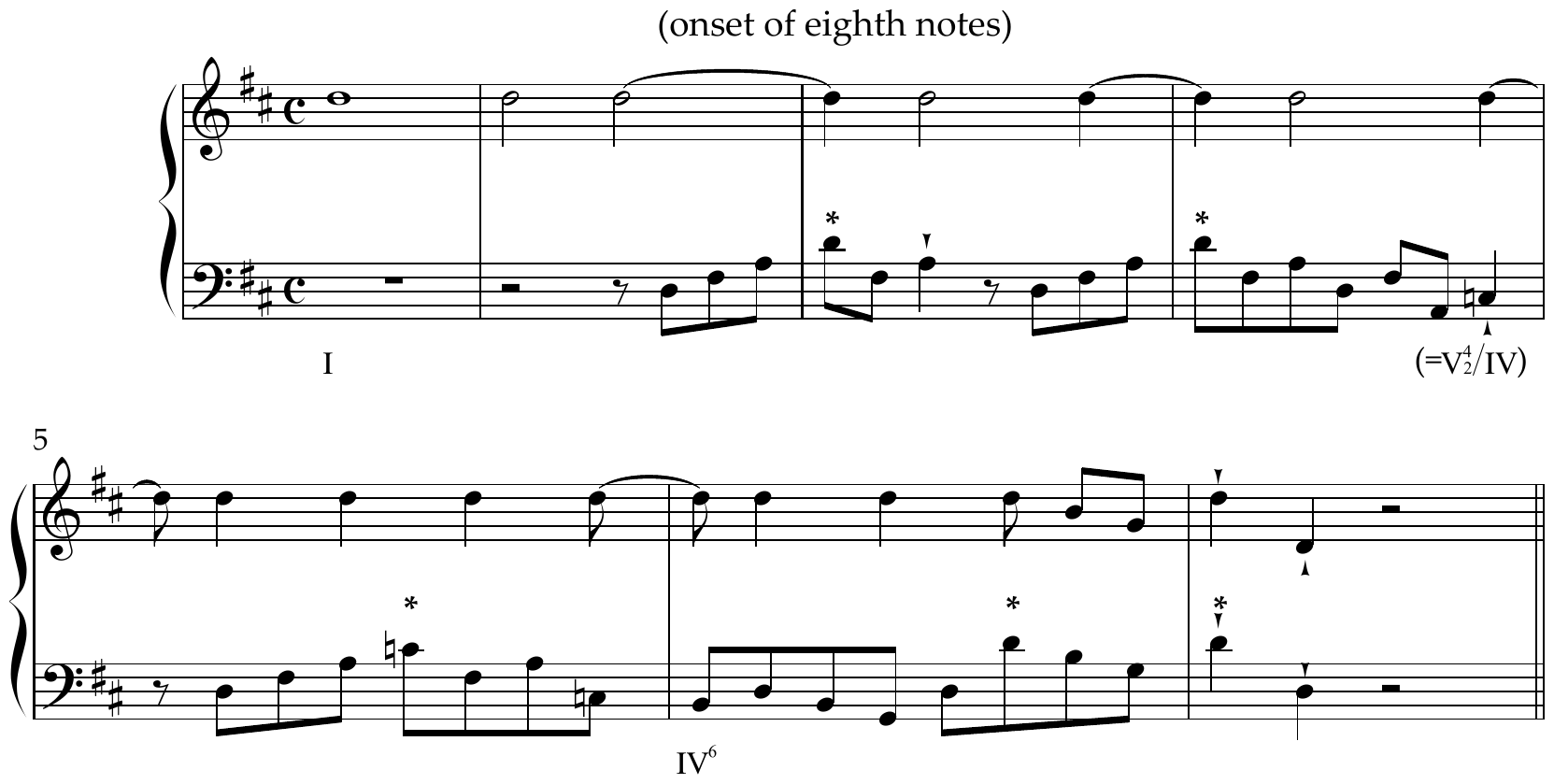
Original notated meter.
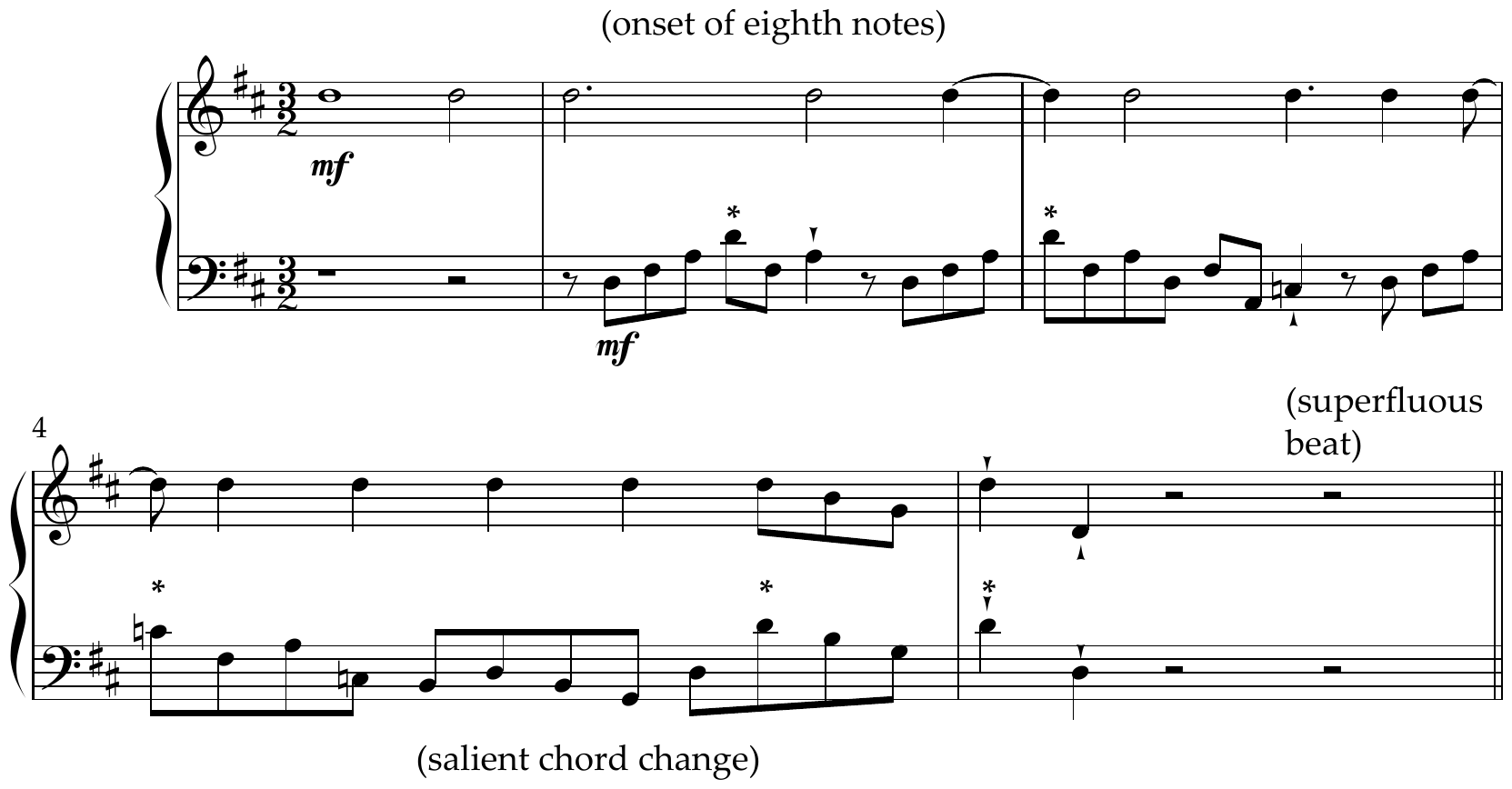
Re-barred into 3/2, with a superfluous beat.
C. P. E. Bach, Symphony in D Major, Wq. 183/1, first movement, mm. 1–7.
What factors support the notated meter? Our tendency to hear an initial accent and to impose binary regularity favor the notated meter from the outset in mm. 1–2, though the surface gives us few attack points to work with. One might experience the upward arpeggio of the lower strings as an upbeat into the melodically accented high points on the downbeats of m. 3 and m. 4, creating strong parallelism. Mirka (2009, 39) lists these factors as “initial accent” and “binary regularity”; they are equivalent to Lerdahl and Jackendoff’s (1983) “strong beat early” and “binary regularity” metrical preference rules. Lerdahl and Jackendoff’s (1983) parallelism rule is MPR1. In addition, the most salient chord change in this passage occurs on the downbeat of m. 6, involving resolution to a subdominant chord, marking that timepoint for our attention. As Temperley (2008, 318) observes, “Not all harmonic changes are equal.” The root-preserving harmonic change from I to V7/IV is not as strong as the change to IV in m. 6. As Mirka (2009, 50–52) surveys, harmonic change is a most powerful preference factor. The transformation of the tonic chord into a V42 of IV is more problematic for present purposes: should we hear a chord change on the fourth beat of notated m. 4? Should we pay attention to the (relatively) novel and salient C4 in the middle of m. 5? Under the notated meter, this is a point of incongruence, since the peak of the wave falls in the middle of the measure. Finally, the change to unison octaves on the downbeat of m. 7 supports the notated meter.
Though these are compelling factors in favor of the meter as notated, there are also some challenges: though the (perceived) onset of eighth-note motion in the middle of m. 2 corresponds to the notated half note level, it can suggest reinterpreting the preceding whole note and half note as one measure in 3/2. In addition, the indirect metric dissonances (Krebs 1999) in the upper layer are disorienting: from m. 3, half notes are shifted by a quarter note, while quarter notes (in mm. 5–6) are displaced by eighth notes. This deprives the downbeats in mm. 3–6 of upper-layer attack points that might have clarified the notated meter (note, too, that the downbeat of m. 5 has no attack point in either layer).
The re-barred Example 7b represents the meter as it may be heard initially. There are some attractive aspects to this reading, which I find more compelling subjectively. In the 3/2 hearing, the downbeat of re-barred m. 2 is the onset of (perceived) motion in eighth notes. Subsequently, the downbeats of re-notated m. 3 and m. 4 coincide with the melodic accent of the high points, clarifying the sense of 3/2. The downbeat of re-barred m. 5 is strongly emphasized through the unison gesture.
To be sure, the first arpeggiated peak (re-notated m. 2, beat 2) does not emphasize the 3/2 hearing. Another drawback of this interpretation is the fact that re-barred m. 5 corresponds to the original m. 7, which—in the actual score—includes only two half-note beats. In performance, however, there might be a tendency to extend this moment in a hesitant fashion (cf. Mirka 2009, 119). Andrew Manze and the English Concert (Harmonia Mundi, 2006) perform the passage in this manner. By contrast, Ton Koopman and the Amsterdam Baroque Orchestra (Erato, 1990) take a metronomic approach that supports the notated meter. The most salient chord change in the passage falls on the second half note of re-barred m. 4 in this hearing, again weakening the 3/2 hearing and favoring the notated meter. Whatever its drawbacks, Example 7b outlines a plausible real-time hearing of this unusual opening.
The second wave of arpeggios (mm. 8–14) is even more strongly suggestive of 3/2, since it is based entirely in a single sonority, B minor (vi), without any chord changes that might serve as metric cues—see the original notation in Example 8a and a re-barred version in Example 8b. Moreover, successively rising high points on D4 and F♯4 emerge on the downbeats of re-barred m. 10 and m. 11, creating melodic accents and parallelism between the second and third sub-waves of this arpeggio. Thus, the second wave supports 3/2 more strongly than the first wave.
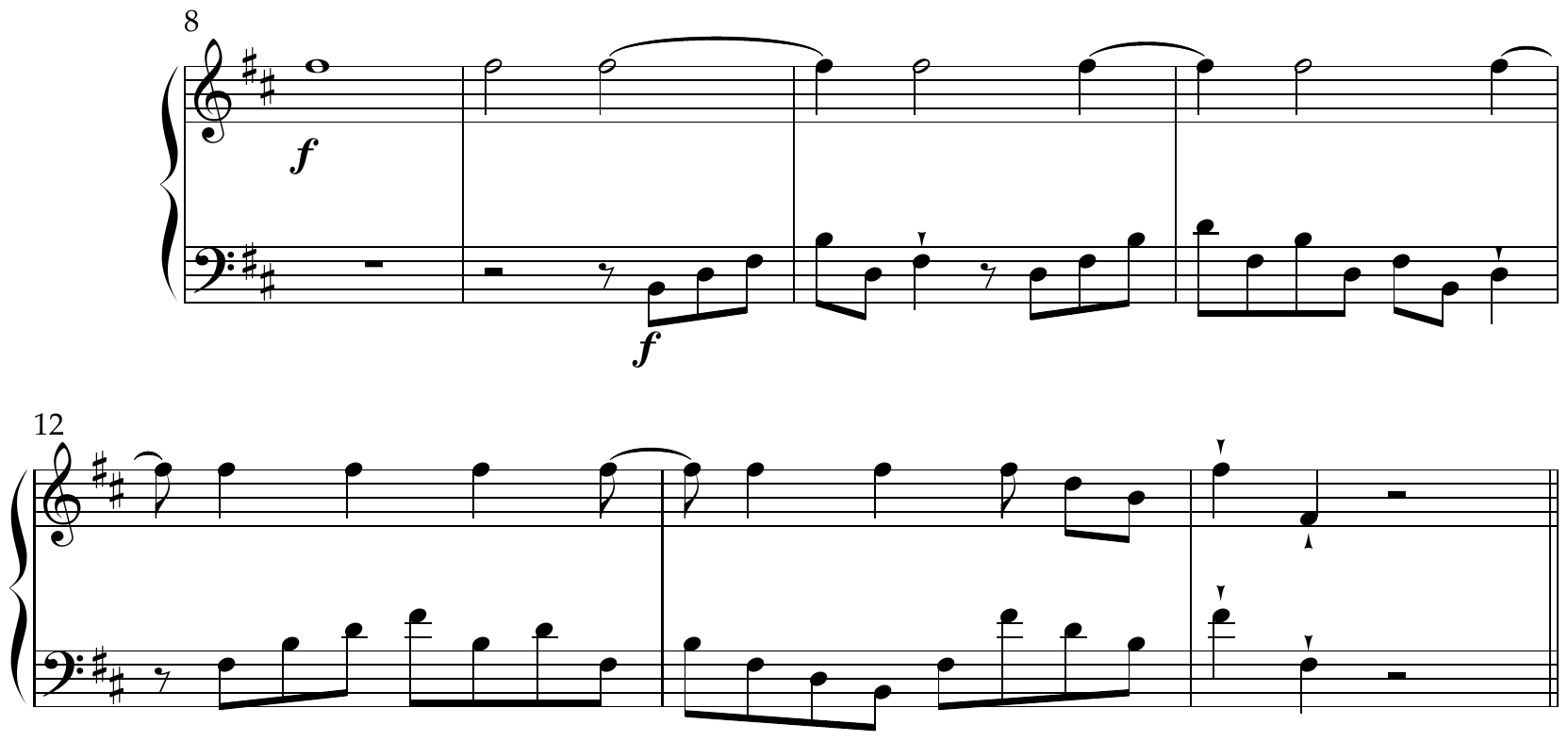
Original notated meter.
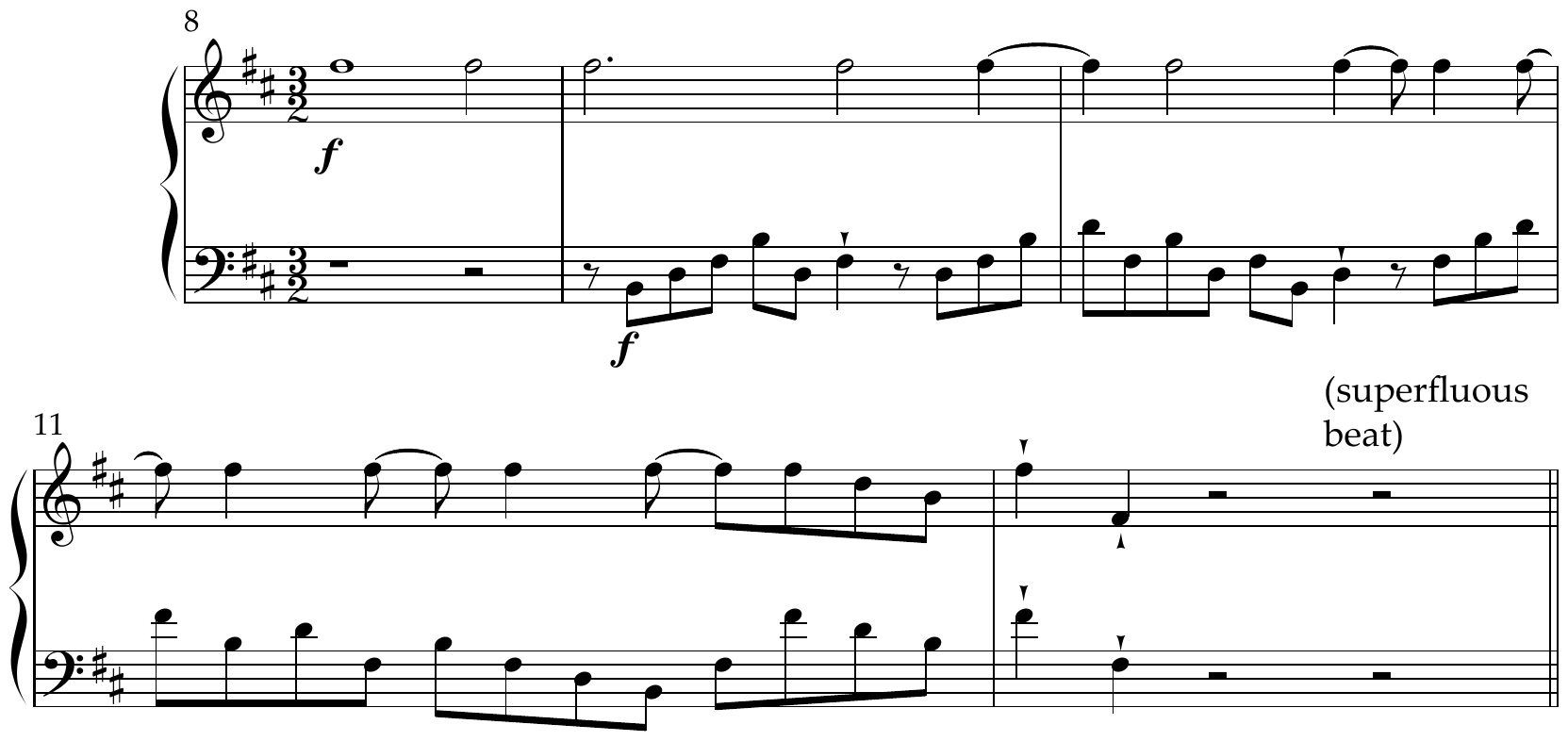
Re-barred into 3/2, with a superfluous beat.
C. P. E. Bach, Symphony in D Major, Wq. 183/1, first movement, mm. 8–14.
The third and final wave (Example 9), which outlines a IV sonority in mm. 15–18, is truncated, deviating from the pre-established pattern and leading to the surprising tutti texture of m. 19. One of the most disorienting things about the opening arpeggiated waves is the lack of consistent parallelism between the three-upbeat-stroke gestures and the melodic peaks to which they lead. The sub-waves of ups and downs do not consistently support 2/2-like or 3/2-like groupings, and if we try to impose either on the surface, something will always remain incongruent and unsettling.
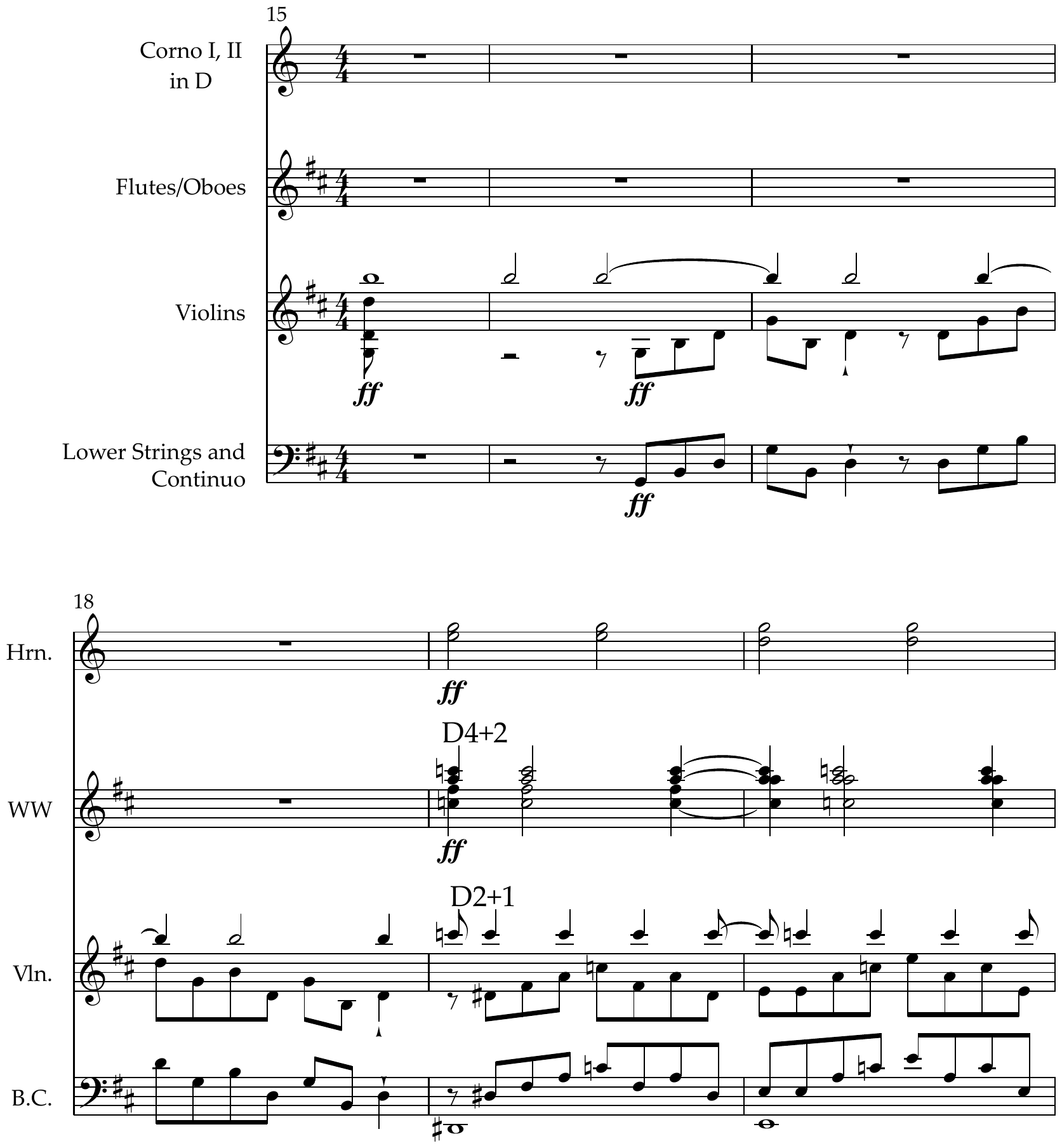
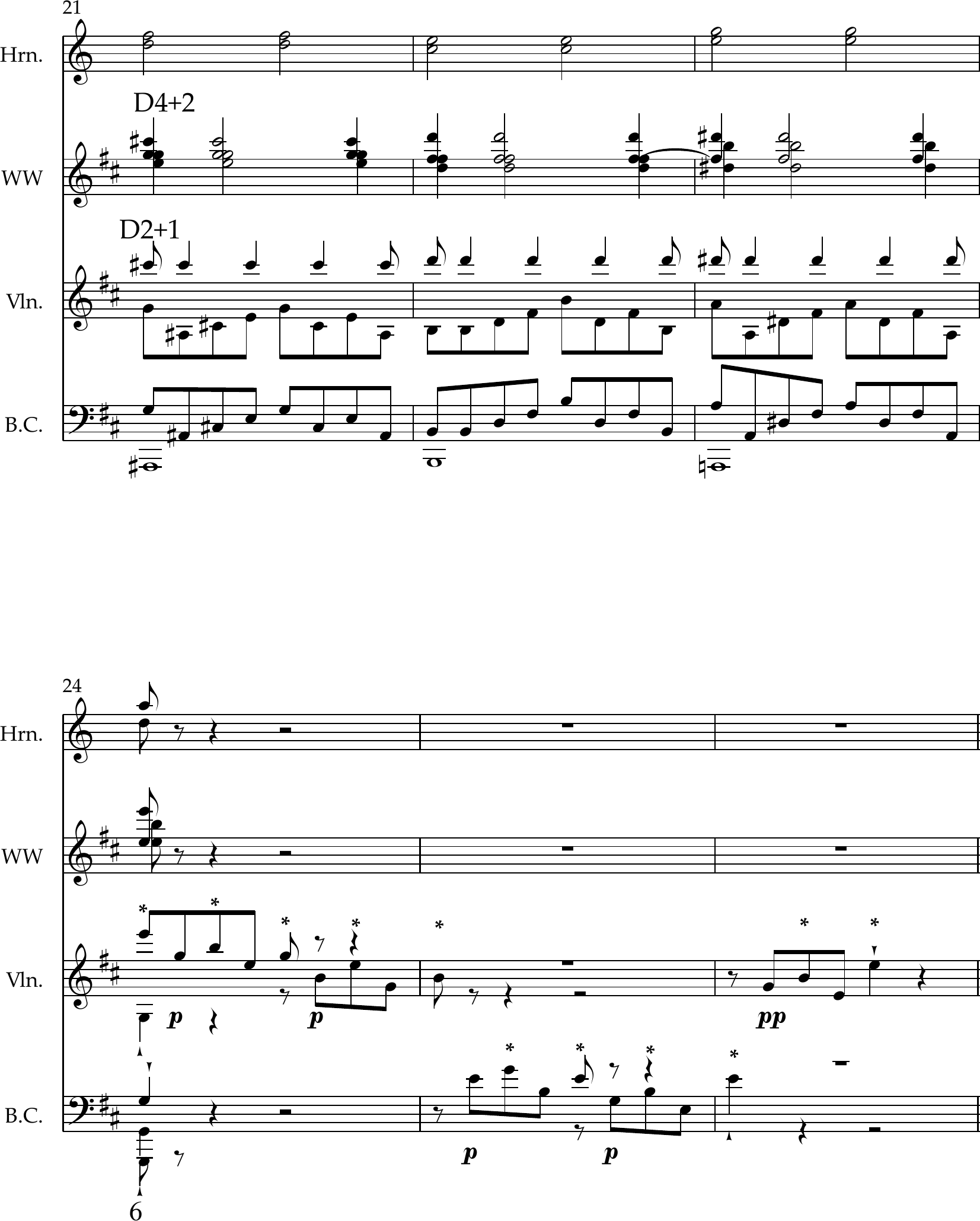
C. P. E. Bach, Symphony in D Major, Wq. 183/1, first movement, mm. 15–26.
The events of m. 19 are remarkable: finally, the notated meter—with its various layers—is clearly revealed to the mind’s ear. A powerful preference factor, chord change, reinforces each downbeat from m. 19 to m. 24. Eighth-note pulsations continue, while various instruments highlight other subdivisions with simultaneous or direct displacement dissonances (Krebs 1999): quarter notes offset by an eighth note in the first violins (D2+1), as well as half notes offset by quarter notes in the flutes and oboes (D4+2). Thus, displacements that were heard successively (or indirectly) at the outset are now sounded simultaneously in a tonally unsettling yet metrically clear tutti. These displaced layers interact with unsyncopated half notes in the horns as well as unsyncopated whole notes in the continuo instruments. Thus, mm. 19–23 render the notated meter crystal clear, though with a piling up of displacement dissonances differentiated through timbre. This timbral differentiation is brought out particularly clearly in a live 2018 recording by the WDR Symphony Orchestra, conducted by Andrea Marcon (https://www.youtube.com/watch?v=bVhV-Qwlc5Y).
The home-key ii6 of mm. 24–26 not only represents the cessation of harmonic deception, but also further clarifies the metric grid through melodic accents and parallelism between motions in pitch space: each quarter note is subdivided into a high-low pattern, while a two-measure unit emerges in mm. 24–25 and contrasts with a 1-measure gesture in m. 26. Now no displacement dissonances or wrinkles are left: the zigzag pattern projects quarter notes clearly; the bouncing back up of a metaphoric object in space is congruent with the notated meter.
Thus, we can narrate the events of the first 26 measures as follows: the symphony starts with a meter-finding problem through waves of arpeggiations translating the rhetoric of a keyboard fantasy into the symphonic medium; a tutti entrance solves the metric problem while introducing harmonic fantasy-like deceptions. In this way, the piece poses some problems of composition and genre to be solved later: how can the fantasy-like, hesitant (but in-tempo) arpeggiations find their place in a more orderly symphonic exposition? How would we know that we have entered the script of a sonata exposition and decisively abandoned generic allusions to the keyboard fantasy? As I demonstrate in the subsequent sections, Bach takes elements that were initially ambiguous or fantasy-like and embeds them in conventional positions later in the exposition. Thus, he reinterprets such “problematic” elements as conventional elements of the mold of a galant exposition.
Rational Formal Deception
As the opening problems subside, it becomes clear that we have now entered the realm of a galant exposition (Burstein 2020). After dominant-tonic resolutions in mm. 27–30, the onset of the home-key Prinner schema in m. 31 is a particularly strong orienting cue for our position in the exposition’s journey, yet one that arrives unusually late (Example 10). A home-key Prinner is a hallmark of the galant style (Gjerdingen 2007): this schema is conventional and is very often a “riposte” to an opening idea, be it an inter-opus schema or a piece-specific opening gambit. In this particular case, the schema signals the shift from the fantasy-like opening into a conventional galant exposition: this shift is strongly supported through the subsequent chain of events, in which the music forges its way toward conventional cadential points of articulation.
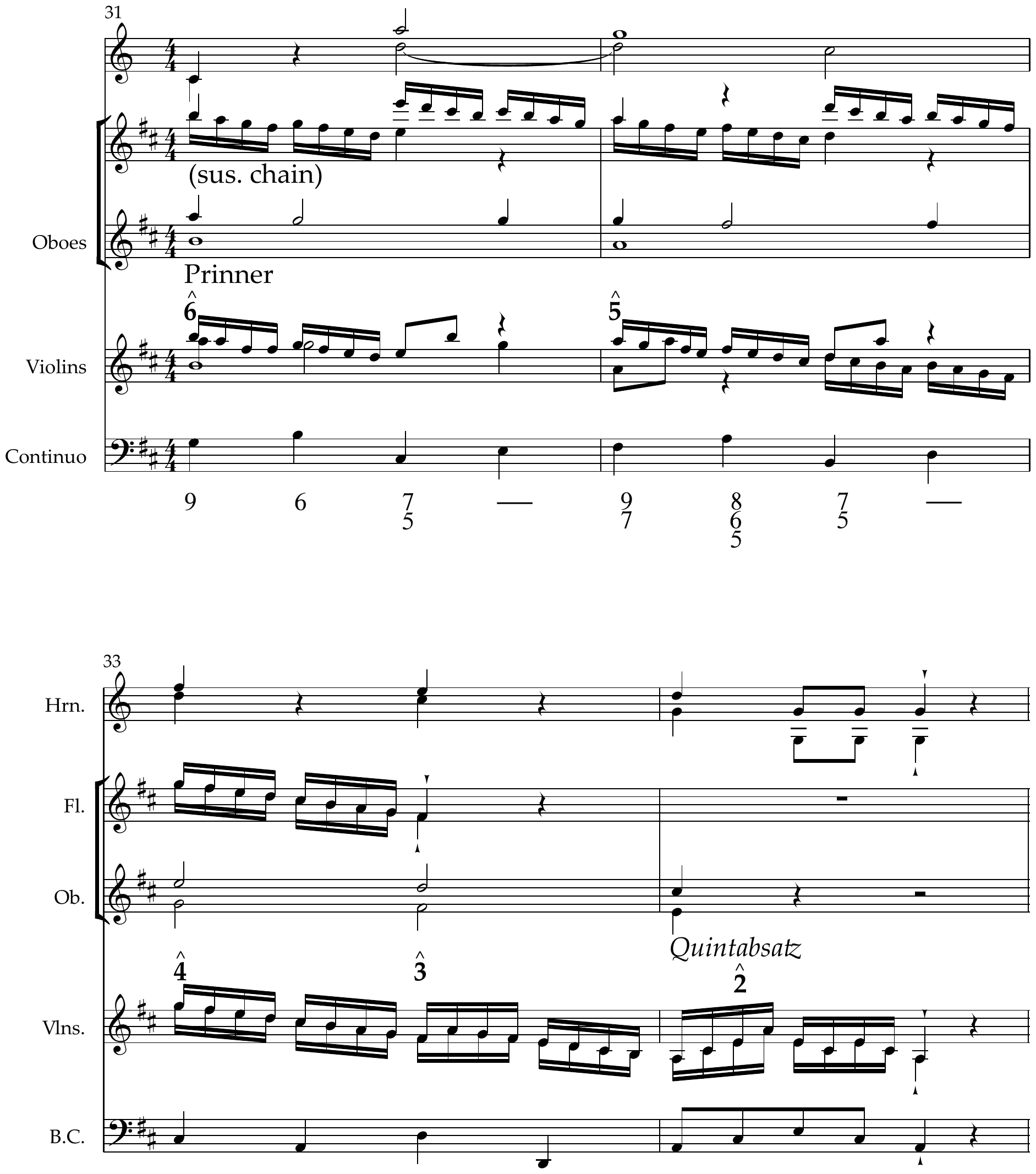
I follow Burstein’s (2020) neo-Kochian terms (and adapt his graphic representation) for presenting the punctuation form of galant expositions. My motivation in understanding the punctuation sequence has less to do with the fact that it was explicitly described in the period and more with the fact that these were the formal conventions with which Bach worked, rather than those of the (later) high-classical exposition. To be sure, we might be more familiar with high-classical expositions both through musical exposure and through influential theoretical descriptions (Caplin 1998, Hepokoski and Darcy 2006), yet this later formal mold is misleading when dealing with galant-style expositions.
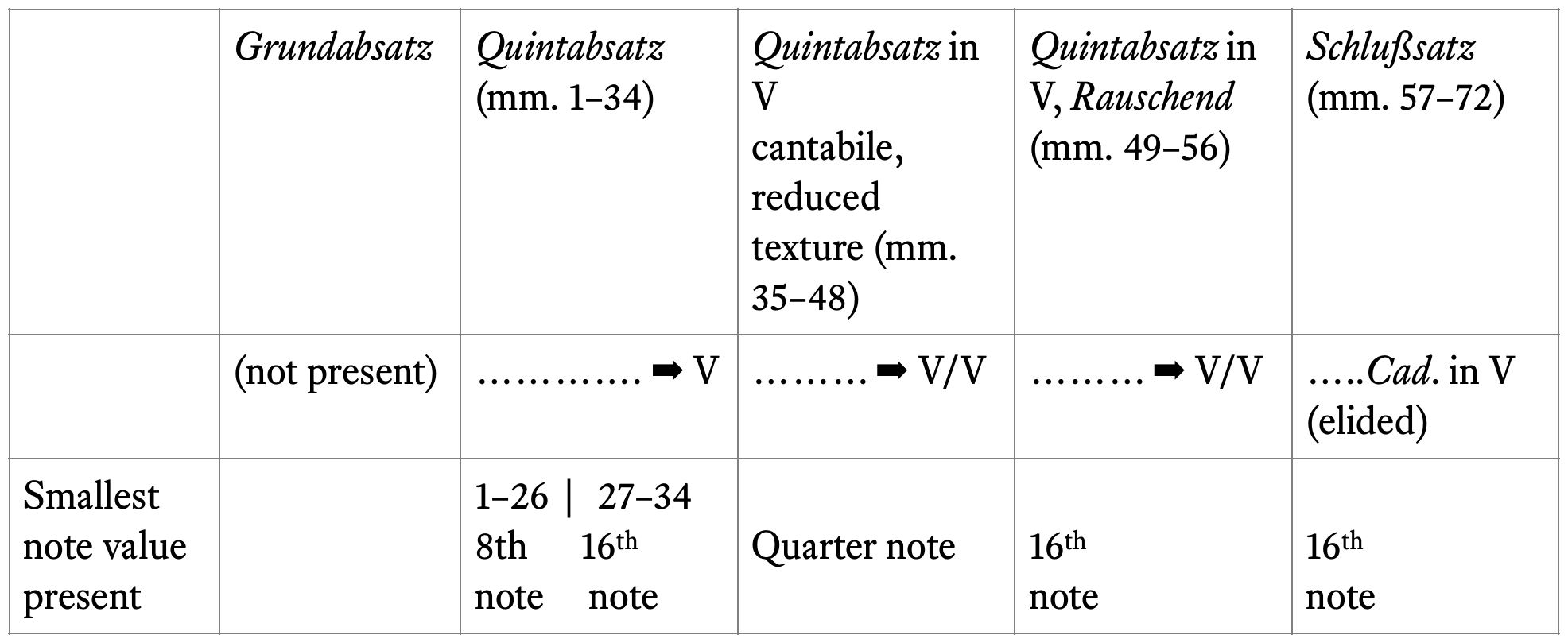
Example 11 diagrams the galant punctuation form (Burstein 2020) of the exposition. Bach’s exposition does not include a Grundabsatz, the absence of which is conventional, since not every exposition includes all resting points. It repeats its motion towards a Quintabsatz in the key of V, reversing the typical succession of active (rauschend) followed by lyrical (cantabile). As Burstein (2020, esp. 8–9) emphasizes, certain things about the punctuation outline are disorienting to our high-classical-biased minds:
-
Galant expositions work their way towards several punctuation points, which may or may not overlap with present-day definitions of cadences or follow expectations about themes and their contrasting characters.
-
There is no expectation for a big mid-exposition cadence akin to a medial caesura (Hepokoski and Darcy 2006); there is also nothing unusual (or marked for our attention) about a piece with two half-cadential breaks (Burstein 2020, 182–200).
-
Areas of the exposition are defined not as containers or spaces but rather according to the point of cadential articulation toward which they lead.
-
Though we expect thematic contrast in the secondary key area by way of a more lyrical theme, this was actually an optional element that would have been construed as an “insert” in the period (Burstein 2020, 94–95).
Taking these issues as they apply to Bach’s exposition, we can make the following observations:
-
All of the punctuation points in Example 11 correspond to cadence points that would be recognized as such in modern-day terminology (HC in the home key, two HCs in the key of V, and an elided PAC in the key of V).
-
The Quintabsatz of m. 34 (indicated in Example 10) is the punctuation point that most strongly resembles a prototypical medial caesura (energy-gain, a literal gap, and then a significant textural drop), yet the second Quintabsatz in V of m. 56 might be more decisive and is followed by the drive toward ultimate cadential closure for the exposition. The multiplicity of cadence points should not be particularly marked for our analytical attention but rather represents earlier compositional practices. Burstein observes: “It would be too restrictive and tautological to argue that the first half-cadential break that precedes a new-key theme must by definition be regarded as the medial caesura. If the concepts of the medial caesura and post-medial caesura are to have implications for interpretation and performance, some features must suggest that the medial caesura proper could be fairly portrayed as having greater formal weight” (2020, 272n21). Perhaps the fact that the paired Quintabsätze in V follow the order cantabile-then-rauschend can be viewed as a deviation from the convention of starting with a more active Quintabsatz and moving to a more cantabile one (see Burstein 2020, 61–63); such a pairing does not necessarily correspond to what we would now label as transition and secondary theme (Burstein 2020, 86). In any case, this seems like a minor deviation from the mold.
-
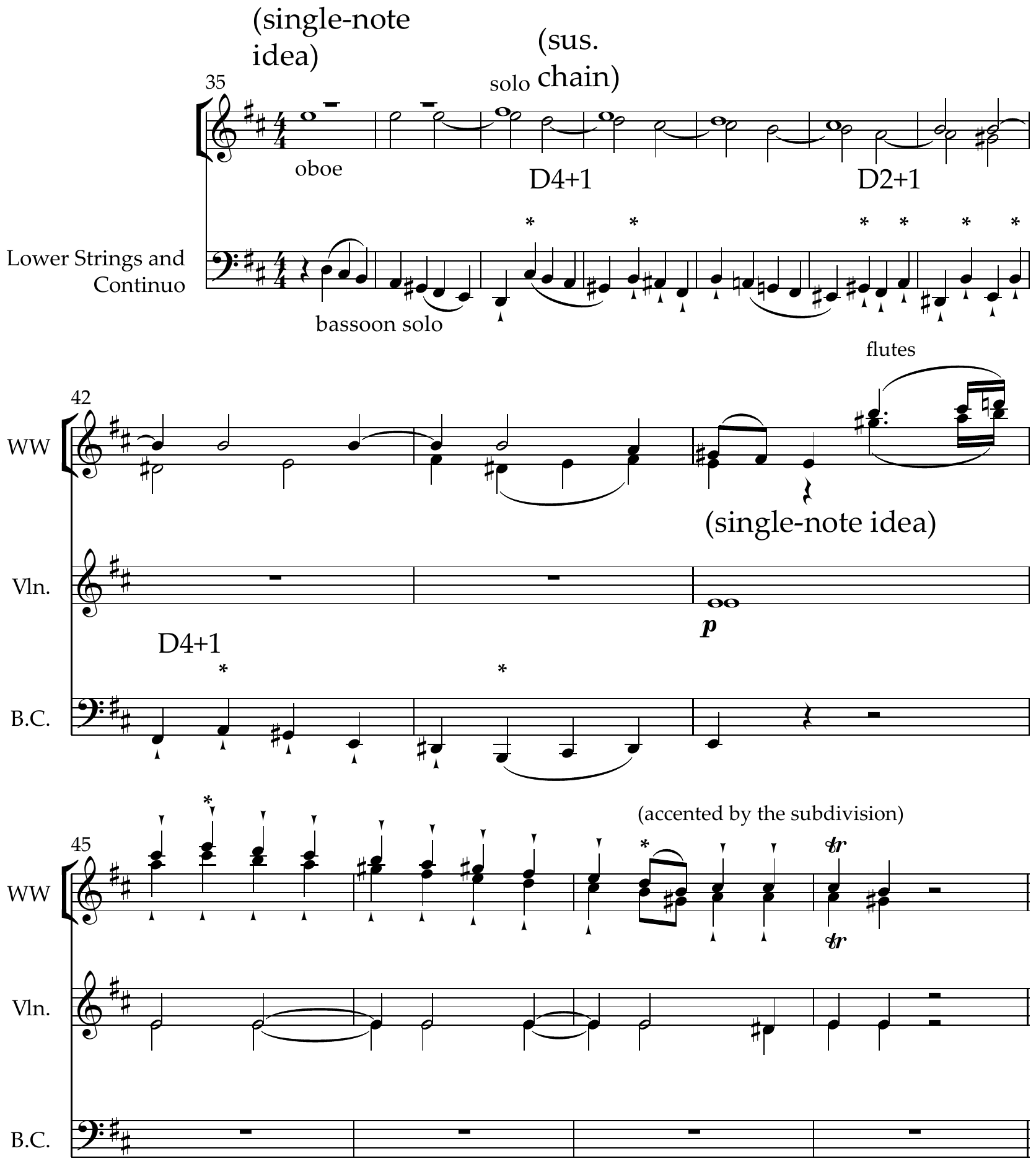
If anything is “redundant” about Bach’s form as represented in Example 11, it is not the second Quintabsatz in V, but rather the cantabile materials of mm. 35–48, which can be considered an insert (Example 12). Yet in the compositional game of this particular piece, the materials leading up to these punctuation points provide opportunities for adapting the opening fantasy-like materials and for solving the ambiguities and problems that they pose.
Overall, the story of Example 11 is one of a musical work conforming to conventions of its time. How then can we explain the shock value of the home-key Prinner in m. 31? I have explored above the notion that this “riposte” arrives too late, or, viewed differently, puts the piece back on its tracks. This schema often leads to a galant punctuation point, be it a Grundabsatz ending on or a home-key Quintabsatz with an added descent to ; by reaching the latter suffix, it retroactively clarifies that the piece so far had been working towards a home-key Quintabsatz (Burstein 2020, 44–45). Caplin (2015, 41) discusses the respective “syntactical strength” of a Prinner ending on and a Prinner continuing on to an HC ending on . Although Caplin de facto subsumes the analytical object “Prinner” under his form-functional apparatus, his discussion demonstrates the wealth of possibilities associated with this conventional skeleton. In this particular case, the entrance of the Prinner (as a strong cue for position within form) signals that we have now departed from the idiosyncratic, fantasy-like opening and reconnected to a much more conventional course of events within a galant exposition.
The punctuation form also interacts with the metric play: at each point, there is a lowest metric subdivision available for use: this is marked on the bottom row of Example 11. Each process of motion toward a resting point is associated with a distinct lowest-possible subdivision (quarter, eighth, or sixteenth note). The only exception is the process leading to the initial Quintabsatz, which starts out with eighth notes as the lowest possible division and adds in sixteenth notes around the point where the fantasy becomes a sonata. This compositional constraint, akin to a counterpoint exercise, facilitates some of the motivic connections and interplay between the compositional “problems” of the opening fantasy and their resolution in the more sonata-like portion of this exposition.
Transforming Ideas
Single-Note Idea
Bach’s compositional choice of a fantasy-like deception in the key of A minor (v) was felicitous: this allows the same absolute bass pitches, D♯–E, to contribute to conventional punctuations within the galant exposition. The materials presented starting in m. 35 (see again Example 12) contain “touches” upon D♯–E (m. 41, mm. 43–44), which are then transformed into the first Quintabsatz in V. Measure 48 attains this punctuation point softly, in a light texture. In this way, the fantasy-like tutti burst is tamed into a reduced texture and also becomes part of the conventional course of events in the galant exposition. But the story of D♯–E is not over: these pitches are also integrated into another point of arrival, the second Quintabsatz in V of m. 56. The tutti-texture drive towards this repeated point of formal articulation is accompanied by a shift to the parallel minor, along with the embedding of D♯–E into the le–sol–fi–sol schema (Byros 2012): this creates a more emphatic arrival on these pitches (not shown). Note that the recognition of the le–sol–fi–sol schema was responsible both for historical listeners hearing a clear shift to G minor at the opening of Beethoven’s Eroica Symphony as well as for invocations of improvisation (Byros 2012, 285). With the le–sol–fi–sol schema, we have a tutti-forte counterpart to the surprise of m. 19, which now fits into the mold of the galant exposition. The le–sol–fi–sol schema also provides a wider context for a passage that was originally tonally disruptive: the tonal shift at the opening was unexpected; the shift to the parallel minor that embeds a le–sol–fi–sol on the way to a Quintabsatz in V is more conventional. On the association between le–sol–fi–sol and HCs, see Byros (2012, 295–99). With the risk of anachronistically equating the Quintabsatz in V with its descendent in the high-classical exposition, the V:HC MC, note that the latter cadence point is sometimes preceded by a shift to the parallel minor. Hepokoski and Darcy (2006, 25) note the possibility of reaching a V:HC MC by way of a shift to the parallel minor. See also Long’s (2024) discussion of minor-mode shifts in galant expositions. Though words of caution about anachronisms are necessary, the predecessor formal juncture (Quintabsatz in V) in galant expositions is sometimes preceded by a parallel-minor effect (Burstein 2020, 126, 183–84). In any case, the formerly disruptive tonal shift finds a proper place in a minor-inflected schema and leads to a conventional punctuation point.
Though the materials from m. 35 onward sound fresh, the piece exhibits an intricate web of revisited compositional ideas (see again Example 12). The second oboe in mm. 35–36 articulates the single-note idea with which the first violins opened the piece; the oboes subsequently enter a chain of 2–3 suspensions that supports the notated meter through an unambiguous association with metric stress. Both the single-note idea and the suspension-chain idea (in a 7–6 guise) are foreshadowed in the oboes and horns in mm. 27–30 and mm. 31–32 respectively. The former idea is also reinforced stereophonically through the first and second violins in alternation in mm. 27–30. The syncopations of the opening single-note idea migrate to the bassoon part, where they are set in relief as local melodic high points (and in one case a salient low point) on weak beats (indicated with asterisks in Example 12). Melodic high points in mm. 37–44, often preceded by wide leaps, set in relief a variant of the growingly dense opening syncopations of the first violins. This is constrained by the fastest-available pulse in this area. In other words, the bassoon’s active melodic line “translates” through its melodic accents the compositional idea of syncopations from the single-note idea into a freely floating countermelody. Example 13 turns the bassoon’s melodic accents into a single-note syncopated line, demonstrating how this ornate and galant contour is in fact a motivic transformation of the single-note idea.

The relationship between the strict counterpoint of the oboes and the bassoon’s galant line brings to mind Kirnberger’s discussion of strict counterpoint and the galant style, as well as his distinction between essential and nonessential dissonances. The oboes’ strict-style suspensions consistently fall on downbeats; the bassoon’s sinuous galant line outlines some dominant seventh chords. Kirnberger (1982, 97) recognizes that an essential dissonance may fall not only on a weak beat but also on a strong beat, whereas a suspension never falls on a weak beat. To put it in terms inspired by Klorman (2016), the oboes and bassoons have a “conversation” on this topic of dissonance treatment, in which the bassoon’s line defines the terms of the conversation. After all, it is the bassoon—with its more galant and up-to-date perspective—that determines whether a particular dissonance is just a suspension or also the seventh of a dominant seventh chord.
In m. 44 (see again Example 12), the violins enter with the single-note idea and accelerate to the extent possible within the prevailing constraint of quarter notes as the smallest possible subdivision. Thus, after the bassoon’s veiled foreshadowing, the idea is clearly reiterated by the violins. In addition, the E6 high point of the flutes in m. 45 foreshadows the violins’ syncopation, since it is on the second beat; the subdivided beat 2 of m. 47, which stands out from its surroundings, coincides with the violins’ syncopation. Thus, the interplay of the flutes and violins in mm. 44–48 continues to elaborate on the single-note idea.
The symphony’s opening is based upon a D–B–F♯ bass outline, which may relate to Bach’s model fantasy. This outline is subtly replicated in mm. 37–40. Although the piece is now in the key of V (and making its way to a Quintabsatz in V), D and B as bass notes and implied triadic roots are set in relief both as downbeats and in terms of the bassoon’s contour; the F♯ in m. 40 is highlighted as a resolution of a preceding V65 of F♯ minor. Though embedded in a new context, these events monotonally echo the fantasy-like opening. Thus, a fantasy idea now finds its place in a more orderly (and clear) meter, as well as in conventional formal processes of the galant exposition.
Arpeggiated Hammer Strokes Become Fenaroli
Following the darker, second Quintabsatz in V of m. 56, Bach uses a conventional galant schema as part of the drive toward a final cadence: a Fenaroli in mm. 56–60 (Example 14) and mm. 63–67 (not shown). This instantiation of the Fenaroli is a transformation of the six artisanal strokes from the opening, recasting an ambiguous element into the mold of a conventional schema within its typical position in the galant exposition. Several surface features exemplify the schema, beyond the typical outer-voice scale-degree patterns, ––– over ––– or variants: (1) the schema is characterized by its twofold repetition of its scale-degree constellation; (2) the schema is often accompanied by a pedal, here situated prominently in the horns; (3) though often associated with secondary key-area materials brought back in the home key (Gjerdingen 2007, 228), the schema is “too processive” (462) when looking for a secondary theme (i.e., anachronistically applying later sonata norms to a galant piece). The opening’s mysterious artisanal strokes are thus molded into a commonplace pattern that is given a tuneful galant realization, unlike the opening fantasy-like arpeggiation. In other words, this conventional Fenaroli schema is a solution to a piece-specific compositional problem; much like the le–sol–fi–sol schema retrofitted the fantasy-like outburst into an appropriate cadential function within the galant exposition, the Fenaroli molds the inchoate arpeggios into a typical schema in a conventional position.
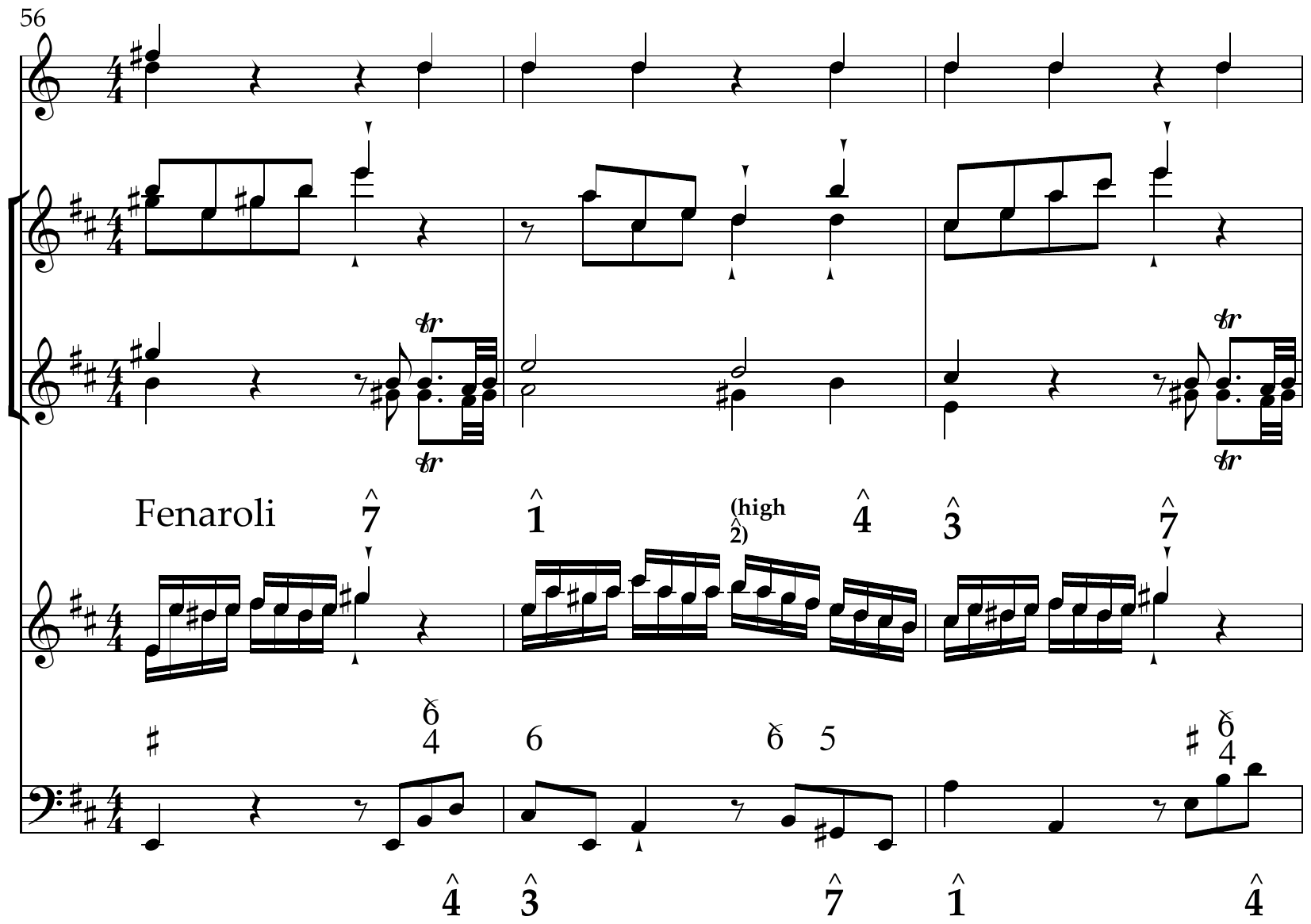
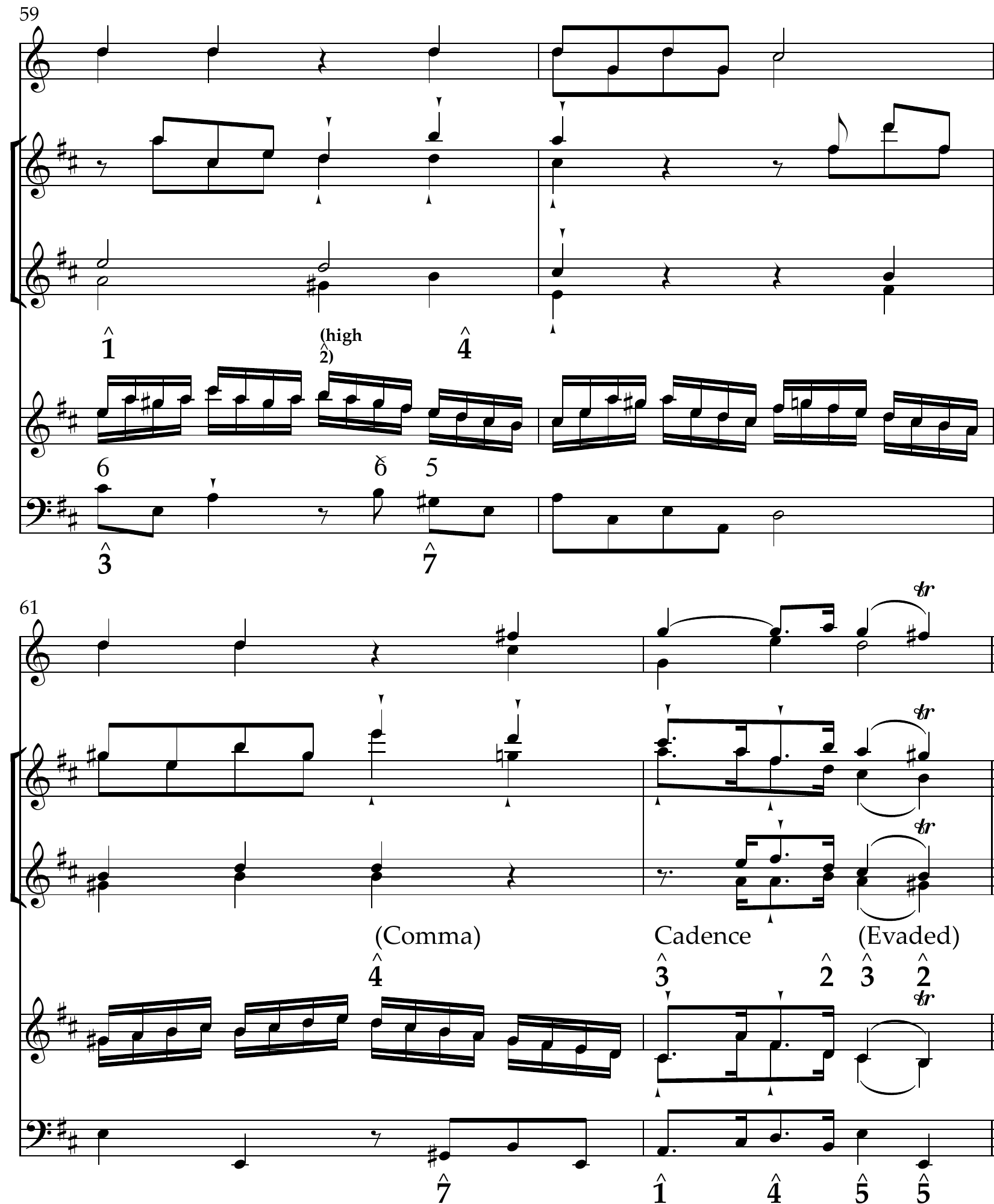
C. P. E. Bach, Symphony in D Major, Wq. 183/1, first movement, mm. 56–62.
The twofold repetition of the schema is also felicitous for compositional problem solving. While the opening three eighth-note strokes had always sounded like an upbeat—which remains the case here—the Fenaroli affords parallelism in congruence with the piece’s notated meter through its characteristic repetitions. The harmonic framework (in essence, repeated V7–I motions in some inversion) affords chord changes that also align clearly with the notated meter. This, too, contrasts with the metrically murky chord changes of the opening D-major wave, as well as with the lack of chord changes within the following B-minor wave. Needless to say, the Fenaroli appears long after the meter has been established perceptually, yet it elegantly solves one of the opening compositional problems, that of fitting the inchoate six-stroke idea into a conventional schema realized in congruence with the notated meter.
A Final Flourish
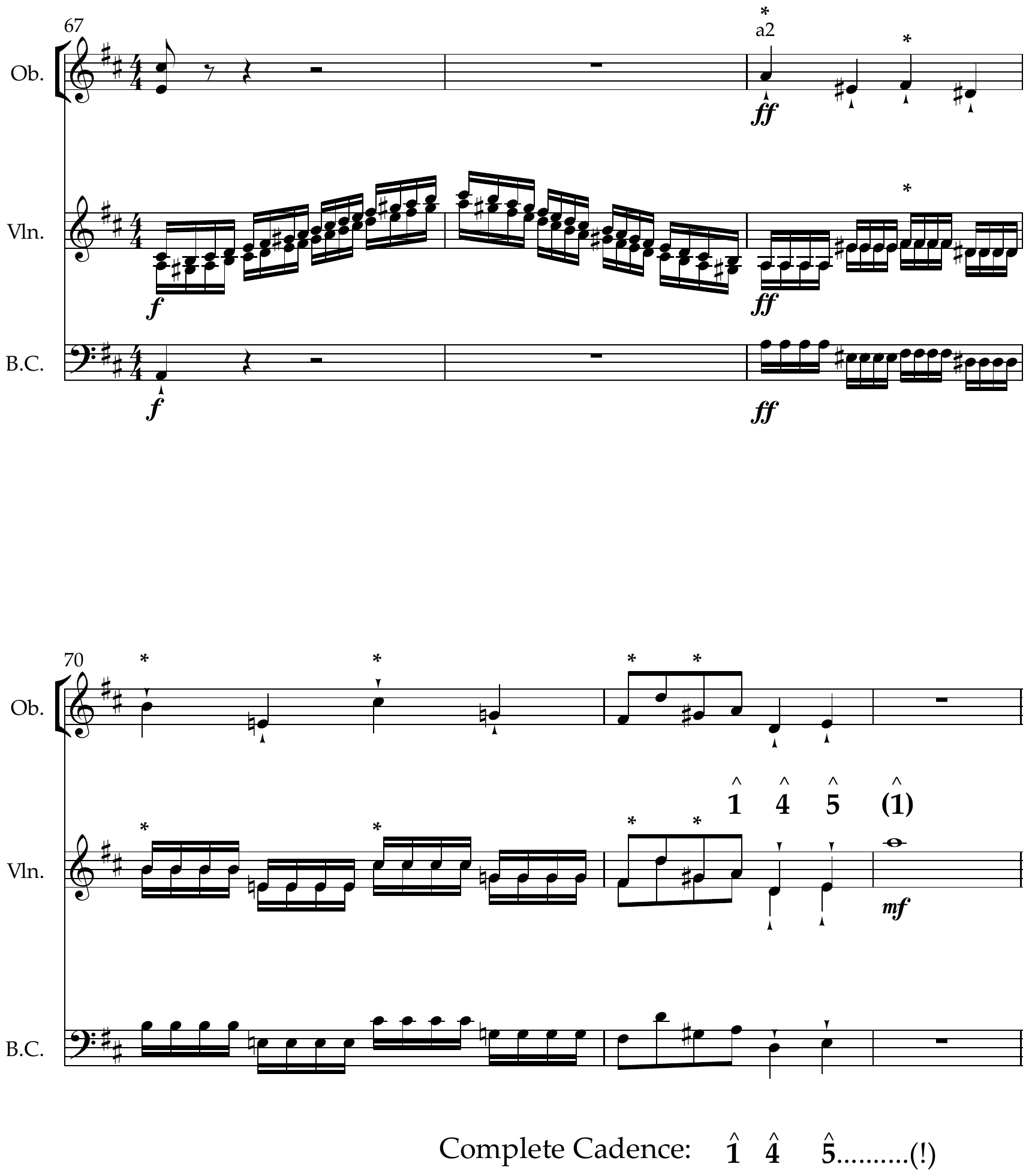
With the Fenaroli, we have seen how the artisanal hammer strokes were converted into an inter-opus schema. Before driving toward a definitive final cadence for the exposition, the violins engage in an energizing flourish (Example 15). The up-and-down figures of mm. 67–68 articulate a parallelism on the level of an entire measure and bring to mind Kirnberger’s metaphor of an undivided motion through space. After that point, up-and-down gestures in mm. 69–70 create parallelism on the level of a half measure; the opening of m. 71 suggests a subdivision into quarter notes. The idea of rhythmic diminution and augmentation—involving various metric levels—is revisited here one more time before the exposition comes to its elided cadential close. Bach revisits such play between undivided motion and cadential schemata in the symphony’s Finale (not shown). At its conclusion (mm. 102–13), an undifferentiated 13-note ascent culminates in , which triggers a further ascent through –––, that is, a Deceptive Cadence bass schema string, followed by ––, a Complete Cadence (Gjerdingen 2007). The swarm of undifferentiated sixteenth notes leads to a (“statistical”) local high point on , which initiates a conventional Deceptive Cadence–Complete Cadence schematic pairing. Of course, the understanding that the high point on is a detached, activating schema event can happen only in retrospect, as the formulaic succession of scale degrees, –– and ––, brings the Finale to a close.
Conclusion
Our analytical journey through Bach’s symphonic exposition is now complete. As the opening tonal and metric problems subside once the Prinner-riposte leads the piece safely to a home-key Quintabsatz, the piece revisits some of the same opening materials in more conventional guises as part of the script of resting points of a galant sonata exposition: the ambiguous fantasy-like gestures are now clearly embedded in the notated meter, in the expected tonal course of events, and in the punctuation script of the galant sonata exposition. Materials that were enigmatic at first find a conventional, schematic (or formulaic) place, thereby solving the compositional problems of the beginning of the piece. Thus, the exposition provides an intriguing listening puzzle for various types of listeners: it is likely that many listeners can appreciate the resolution of the meter-finding problem, while other patterns (e.g., galant schemata embedded within a particular formal position) would be more recognizable to those more intimately familiar with the galant style. I hope that my analytical exploration encourages others to engage with this fascinating piece and offer further, even divergent interpretations of it.
A secondary thread explored here is the possibility that Bach intended the symphony as a compositional commentary on Kirnberger’s ideas. Though it seems risky to argue that a symphony movement is a coded theoretical commentary, several factors hint that a connection is possible. As Ferris (2000) stresses, Bach’s late addition to the free-fantasy chapter was a rare occasion in which the composer engaged directly in a theoretical polemic. Bach’s compositional play in this movement suggests an equivalence between metric play and tonal deception, perhaps reacting to emerging theoretical notions about meter. Moreover, the bassoon’s galant line pitted against the oboes’ strict counterpoint also suggests an engagement of Kirnberger’s ideas about dissonance treatment. While my observations are surely speculative, I hope to have made a plausible case that the piece provides not only an exciting listening journey, but perhaps also a composed reflection on theoretical issues.
Works Cited
Albrechtsberger, Johann Georg. [1793] ca. 1807. Ausweichungen von C-dur und C-moll in die übrigen Dur- und Moll-Töne. Leipzig.
Bach, Carl Philipp Emanuel. 1753–62. Versuch über die wahre Art das Clavier zu spielen. 2 vols. Berlin.
Bach, Carl Philipp Emanuel. [1753–62] 1949. Essay on the True Art of Playing Keyboard Instruments. Translated and edited by William J. Mitchell. Norton.
Bach, Carl Philipp Emanuel. 1994. Briefe und Dokumente: Kritische Gesamtausgabe. Edited by Ernst Suchalla. Vandenhoeck und Ruprecht.
Bach, Carl Philipp Emanuel. 1997. The Letters of C. P. E. Bach. Translated and edited by Stephen L. Clark. Clarendon Press.
Bach, Carl Philipp Emanuel. 2005. The Complete Works. Vol. III/3, Orchester-Sinfonien mit zwölf obligaten Stimmen: Wq 183. Edited by David Kidger. https://www.cpebach.org/toc/toc-III-3.html.
Browne, Richmond. 1981. “Tonal Implications of the Diatonic Set.” In Theory Only 5 (6–7): 3–21.
Burstein, L. Poundie. 2020. Journeys Through Galant Expositions. Oxford University Press.
Byros, Vasili. 2012. “Meyer’s Anvil: Revisiting the Schema Concept.” Music Analysis 31 (3): 273–346.
Byros, Vasili. 2022. “Of Elegant Tones and Fantastical Progressions: A Historical, Schema-Based, and Comprovisational Perspective on Diminished Seventh-Chord Modulation, c. 1720–1830. Or, an Exercise in corporis studium.” In The Oxford Handbook of Music and Corpus Studies, edited by Daniel Shanahan, John Ashley Burgoyne, and Ian Quinn. Oxford University Press. https://doi.org/10.1093/oxfordhb/9780190945442.013.27
Caplin, William E. 1998. Classical Form: A Theory of Formal Functions for the Instrumental Music of Haydn, Mozart, and Beethoven. Oxford University Press.
Caplin, William E. 2015. “Harmony and Cadence in Gjerdingen’s ‘Prinner.’” In What Is a Cadence? Theoretical and Analytical Perspectives on Cadences in the Classical Repertoire, edited by Pieter Bergé and Markus Neuwirth, 17–58. Leuven University Press.
Ferris, David. 2000. “C. P. E. Bach and the Art of Strange Modulation.” Music Theory Spectrum 22 (1): 60–88.
Gjerdingen, Robert O. 2007. Music in the Galant Style. Oxford University Press.
Haimo, Ethan. 1996. “Atonality, Analysis, and the Intentional Fallacy.” Music Theory Spectrum 18 (2): 167–199.
Hamilton, Kenneth. 2008. After the Golden Age: Romantic Pianism and Modern Performance. Oxford University Press.
Hepokoski, James, and Warren Darcy. 2006. Elements of Sonata Theory: Norms, Types, and Deformations in the Late-Eighteenth-Century Sonata. Oxford University Press.
Kirnberger, Johann Philipp. 1982. The Art of Strict Musical Composition. Translated by David Beach and Jürgen Thym. Yale University Press.
Kirnberger, Johann Philipp, and Johann Abraham Peter Schulz. 1774. “Rhythmus.” In Allgemeine Theorie der schönen Künste, by Johann Georg Sulzer, 2:975–985. Leipzig.
Kirnberger, Johann Philipp, and Johann Abraham Peter Schulz. [1794] 1967. “Rhythmus.” In Allgemeine Theorie der schönen Künste, 4th ed., by Johann Georg Sulzer, 4:90–105. Olms.
Klorman, Edward. 2016. Mozart’s Music of Friends: Social Interplay in the Chamber Works. Cambridge University Press.
Koch, Heinrich Christoph. 1782–93. Versuch einer Anleitung zur Composition. 3 vols. Leipzig.
Krebs, Harald. 1999. Fantasy Pieces: Metrical Dissonance in the Music of Robert Schumann. Oxford University Press.
Lerdahl, Fred, and Ray Jackendoff. 1983. A Generative Theory of Tonal Music. MIT Press.
London, Justin. 2012. Hearing in Time: Psychological Aspects of Musical Meter. 2nd ed. Oxford University Press.
Long, Rebecca. 2024. “Mid-Exposition Modal Contrast and Francesco Galeazzi’s ‘Characteristic Passage.’” Music Theory Online 30 (3).
Meyer, Leonard B. 1989. Style and Music: Theory, History, and Ideology. University of Pennsylvania Press.
Meyer, Leonard B. 1998. “A Universe of Universals.” Journal of Musicology 16 (1): 3–25.
Mirka, Danuta. 2009. Metric Manipulations in Haydn and Mozart: Chamber Music for Strings, 1787–1791. Oxford University Press.
Schmalfeldt. Janet. 2011. In the Process of Becoming: Analytic and Philosophical Perspectives on Form in Early Nineteenth-Century Music. Oxford University Press.
Temperley, David. 2008. “Hypermetrical Transitions.” Music Theory Spectrum 30 (2): 305–25.
Wollenberg, Susan. 2007. “‘Es lebe die Ordnung und Betriebsamkeit! Was hilft das beste Herz ohne Jene!’: A New Look at Fantasia Elements in the Keyboard Sonatas of C. P. E. Bach.” Eighteenth-Century Music 4 (1): 119–28.
Yust, Jason. 2018. Organized Time: Rhythm, Tonality, and Form. Oxford University Press.