Table of Contents
Acknowledgements: Caroline Traube co-authored an earlier version that we presented at the Timbre and Orchestration in Popular Song conference at McGill University in June 2025. I am grateful to her for her initial collaboration and ongoing contributions. I also had guidance from many other people, including Joseph N. Straus, Mark Spicer, L. Poundie Burstein, Lynne Rogers, Lindsey Reymore, Timothy Koozin, Richard Ashley, Michael Kinney and the Musicking in Old Age Study Group, Lloyd Whitesell, Nicole Biamonte, Mohamed (Moe) Touizrar, Julian Bennett Holmes, Joseph Vaz, and Monica Caverson. Yike Zhang expertly engraved examples 3, 6, 7, 10, 11, and 12, and Greta White illustrated example 14. I am grateful to Eron Smith (MTSNYS Awards Editor), the Theory and Practice editorial team, and the MTSNYS leadership team for supporting my work.
A lot of the very high end is gone . . . but I do have this rich alto voice, which is unharmed. . . . [It] brings a different perspective to some of these songs that I frankly like better, and so do many other people.
—Joni Mitchell (2004)
Joni Mitchell, best known for her innovative and distinctive songwriting, possesses a highly recognizable singing voice that has undergone major sonic change throughout her career. Reviewers have commented on Mitchell’s vocal timbre since the start of her career, calling her voice “crystal clear” (1966), “utterly relaxed” (1976), “shimmering” (1988), “hoarse” (1991), “dusky” (2000), “husky” (2002, 2008), and “deep and expressive” (2024) at various points (Clarke 2002; E. Gardner 2000; Givens [1991] 2000; Kaufman 2024; Lott [1976] 2000; Nash 1988; Variety [1966] 2001; Whitesell 2008). While Mitchell continued releasing studio albums until 2007, reviewers began to comment on her vocal evolution rather than exclusively discussing her voice in its own terms. These reviews range from positive to negative. David Yaffe (2023) wrote about Mitchell’s 2022 Newport performance, “While her voice remained deeper, it has gotten much clearer, and much more supple.” In a review of Taming the Tiger, Stuart Maconie wrote, “She’s never sung better, either, the clear and precise enunciations now gone nicely husky” (Maconie [1998] 2017, 211). In a 2014 article, Renee Montagne wrote, “She’s luxuriated in a voice that got deeper with age” (Mitchell 2014).
Some reviews have focused on perceived age-related changes in her vocal production, suggesting that age and lifestyle have improved or, more commonly, worsened Mitchell’s voice. Stephen Holden, in a review of Both Sides Now in the New York Times, writes, “The craggy alto . . . is so changed from the sweetly yodeling folk soprano of her earliest albums that it hardly seems possible that the two sounds could have come from the same body. . . . You can hear the toll of all those cigarettes” (Holden 2000). Betty Clarke (2002) writes the following in her review of Travelogue: “If the health warning isn’t enough to put you off cigarettes, the nicotine-ravaged vocals of the once angelic, now gasping Joni Mitchell should. Mitchell’s voice is a husky shadow of its former feather-light glory.” Many reviews discuss Mitchell’s voice in reductive binaries of young to old and high to low pitch, and frequently without specific sonic descriptors (Elliott 2015; Holden 2000; Mitchell 2014; Whitesell 2008; Yaffe 2023). Together with critical reception of Mitchell’s later studio albums, old has sometimes been equated with worse.
In this article, I study nuances in Joni Mitchell’s voice to chart transformation of pitch and timbre. There has been change in Mitchell’s voice, and these changing features tied to age or lifestyle do not fully determine Mitchell’s sound, but rather they create conditions of possibility for creative decision making. I assert that through all her periods, Mitchell has both shaped and responded to changes in her voice, drawing on rich vocal resources to achieve expressive effects that interest her. These effects, especially the deepening and darkening of her voice as suggested by the epigraph, are purposefully compatible with the topics Mitchell chose to explore in her latest albums of original music, such as war and climate change. Mitchell has written and performed political songs throughout her career, such as “Big Yellow Taxi” (1970). Notably, these topics became the focus of later music, especially on Shine (Gumbel 2007). The purpose of this research is to study vocal timbre as a dynamic and evolving element of an artist’s sound, with an emphasis on aging as a natural and complex facet of the voice. By examining Mitchell’s oeuvre, this article proposes a methodological framework for analyzing the aging voice.
Background
Joni Mitchell was born in 1943 in Fort Macleod, Alberta, Canada. She has released 19 studio albums, from 1968, at the age of 25, to 2007, at the age of 64, as shown in Example 1.
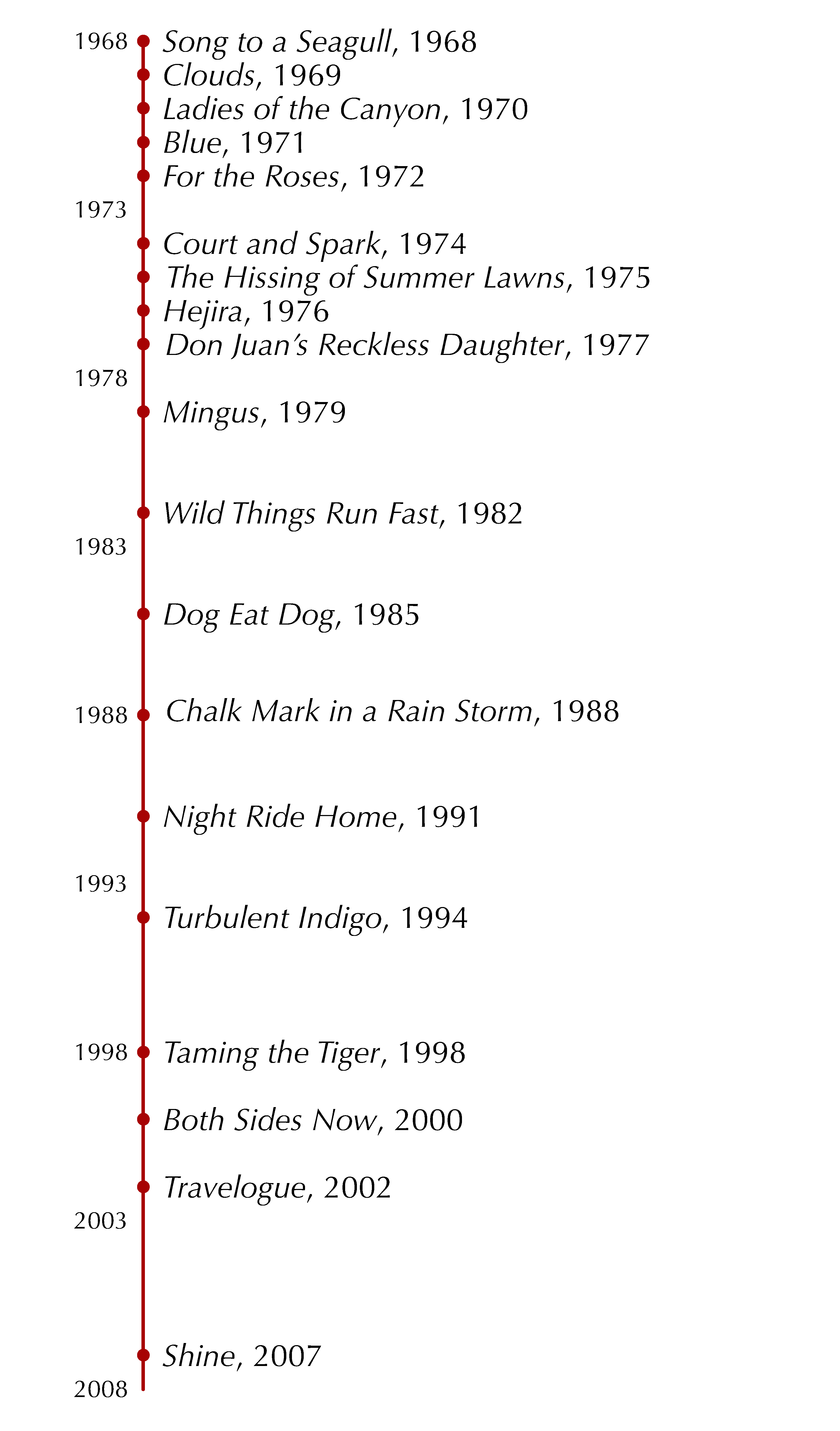
Mitchell rarely performed after the release of her last studio album, Shine (2007), and then halted performances completely in 2015 after suffering a brain aneurysm, which impacted her ability to speak and walk. After a period of recovery, she returned to performing in 2022 with a surprise appearance at the Newport Folk Festival. She has performed publicly on at least ten occasions since then, headlining two shows at the Hollywood Bowl in October 2024 and singing at the 2024 Grammy Awards. Mitchell’s consistent output across four decades (1967–2007) and return to performance in her late seventies allows for a thorough analysis of her voice over time.
Method
I use a mixed methods approach employing quantitative and qualitative analytical techniques, moving from largest to smallest scope, to: (1) analyze sung pitch ranges across Mitchell’s entire studio album output, showing that while her vocal range lowered slightly over her career, the size of her range remained relatively steady; (2) compare three recordings of “A Case of You,” showing how some elements of Mitchell’s sound are invariant while others are specific to each recording, relating to creative decisions and physiology; and (3) analyze specific vowel sounds, showing how timbre semantic descriptors are validated by the audio signal through the change of formants 1 and 2. The term “formant” will be defined in part 3 of the article. To assert claims about Mitchell’s agency in her vocal evolution, I align my analyses with her own commentary about her voice.
Part 1: Pitch Range Analysis
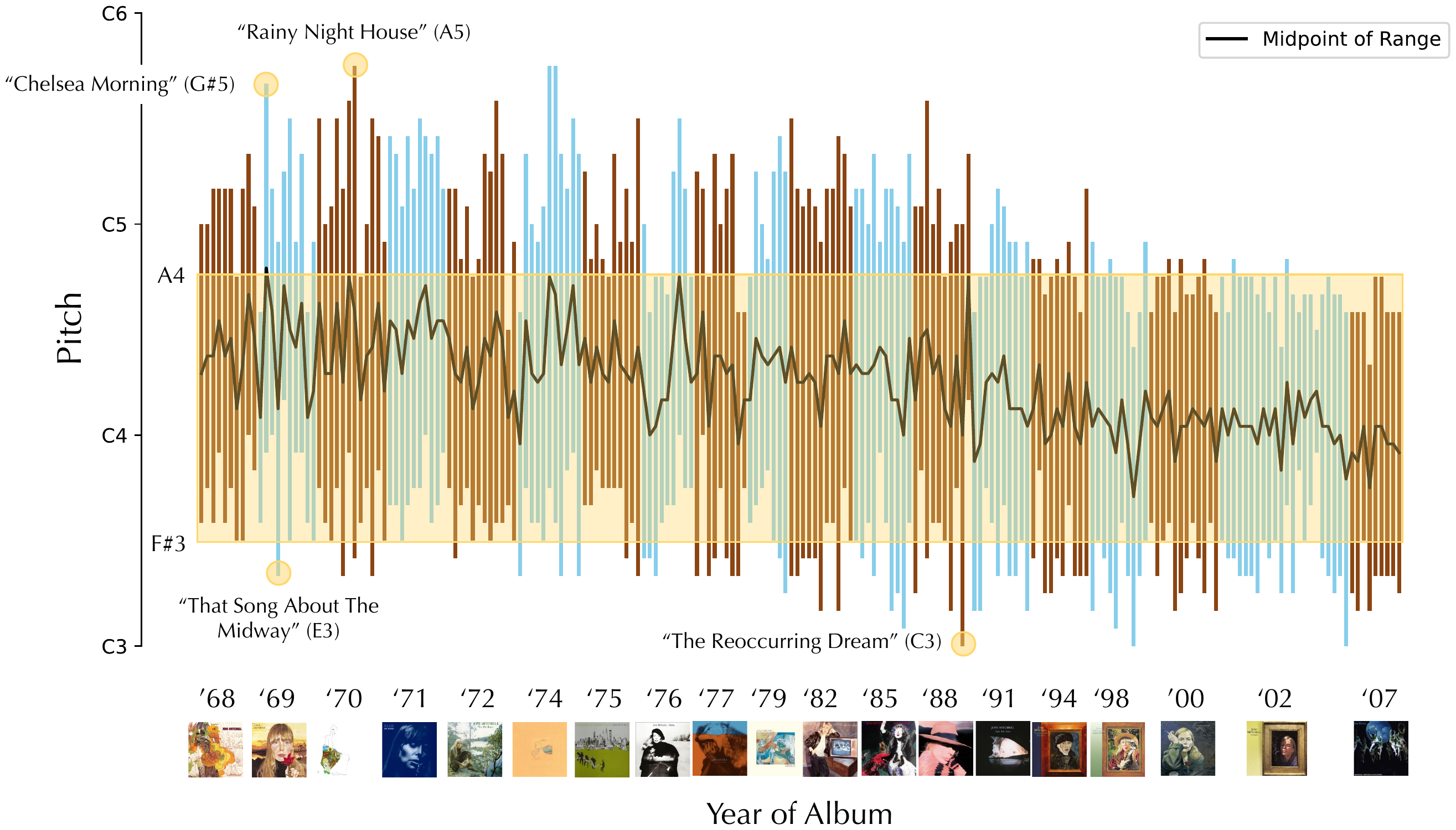
Mitchell’s vocal ranges in each of her songs from her entire studio output, which I tracked by ear, are shown in Example 2. The example reveals a downward trend in pitch ranges of approximately a tritone. Fitting a linear trendline to the midpoints of the vocal range in each of Mitchell’s songs shows that the midpoints trend downwards from approximately F♯4 to C4. A large band of pitches is sung throughout Mitchell’s entire output: around F♯3 to A4. In songs from earlier albums, Mitchell sang high notes that are absent from later albums (e.g., G♯5 in “Chelsea Morning” from Clouds and A5 in “Rainy Night House” from Ladies of the Canyon). By her later albums, starting in 1988, Mitchell sang C3, the lowest note of her range (in “The Reoccurring Dream” from Chalk Mark in a Rain Storm). Mitchell has sung lower notes outside of her studio albums; on “A Case of You” from Live at Newport (2023), she sings A♭2.
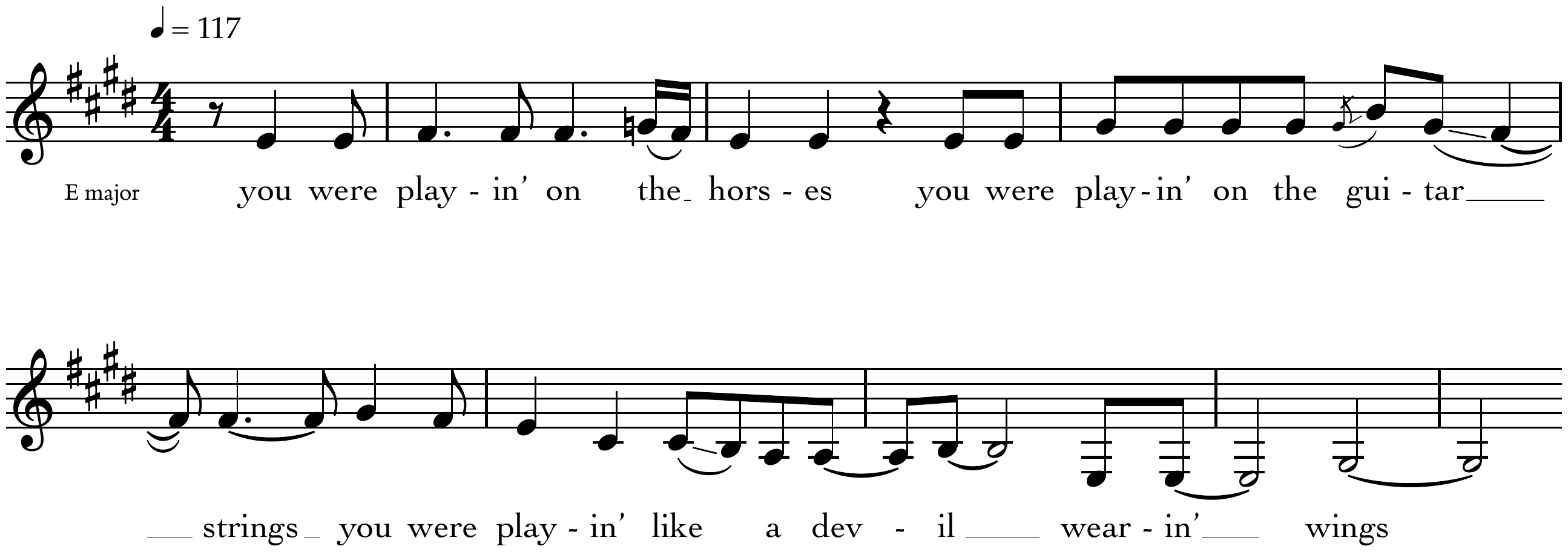
Reviews have focused on the exceptional cases from Mitchell’s output, ignoring instances of low pitch from her earlier works. In “That Song About The Midway” from Clouds, Mitchell sings an E3, as shown in Example 3.
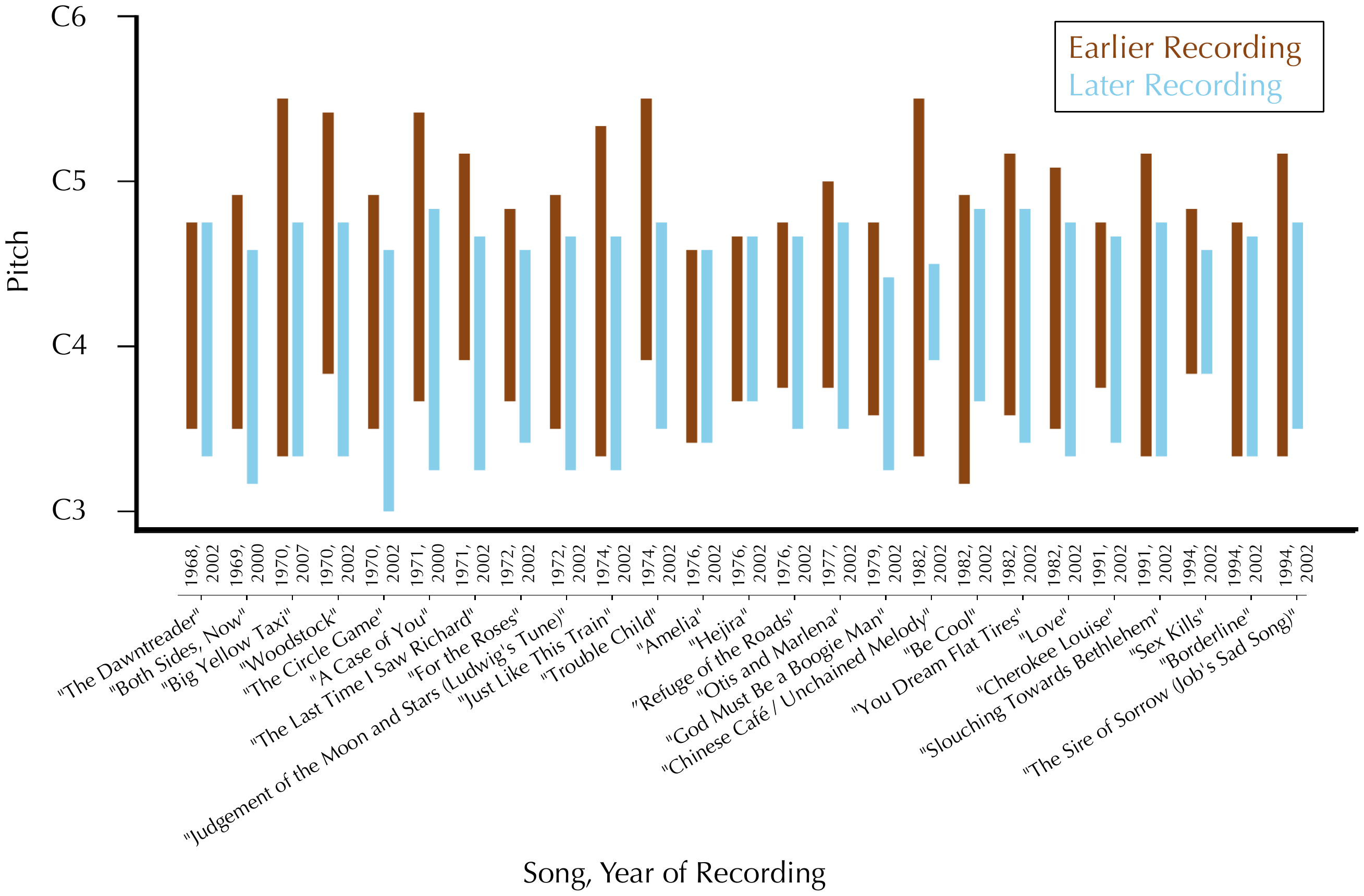
Mitchell re-recorded 25 of her songs on studio albums, as shown in Example 4. The ranges were either lower or smaller in the re-recordings in all but two cases, though often only by a few semitones. Mitchell’s ranges in the re-recordings of “Amelia” and “Hejira” match those of the original recordings.
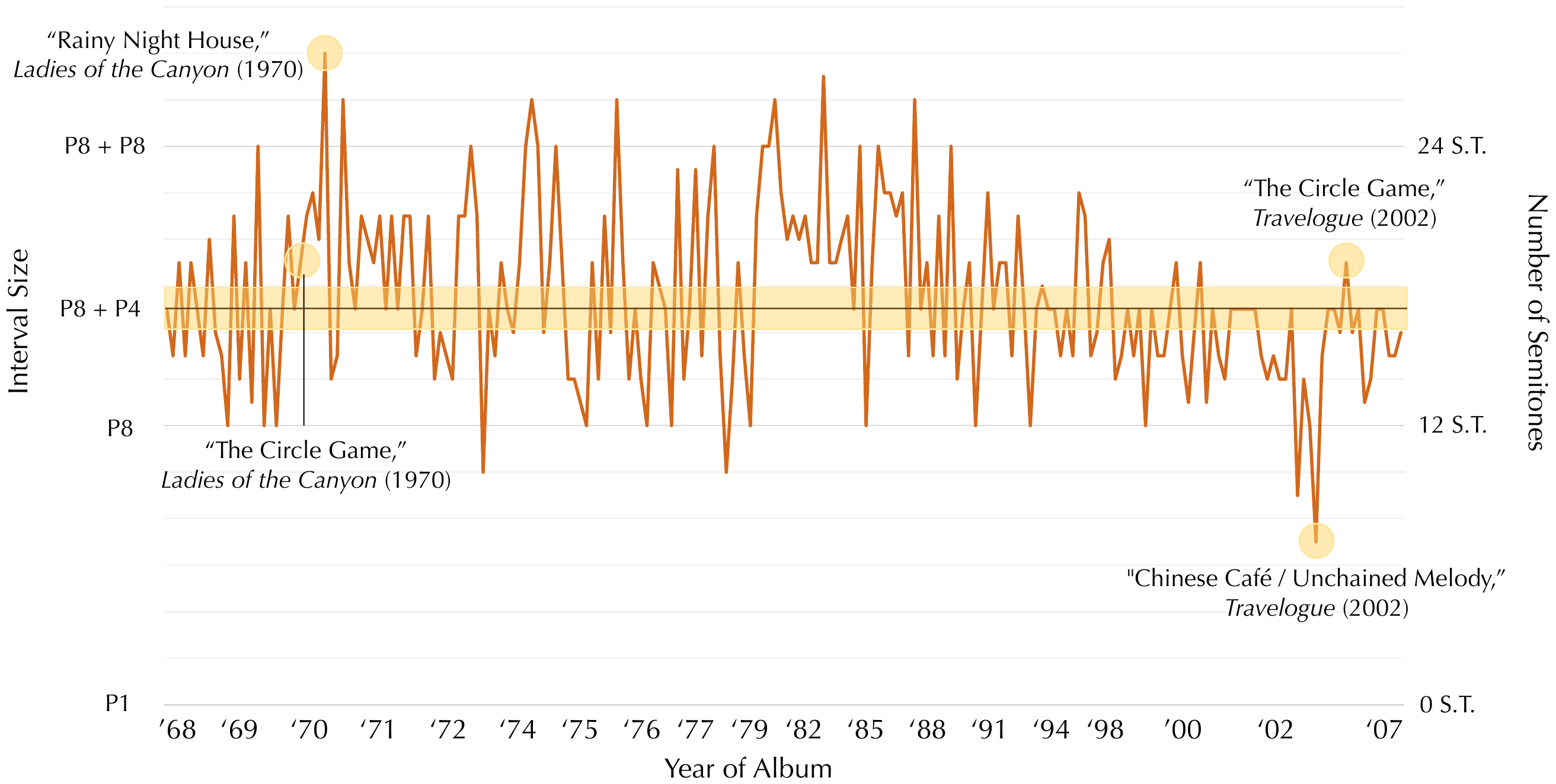
The sizes of Mitchell’s pitch range in each of her songs across her studio recordings are shown in Example 5. Her range often returns to the size of an octave plus a perfect fourth across her chronological output. Her earlier albums feature outliers of higher ranges, the highest at two octaves plus a major third (“Rainy Night House” from Ladies of the Canyon in 1970), and her later albums have outliers of lower ranges, the lowest at a perfect fifth (“Chinese Café/Unchained Melody” from Travelogue in 2002).
Mitchell sang with the greatest vocal agility in earlier albums, especially highlighted in “Big Yellow Taxi” from Ladies of the Canyon, as shown in Example 6. By vocal agility, I mean the ability to traverse wide pitch ranges with speed. Mitchell’s vocal agility in earlier albums was not without criticism, either; Tom Nolan (1975) wrote of her 1974 live album Miles of Aisles that her voice “leapt all over the place in a shrill demonstration of technique. (‘Congratulations to Joni Mitchell upon her conquest of the octave,’ Richard Goldstein wrote sarcastically of her first album.)”

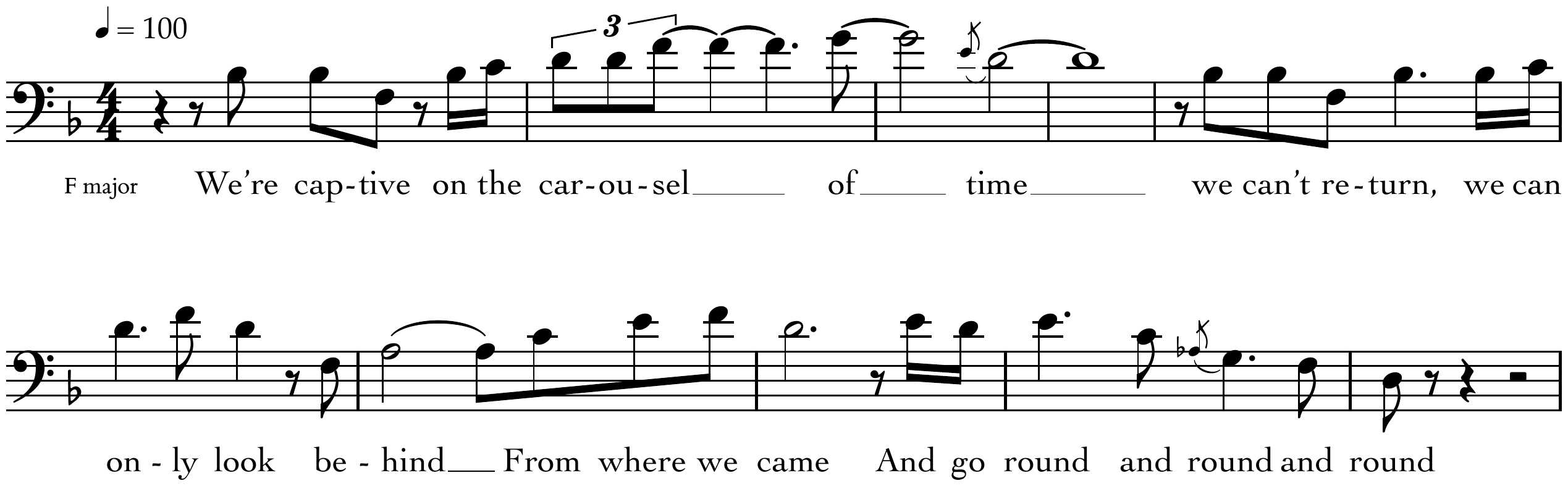
However, some critics have ignored instances of vocal agility or sizeable range from Mitchell’s later works to further the narrative that Mitchell’s voice was “losing flexibility” (Whitesell 2008). “The Circle Game” maintains the same size of range in its two versions, and in the 2002 version, Mitchell sings up to a G4 and spans an octave plus a minor third within a phrase, as shown in Example 7.
In sum, the above examples illustrate Mitchell’s pitch ranges lowering approximately a tritone with a steady central pitch band, the recurring range size of an octave plus a perfect fourth throughout her chronological output, and a move toward less vocal agility in the later studio albums. There are outliers to these trends, as shown by the low notes in early songs and the high notes and relatively agile phrases of later albums. Thus, even though some reviews prioritize descriptors that inherently relate to register, I understand them to not only refer to pitch, but also to timbre, which I examine in the rest of the article.
Part 2: Timbre Semantics Analysis
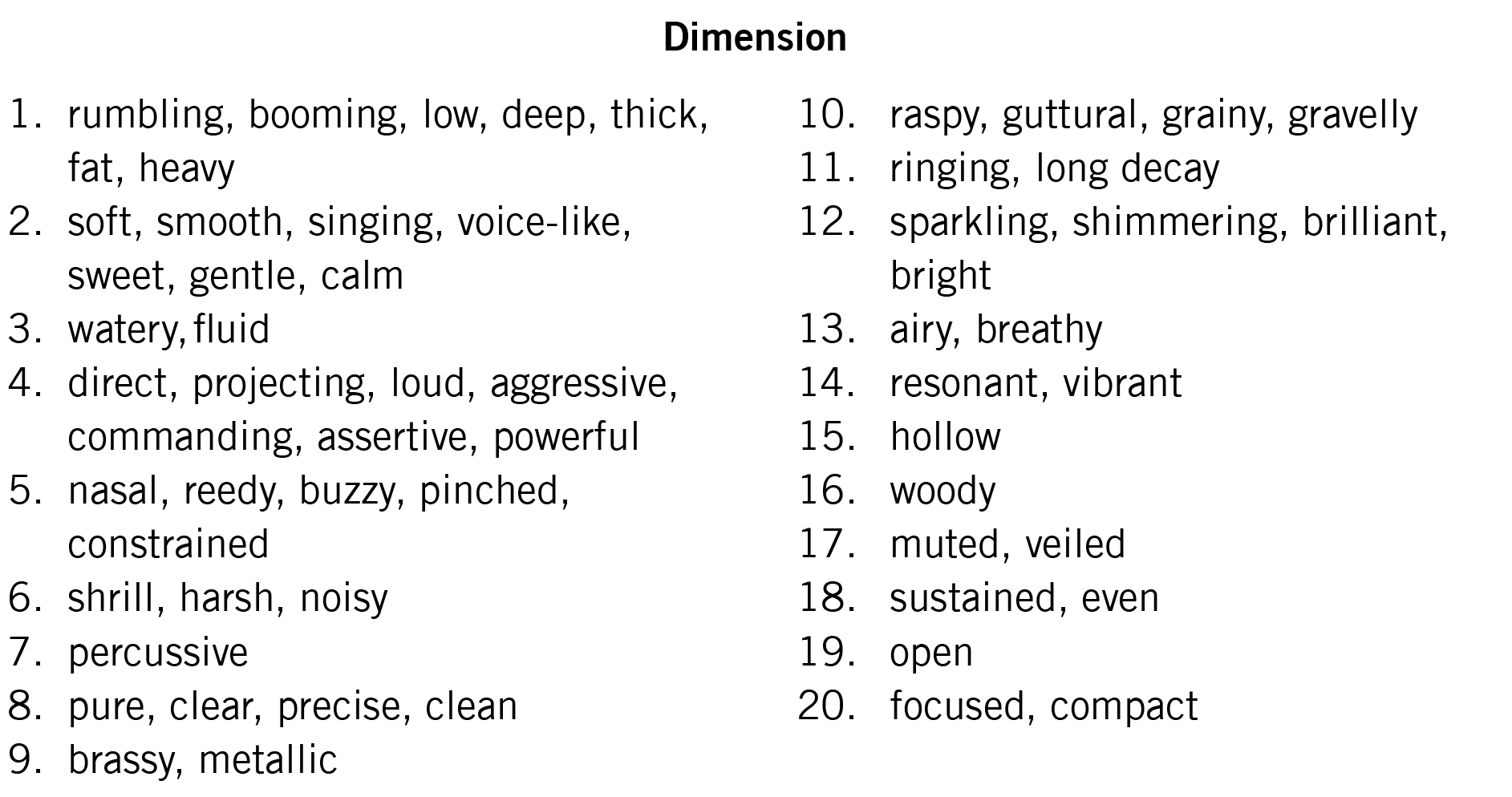
I analyze and compare three recordings and performances of the song “A Case of You,” from 1971, 2000, and 2024. I use Lindsey Reymore’s (2020) 20-dimensional timbre qualia model to qualitatively describe Mitchell’s voice, as shown in Example 8. Reymore built this model by conducting interviews (n = 23) and rating tasks (n = 460) “based on imagined instrument timbres” (Reymore 2020, ii). I indicate which descriptors I hear as prominent in each recording of “A Case of You” to describe the differences between Mitchell’s vocal timbre in specific ways, which I later assess by analyzing vowel sounds. I use my transcriptions of Mitchell’s vocal performances to illustrate her vocal evolution through specific vocal decisions. Others have written about the evolution of certain Joni Mitchell songs: Lloyd Whitesell (2008) conducts an analysis of the “evolution of Mitchell’s own conception of ‘Woodstock’” (34), Timothy Koozin (2024) analyzes recordings of Mitchell’s “Both Sides Now” from 1969, 2000, and 2022, Joanne Winning (2019) compares versions of “Both Sides Now” from 1969 and 2000, and beyond Mitchell, Steven Rings (2013) analyzes Bob Dylan’s vocal evolution through performances of the song “It’s Alright, Ma (I’m Only Bleeding)” from 1964 until 2009.
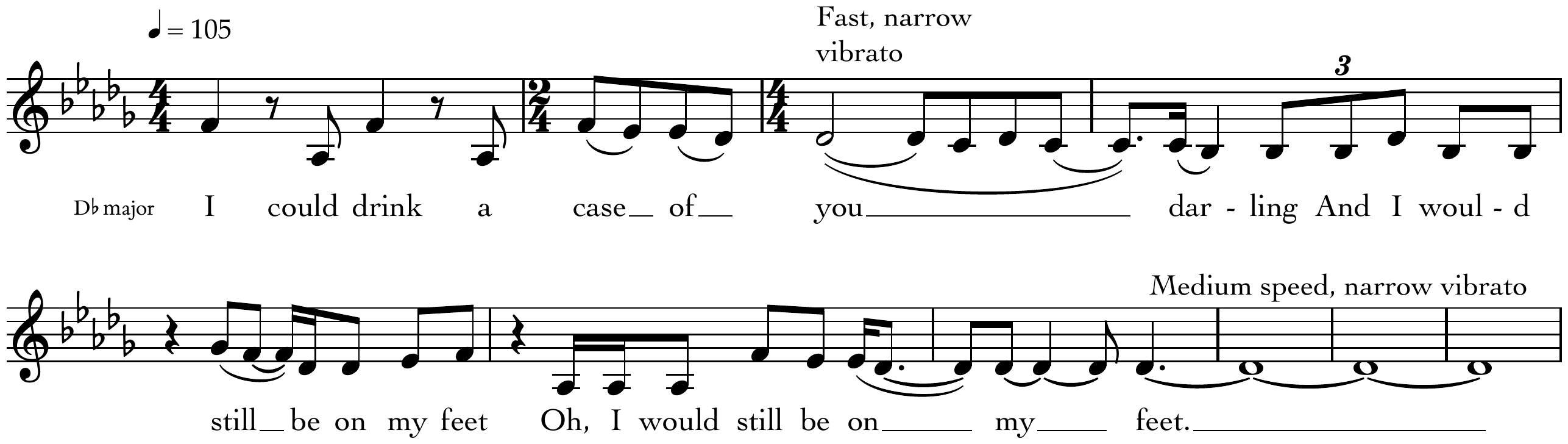
“A Case of You” from Mitchell’s album Blue (1971), recorded when Mitchell was 28, shows distinct characteristics of the folk genre and features sparse instrumentation. Mitchell performs lead vocals and Appalachian dulcimer, James Taylor performs on acoustic guitar, and Russ Kunkel performs on percussion. The song is in D-flat major, and Mitchell spans an octave plus a major sixth, a large range rather than a high register. Her voice is flexible: Mitchell switches between head voice in the high register and chest voice in the lower registers.
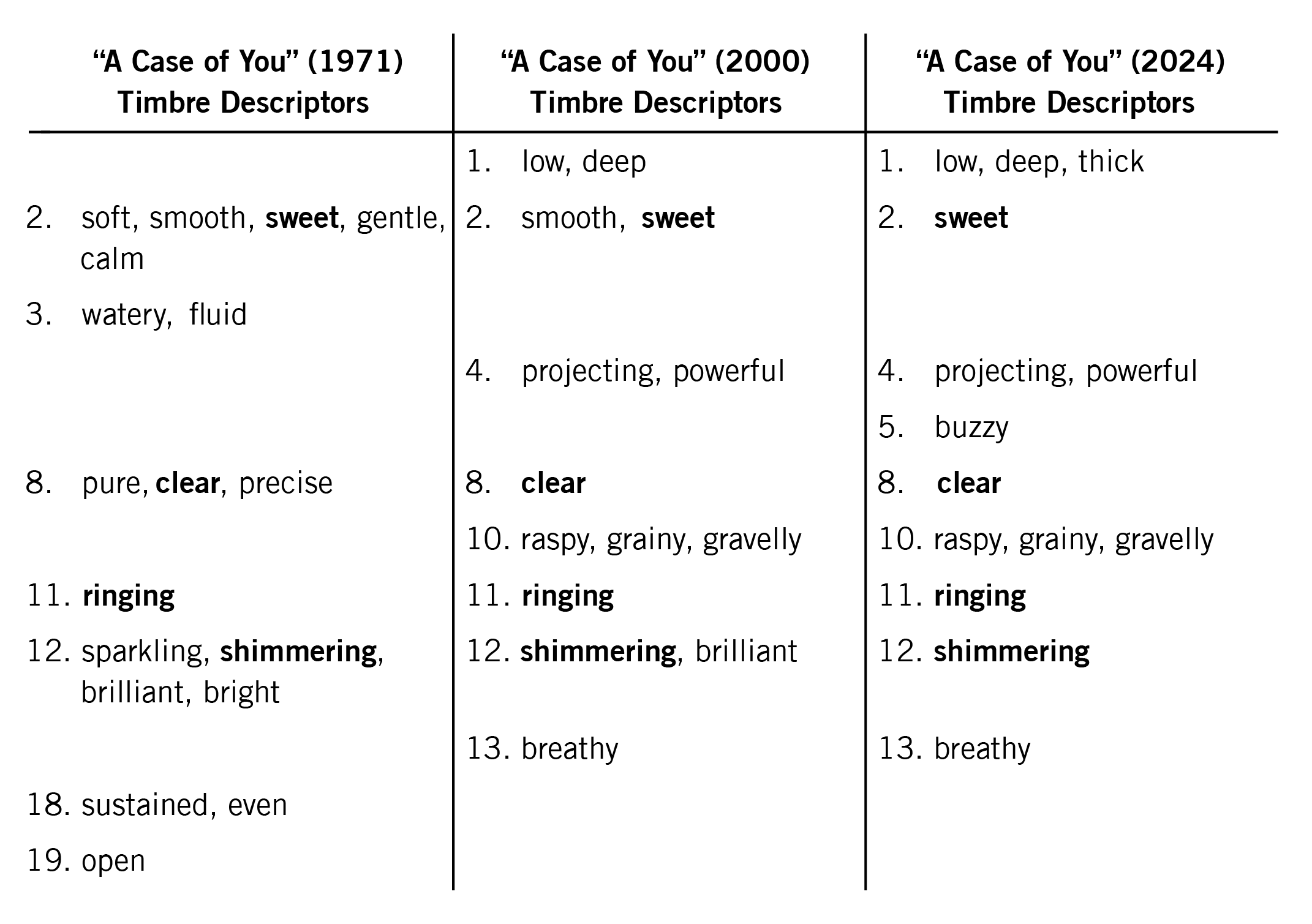
I describe Mitchell’s voice in this recording with the descriptors in the leftmost column of Example 9. Mitchell uses only slight vibrato, primarily on longer-held notes. Her vibrato is narrow in pitch and fast in speed, and this gives her voice a shimmering, sparkling quality, while notes without vibrato sound purer. Many of these vocal features are present in an excerpt from the first chorus, shown in Example 10.
Mitchell’s re-recording of “A Case of You” on her 2000 album Both Sides Now is stylistically distinct from the original, as shown in Example 11. Recorded when Mitchell was 57, it is arranged for full orchestra, in a hybrid genre space between classical and jazz. Mitchell performs lead vocals, lush strings provide the harmonies, individual woodwind instruments (e.g., flute, oboe) play solo lines, and a snare drum is played with brushes in a jazz style. This version was arranged and conducted by Vince Mendoza and performed by members of the London Symphony Orchestra alongside jazz musicians such as Wayne Shorter on saxophone. The song is now in A-flat major, a perfect fourth lower than the original. Perfect fourth transpositions are not unusual; several Genesis songs on their farewell tour (2021–22) were also lowered in key to accommodate Phil Collins’s changing vocal range, including their most successful hit, “Invisible Touch” (US #1, 1986), which was similarly lowered by a perfect fourth. Mark Spicer posits that this transposition distance around the circle of fifths is likely not a coincidence and may be less drastic for audiences (personal communication). Mitchell spans the interval of an octave plus a perfect fifth, only one whole tone smaller than in 1971. The raspiness in her voice in this recording can be heard as a musical decision to sound more like a jazz singer.
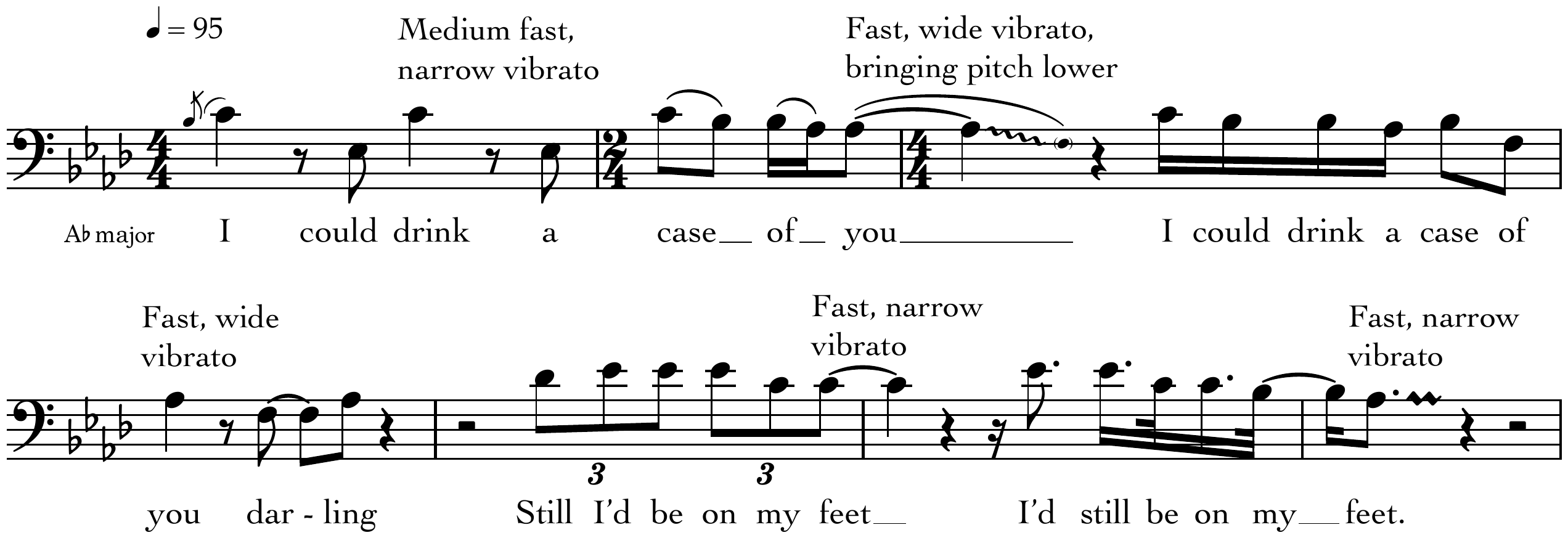
I describe Mitchell’s voice in this recording with the descriptors in the second column of Example 9. Mitchell’s vibrato is slower and wider; the oscillations often begin in tune but oscillate downward, bringing Mitchell flatter than the orchestra, whereas in 1971, her vibrato had little pitch variability. The vibrato, coupled with her voice’s markedly darker quality, contributes to the gravelly, grainy, yet still shimmering sound of her voice. While the twangy, articulated guitar and dulcimer of the original made Mitchell’s voice sound even more pure and smooth, the warm, pure strings of the 2000 recording make her voice sound rougher and raspier in comparison.
In her 2024 performance, at the age of 81, Mitchell returns to a more original styling, reminiscent of the Blue recording, as shown in Example 12. Mitchell performs lead vocals, Brandi Carlile and Marcus Mumford perform backup vocals, piano replaces dulcimer and guitar, and electric strings are featured. Mitchell again sings in D-flat major, though she sings an octave below her original range for the song. Her range is an octave plus a major third, a minor third smaller than in 2000. The vibrato Mitchell uses is also more muted than in 2000, now exclusively heard at ends of phrases.
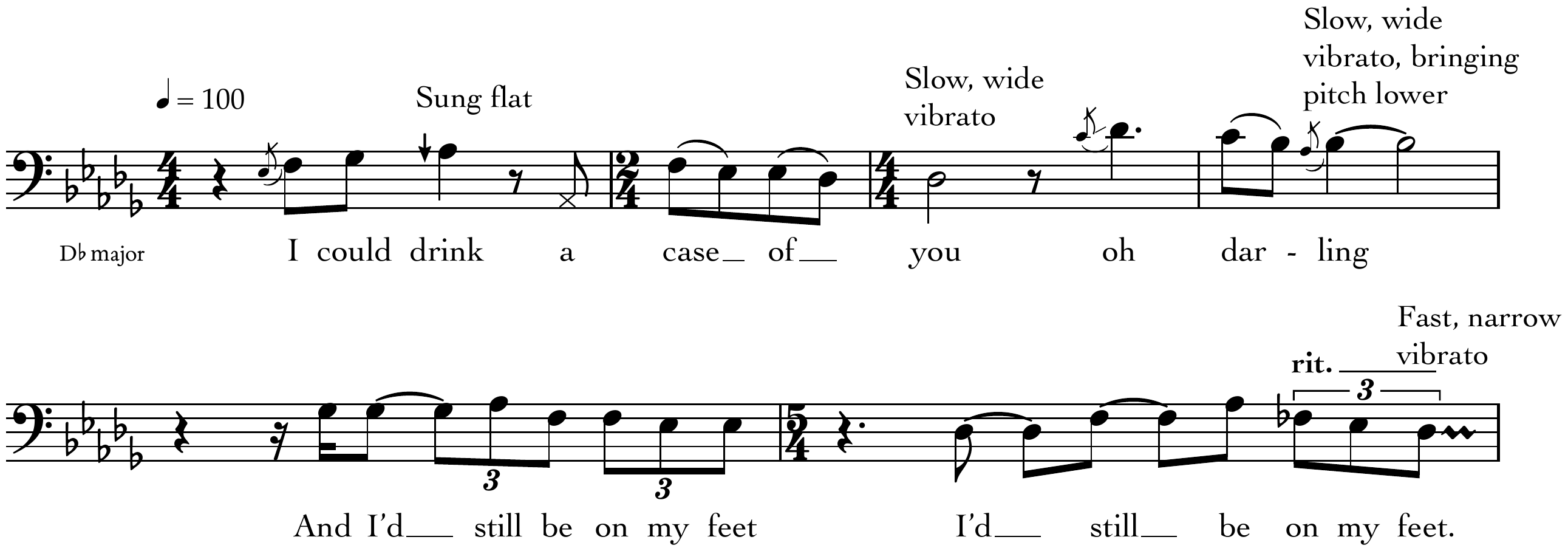
The timbral descriptors I hear in Mitchell’s 2024 performance are in the third column of Example 9. These observations were made while personally attending the live Joni Mitchell and the Joni Jam performance at the Hollywood Bowl on October 19, 2024. I hear the most similarity in her voice between her 2000 recording and 2024 performance. She performs with a buzzier and raspier voice, and her vibrato oscillations take her pitch lower, as they did in 2000. Mitchell’s phrases are shorter than they were in 2000, which in turn were much shorter than they were in 1971, and her breaths between phrases are audible. Mitchell’s agency is apparent when contrasting this performance with her 2022 performance from the Newport Folk Festival, where she mostly sang the harmony below Brandi Carlile’s melody.
The descriptors that are assigned to Mitchell’s voice in multiple recordings are shown in bold in Example 9. I consider these invariable descriptors to access the core of Mitchell’s voice, whereas descriptors unique to each recording are more tied to her voice as it relates to her stylistic decisions over time and to her age. I suggest that many of the changes in Mitchell’s vocal style and genre choices would not have happened if not for vocal damage as a motivator, and that darker, raspier effects may have caused even more damage.
Part 3: Vowel Analysis
To describe individual sounds more precisely, I tracked formant frequencies within several vowels across recordings from Joni Mitchell’s recorded output. I limited my investigation to Mitchell’s 19 studio albums and the 2023 recording of Mitchell’s 2022 appearance at the Newport Folk Festival (entitled Joni Mitchell at Newport). The purpose of this analysis is to describe how the semantic descriptors are validated in the audio signal.
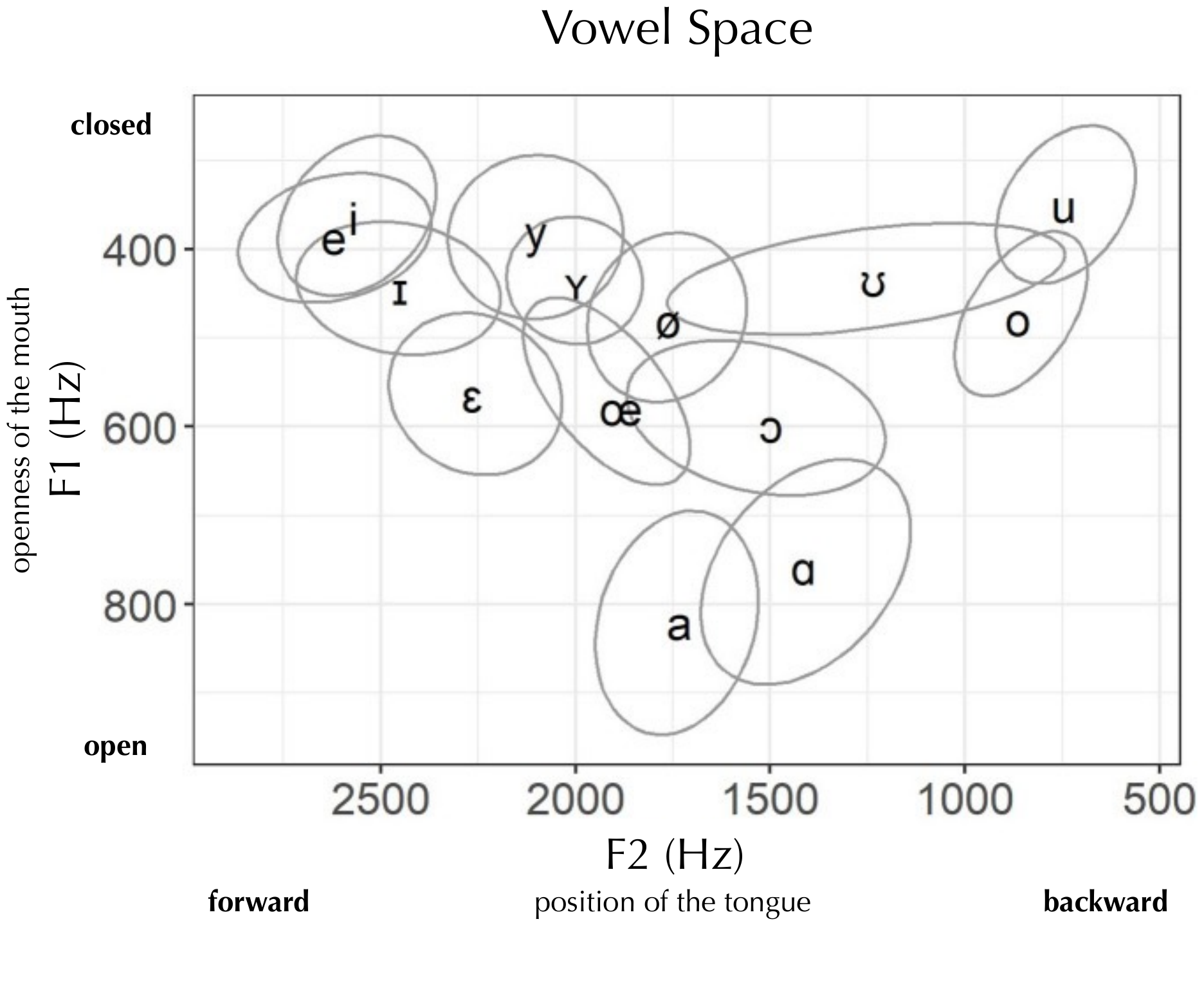
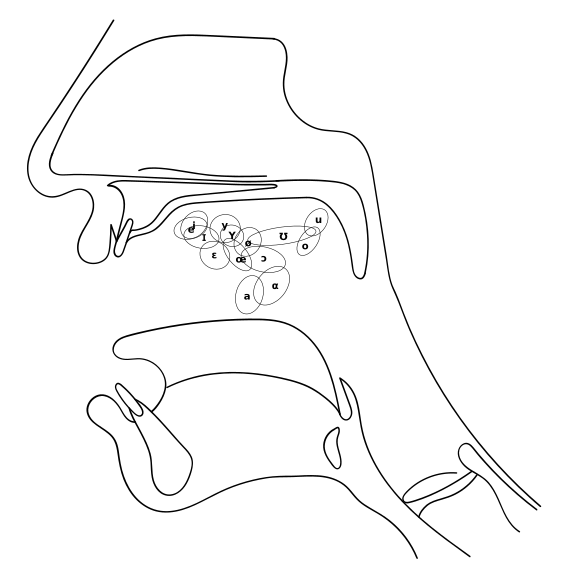
A formant is a local maximum of frequency intensity that results from an acoustic resonance of the human vocal tract (Fant 1960, 1965). The first two formant frequencies, F1 and F2, are typically sufficient to identify a vowel sound, and can be used to visualize the vowel space, as shown in Example 13. The first formant relates to the opening of the mouth, and the second formant relates to the position of the tongue, as shown in Example 14. Formant frequencies are increasingly being used as tools to analyze instrumental timbres in addition to those of the voice (Reuter et al. 2024; Reuter, forthcoming). Tracking formant frequencies of vowels enables precise comparisons of the voice across various recordings and performances. Others compare formant frequencies over time to chart the phonetic change of a specific individual: Josiane Riverin-Coutlée and Jonathan Harrington (2022) conduct a longitudinal analysis of public French speaker Michaëlle Jean, charting specific vowels present in Québécois French that are absent from other French-speaking regions. In this study, I have confined my analysis to five examples of four vowels. I used LALAL.AI to extract an isolated vocal track from the song’s original audio. In the absence of the real isolated vocals (i.e., from the producer or record company themselves), vocal tracks created using source separation software allow for reasonably accurate analysis. I then used the speech analysis software Praat to obtain the mean frequency for each formant. Praat estimates the first five formant frequencies, but I only analyzed formants 1 and 2. For each, I compared F1 and F2 on the same vowel sung at the same pitch.
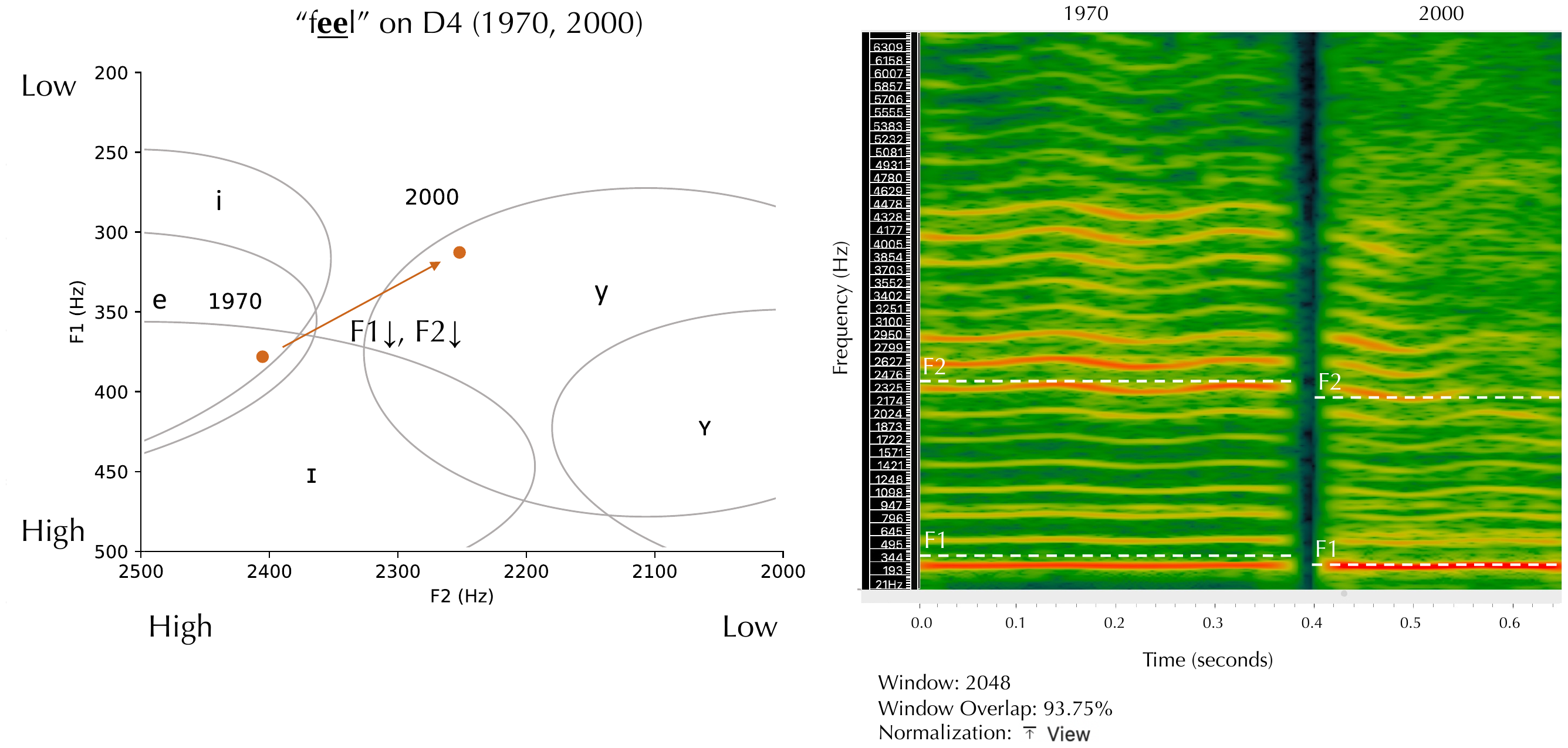
Example 15 shows how F1 and F2 change on the /iː/ vowel in the word “feel” sung on D4 from 1970 to 2000, visualized in vowel space and as a spectrogram. These vowels are from the word “feel” in “Willy” (Ladies of the Canyon) and “Both Sides Now” (Both Sides Now). Mitchell’s voice becomes grainier in the 2000 recording, compared to the more even, forward sound from 1970. Both F1 and F2 decrease from 1970 to 2000, by 17.3% and 6.4% respectively. This is aligned with my qualitative observations of Mitchell’s voice in part 2 since lower formant frequencies on the same vowel tend to indicate a darker sound (Sundberg 1970, 1973). Julie Traub Eichhorn et al. (2018) observe vowel-specific trends of women of various age groups, namely that on the vowel /iː/, F1 decreases and F2 increases from ages 20–30 to ages 40–60. Thus, the observed decrease in F1 may also be due to physiological changes in the body, such as the thinning of vocal folds. Mitchell’s decrease in F2 goes against observed norms of this vowel, potentially indicating deliberate musical decisions to sound darker on the 2000 recording.
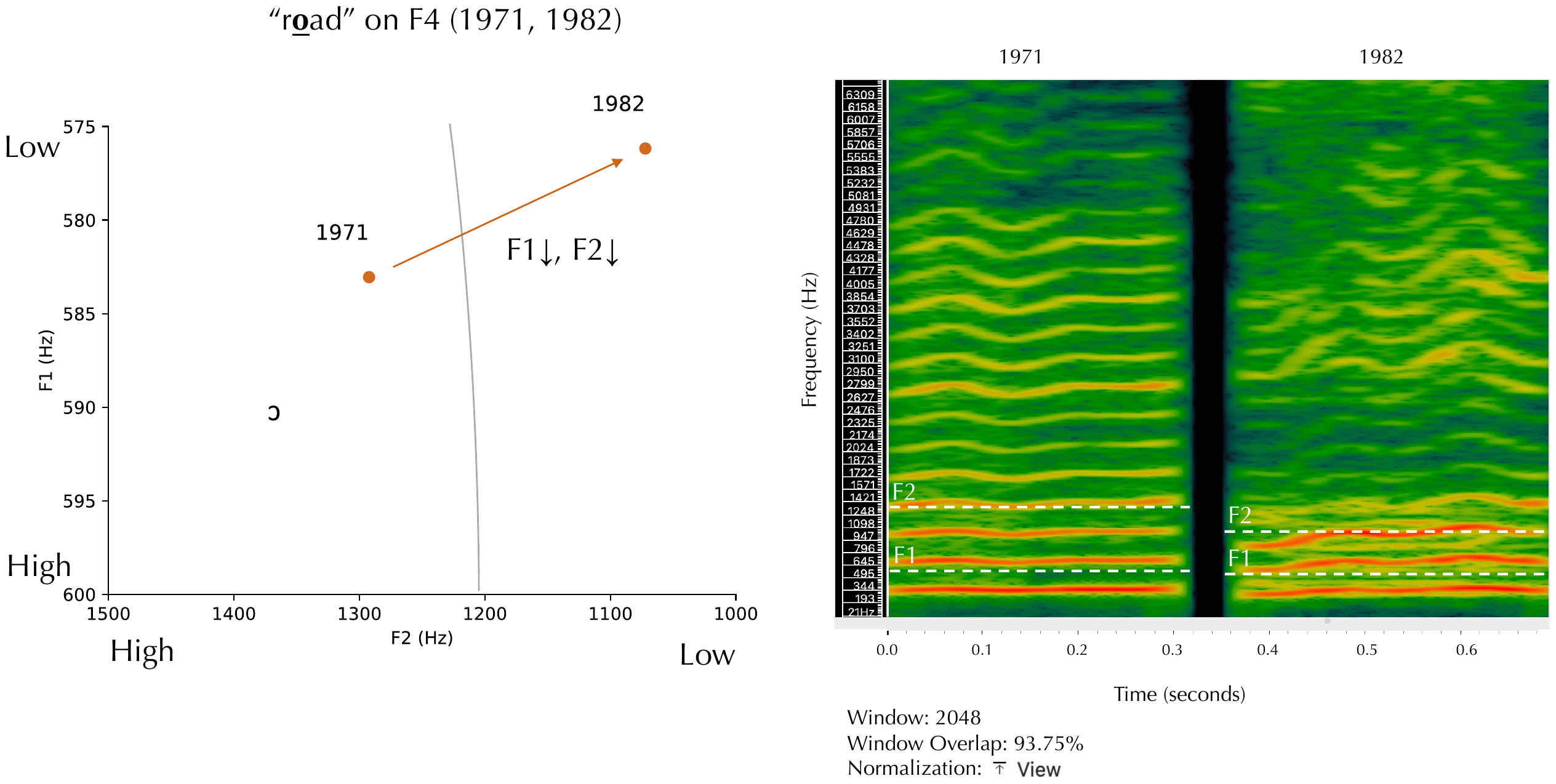
Example 16 shows how F1 and F2 change on the /o/ vowel in the word “road” on F4 from 1971 to 1982. These vowels are from the word “road” in “All I Want” (Blue) and “Wild Things Run Fast” (Wild Things Run Fast). I limited my analysis to a stable section of the diphthong: I selected only the /o/ component of the diphthong vowel by ear. Mitchell’s vowel is round and open in 1971 and more closed in 1982. Both F1 and F2 decrease, by 1.2% and 17.0% respectively, as in the previous example, relating to a darker sound. Most of the formant change occurs in F2.
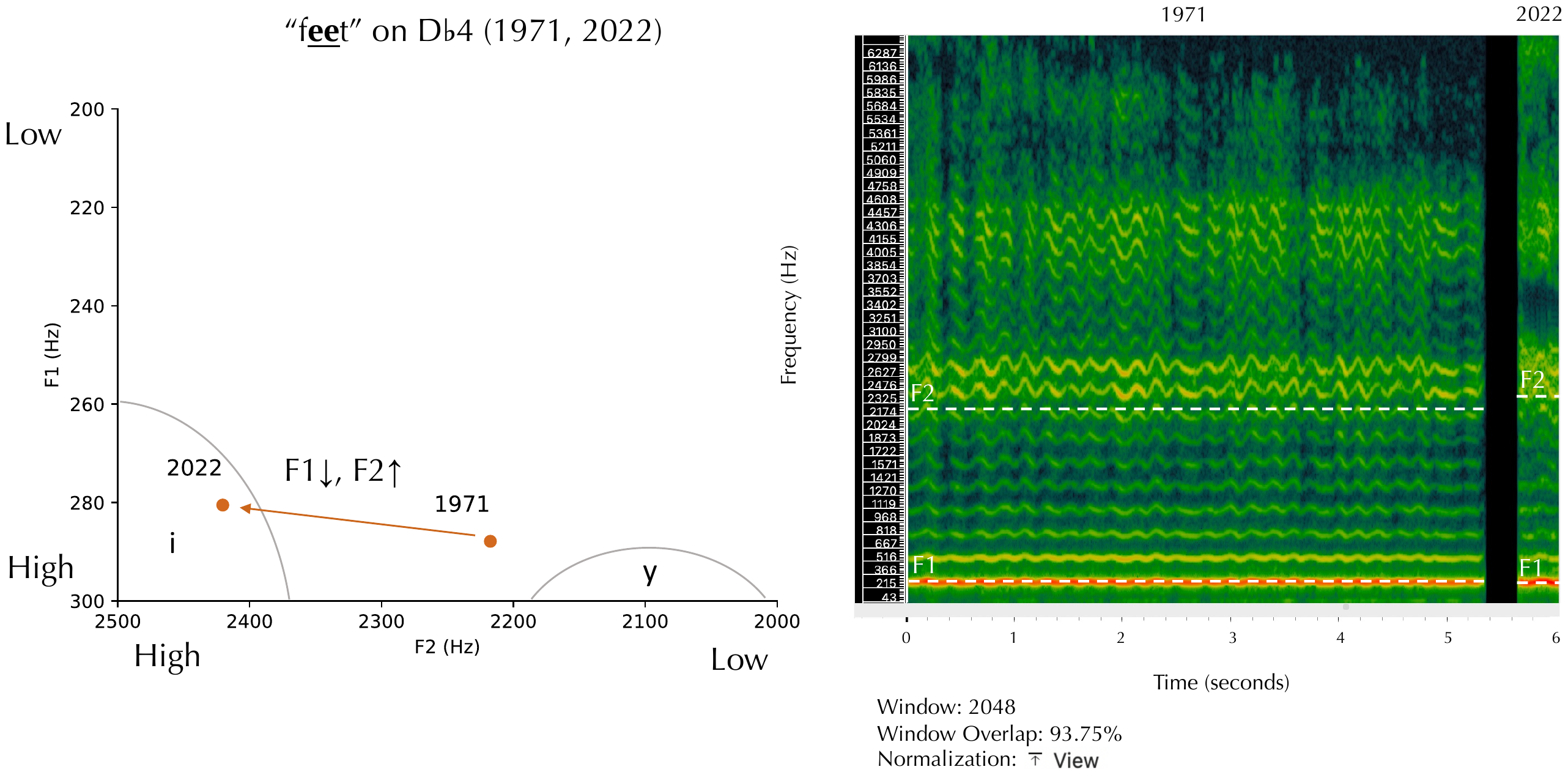
Example 17 shows how F1 and F2 change on the /iː/ vowel in the word “feet” on D♭4 from 1971 to 2022. These vowels are from the word “feet” in two different recordings of “A Case of You” (Blue, Joni Mitchell at Newport). In 1971, Mitchell sounds round and pure, whereas in 2022, she sounds rougher and more shimmering on the vowel. F1 decreases by 2.6%, while F2 increases by 9.2%. The decrease in F1 is aligned with Eichhorn et al. (2018), who observe a decrease in both F1 and F2 on the vowel /iː/ from ages 20–30 to 70+. The increase in F2 may be due to tessitura; as Mitchell’s pitch range lowered with age, the same pitch moved higher and higher within her range, and she may have had to strain more to reach this note, which tends to relate to higher formant frequencies (Garnier et al. 2010).
Example 18 shows how F1 and F2 change on the /uː/ vowel in the word “you” on D4 in 1972, 1974, 1977, 1998, 2002, and 2022. These vowels are from the word “you” in “See You Sometime” (For the Roses), “Down to You” (Court and Spark), “Jericho” (Don Juan’s Reckless Daughter), “My Best to You” (Taming the Tiger), “For the Roses” (Travelogue), and “Both Sides Now” (Joni Mitchell at Newport). I listened to each vowel to ensure that I chose sections of the diphthong that were sonically equivalent. F1 decreases from 1972 to 1977 and then increases from 1977 to 2022, while F2 increases and decreases widely between successive observations. Mitchell’s lowest F1 and F2 in 1977 and highest F1 and F2 in 2022 may indicate tenseness and laxness in Mitchell’s vocal production respectively, as tenseness is correlated with proximity to the edge of the vowel space, so formant values moving toward the center of the vowel space (most central in 2022) may indicate laxness (Slawson 1985, 55–56; Ishizaki 2025). Laxness tends to be an age-related feature of singing; the tenseness of Mitchell’s voice in Don Juan’s Reckless Daughter (both on this specific vowel and throughout the album) sounds like a stylistic decision, invoking rasp and tension, whereas recordings of this vowel after this album sound more stylistically similar to those on earlier albums, albeit with a transformed physiology. This seems to echo Mitchell’s creative styling of her versions of “A Case of You,” returning to original interpretations from 2022 onward. The increase in F1 and F2 between 2002 and 2022 may be due to tessitura, since D4 became higher within Mitchell’s range over time, perhaps implying strain and thus higher formant frequencies (Garnier et al. 2010).
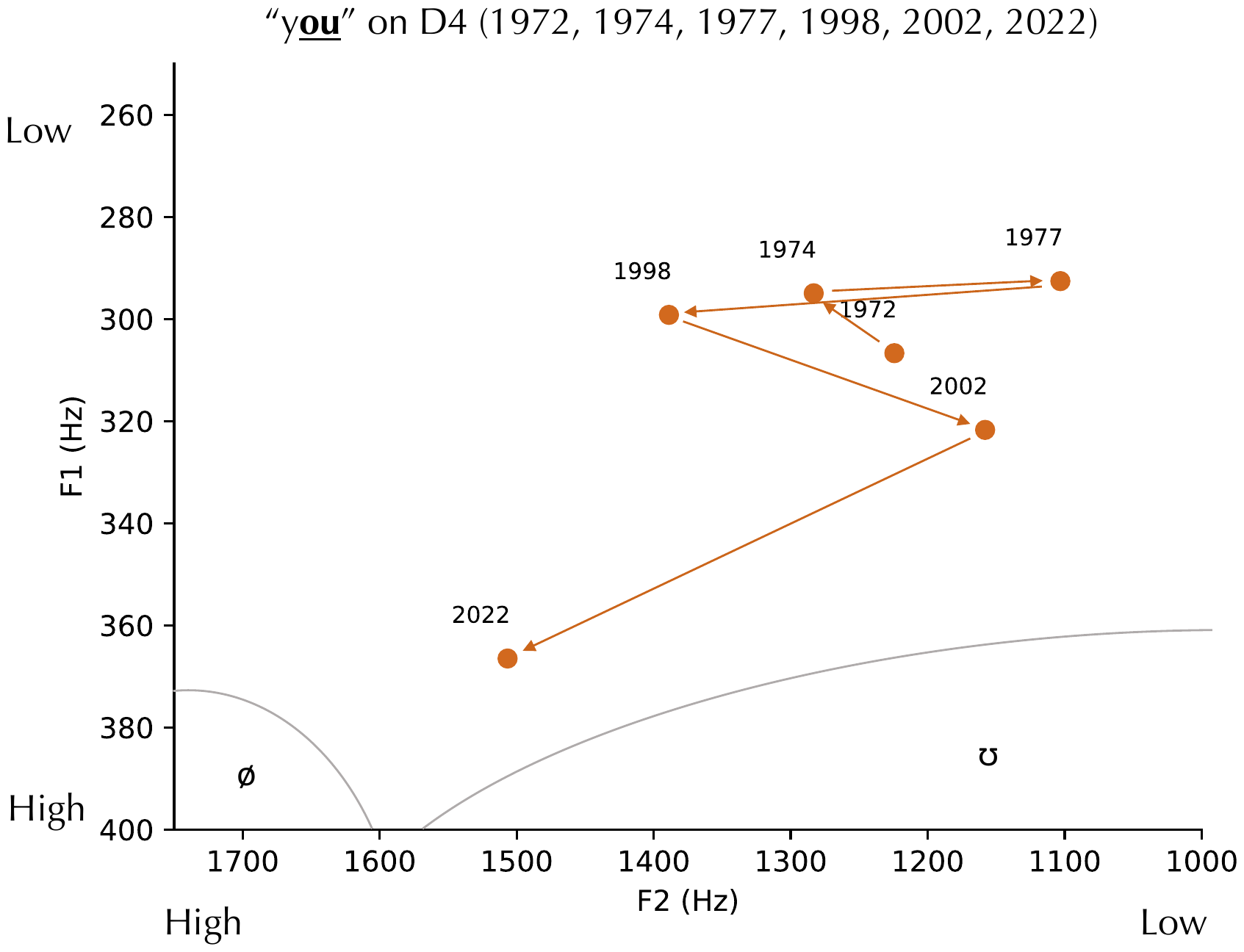
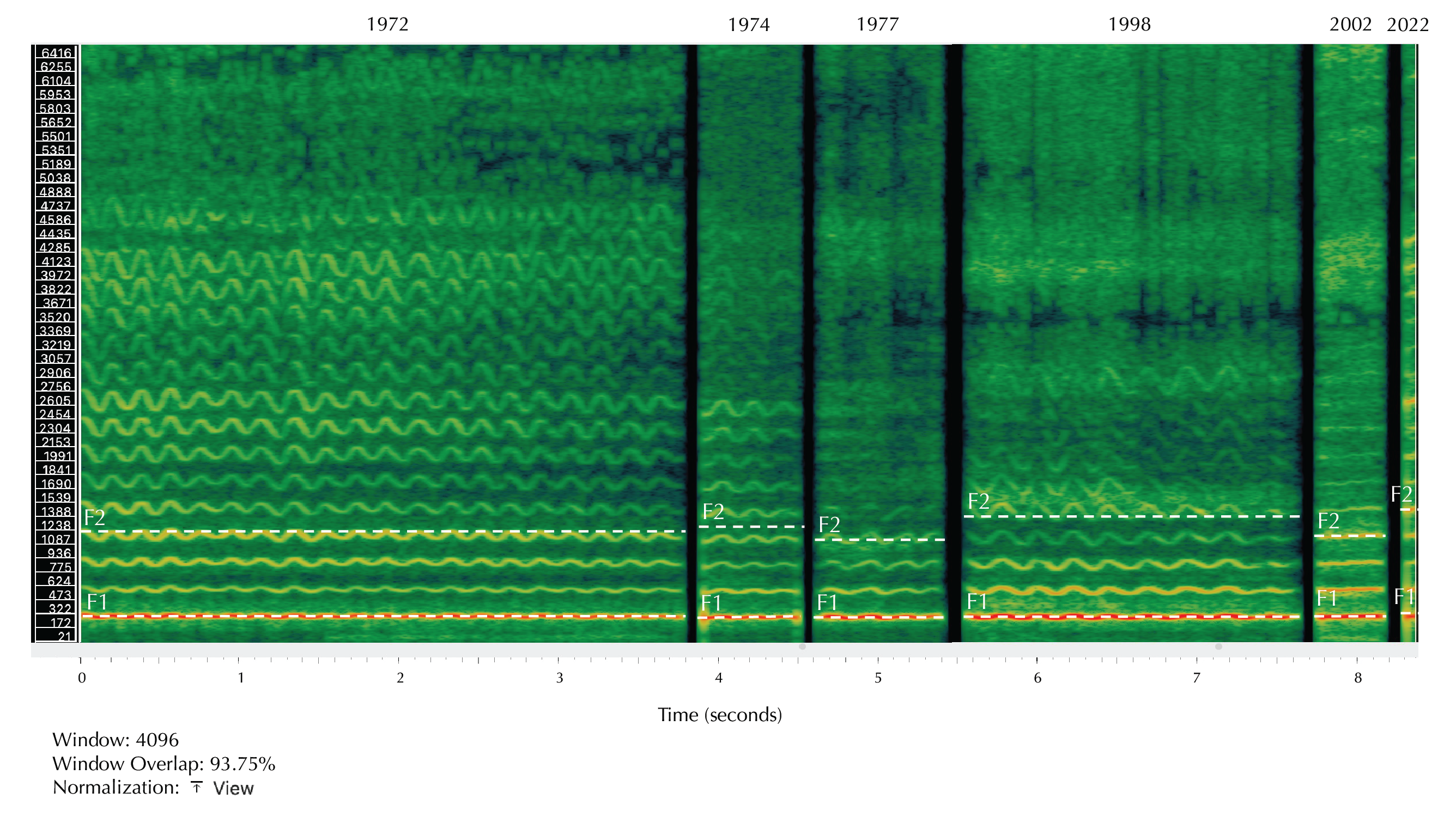
Location of formants 1 and 2 on the /uː/ vowel in the word “you” on D4 in 1972, 1974, 1977, 1998, 2002, and 2022.
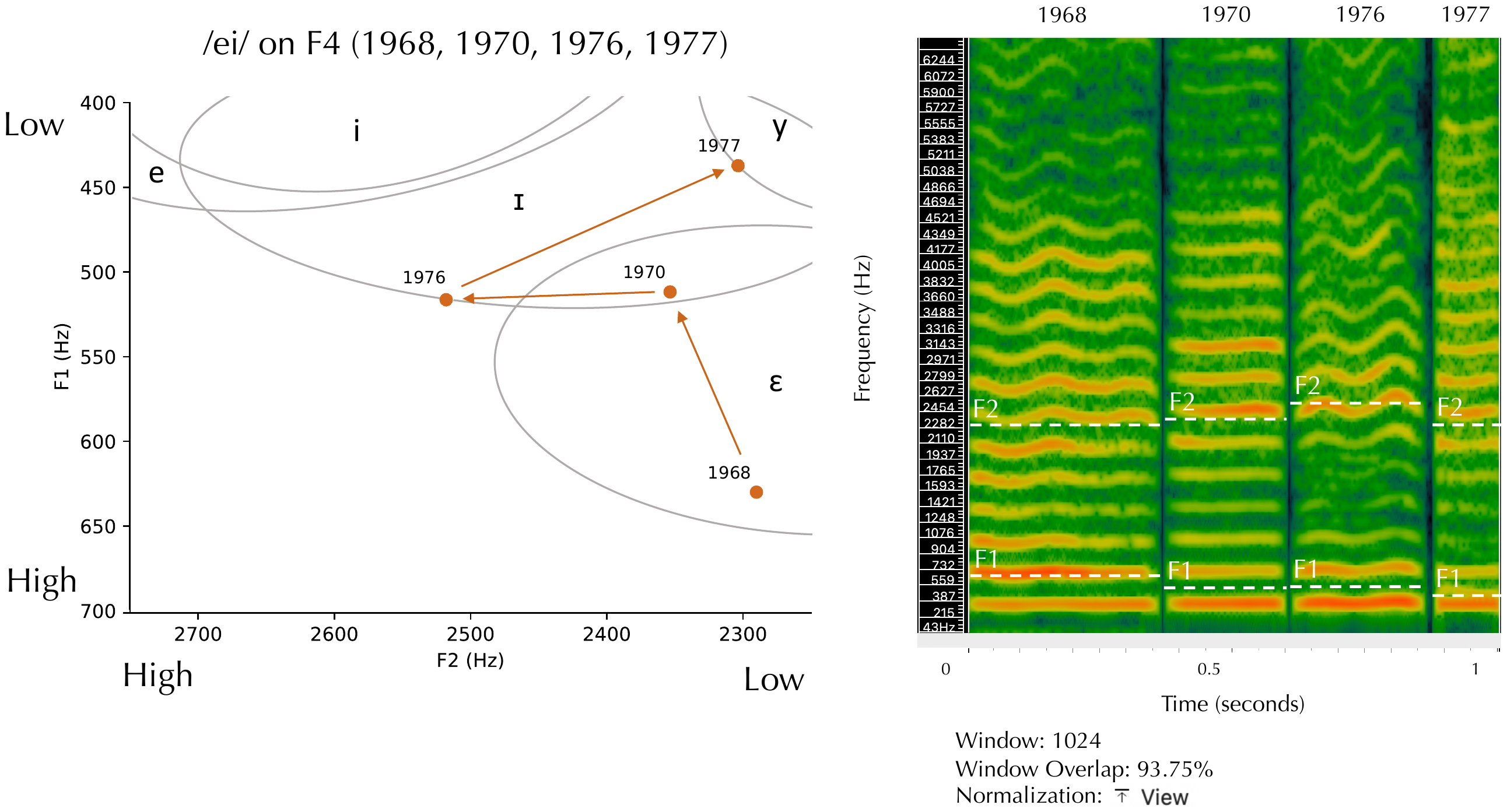
Example 19 shows how F1 and F2 change on the /ei/ vowel in various lyrics that preceded the vowel with an “L” on F4 in Mitchell’s first decade of studio albums, from 1968, 1970, 1976, and 1977. These vowels are from various words: “plane” in “Nathan La Freneer” (Song to a Seagull), “lady” in “Willy” (Ladies of the Canyon), “plane” in “Black Crow” (Hejira), and “plane” in “Dreamland” (Don Juan’s Reckless Daughter). I listened to each vowel by ear to ensure that I chose components of the diphthong that were sonically equivalent. Mitchell’s sound on this vowel in 1968 on her first studio album is much rounder and more open than in later years, even compared to just two years later. F1 decreases globally, with a very small increase between 1970 and 1976, whereas F2 increases and then decreases, returning to a similar level in 1977 as in 1968. The decrease in F1 and dramatic increase in F2 in 1976 may be due to tenseness, just as Mitchell’s /uː/ vowel was more tense in the late 1970s. This vowel becomes more unrounded in 1977, contrary to the trends exhibited in Example 18; the /ei/ vowel instead becomes more lax in 1977 than /uː/, which became more tense. The large difference between formants in 1968 versus 1970 may indicate that Mitchell took a few years to establish her signature sound at the start of her career.
Even with Mitchell’s extensive studio output, because of her changing range and transposed renditions of the same songs, it is rare to find the same lyric on the same pitch. An exception to this is the word “feet” in “A Case of You” from 1971 and 2022. Mitchell maintained the same key but sung an octave lower in 2022. “Feet” was sung on D♭4 as the low tonic note in 1971 and as the high tonic note in 2022. Even when examples exist, date ranges often limit observations to only several snapshots. These observations should be considered as attempts to quantify my qualitative timbral observations in this section and in part 2.
Some of Mitchell’s vowels exhibit more change than others. This can partially be explained by uneven vowel change with age, though I also understand Mitchell’s sung vocal change to be more intentional and controlled than that of speakers (Eichhorn et al. 2018). Mitchell emphasizes and exaggerates tenseness and laxness in the late 1970s, and she revisits formant values from her twenties and thirties in her eighties as she retrained her voice in the 2020s after health issues. Like the timbral descriptors of part 2, some elements of Mitchell’s voice are invariant, while others are flexible, owing in part to creative decisions, age-related factors, and Mitchell’s response to them.
Discussion
Recording and Genre
There are several additional considerations in this analysis. Recording technologies have changed dramatically from 1968 to the present, affecting the sound of Mitchell’s recorded voice. The production style of her recordings has also changed. In earlier folk recordings, the vocals sound more natural, like a perfected live performance, whereas in later rock tracks, there is more reverb applied to the voice. Mitchell has explored many genres in her music over the years, including folk, rock, jazz, blues, pop, classical, and experimental and hybrid styles. These genres influence Mitchell’s vocal style, as she incorporates pitch bending, variability on a single pitch, and brighter or darker timbres depending on the musical style. Reviewers often assess Mitchell’s voice in her ventures into other genres with standards from folk music, her original recorded genre, without considering her voice on its own terms in these new stylistic milieus. Anne Karppinen writes, “Mitchell’s change of style from folk to jazz in the mid-seventies made the critics at least dimly aware of the possibilities of vocal genre-shifting; yet for a singer to learn a new technique, and for the press to notice and perhaps even approve of it can be a lengthy process” (Karppinen 2016, 148–49). Accent may also play a role here; Mitchell’s Canadian accent, which she still holds onto, is sometimes more or less present in her singing voice depending on the genre at hand. Mitchell said that singing with David Crosby, Stephen Stills, and Graham Nash specifically influenced her accent: “In order to blend with them you had to adopt a kind of vocal affectation to get the blend. . . . Suddenly I have kind of an overt American accent, to my ear anyway, being Canadian, on the second album which kind of dies down by the time you get to the third” (Mitchell [1986] 2002). Two years before Court and Spark, Mitchell seemed to have already been planning her vocal evolution: “I could sing much stronger than I do, you know, especially on the low register. I’ve got a voice I haven’t used yet and haven’t developed, which is very deep and strong and could carry over a loud band. And I’m very tempted to go in that direction experimentally” (Mitchell [1972] 2002).
Persona
Across these recordings of “A Case of You” and her recorded output more generally, Mitchell uses timbre as an affordance to portray different personas (Grier 2012; Monk 2012, 245). Mitchell said, “There are showy, fun songs that will accommodate a certain amount of winky-wink, nod-nod from the stage, but on these intimate things you almost have to sing with a method acting kind of way—you have to find your sincerity like an actor does” (Mitchell [1997] 2000). One of these changes in persona is in relation to her gender. Critics and audiences have responded more positively to aging male singers than aging female ones (Jennings and Gardner 2012; Naiman 2019). Considering the often gender-based criticisms directed at Mitchell throughout her career, it is no surprise that she would explore gender portrayals further distanced from her earlier “ingénue” roles (Baker 2019; A. Gardner 2019; Mitchell 2004). In an interview at the age of 51, Mitchell said, “I’ve written some songs, like ‘Cold Blue Steel and Sweet Fire,’ that I didn’t have the right voice for, I don’t think, although maybe it’s interesting the way it was. But I think that would be a good song for a man with more grit in his voice to sing, to bring out the darkness of it” (Mitchell [1994] 2001). In another interview from the same month, Mitchell said, “I’m finally developing enough character in my voice, I think, to play the roles that I write for myself. Like ‘Cold Blue Steel and Sweet Fire,’ which was fairly early, should be sung by a man, or I think I could probably sing it better now” (Mitchell 1994a). Saying that either she (with her transformed voice) or a man could sing this song seems to imply that Mitchell thought of her voice as possessing qualities associated with men’s voices, namely grittiness and gravelliness.
Mitchell also may have been influenced by her understanding of Black vocal styles, especially in the 1970s and onward (Fellezs 2011). Mitchell wrote and played jazz music, most explicitly on Mingus (1979b), Both Sides Now (2000), Travelogue (2002), and Joni’s Jazz (2025), though also in Court and Spark (1974b), The Hissing of Summer Lawns (1975), Hejira (1976), and Don Juan’s Reckless Daughter (1977). Mitchell wanting to sound like a jazz singer in the 1970s, when the most famous jazz singers in contemporary history were Black, may have been a racially motivated decision. I understand this as extending into Mitchell’s vocal sound by her choosing to draw on her concept of a “Black vocal style,” such as a raspiness in her voice and the use of straight tone on moving notes rather than one with vibrato, even though these are by no means true or representative sonic features of all Black jazz voices. Karppinen asserts that audiences may have criticized Mitchell’s voice in her jazz records because she is not a “natural jazz singer” in terms of her identity, like “Ella Fitzgerald and Billie Holiday—black female singers of the big band era” (Karppinen 2016, 150). Mitchell’s voice and vocal style were already transforming throughout the 1970s while she began to sing in a jazz style; it is unclear whether physiological changes in her voice motivated a stylistic change, or whether Mitchell’s ideas of style motivated an exploration of novel vocal techniques to access a new sound. Vocal damage and race are sometimes intertwined. Rudolph Fisher, a medical student in the 1920s, wrote that singers in Harlem “wore themselves ragged trying to rise above the inattentive din of conversation, and soon, literally, yelled themselves hoarse; eventually they lost whatever music there was in their voices and acquired that familiar throaty roughness which is so frequent among blues singers, and which, though admired as characteristically African, is as a matter of fact nothing but a form of chronic laryngitis” (Fisher [1987] 2008, 334; Stras 2006). While Mitchell sang in a jazz rather than blues style, her vocal style, a combination of creative choice and vocal damage, can be heard as her trying to emulate Black blues voices.
Though Mitchell had informal instruction in jazz singing with Annie Ross, a white British artist, whom Mitchell emulated vocally in many ways, especially Ross’s scat-style singing that Mitchell employs on “Twisted” from Court and Spark (co-written with Ross), Mitchell still chose to call herself a “Black man in a white woman’s body” (Strauss 1998). Of this label and of Mitchell’s Art Nouveau persona, Miles P. Grier writes, “Beholden to no sexual double standard, strolling the street with a bopping walk that could not but call to mind the jazz genre, Art Nouveau would seem the perfect vehicle to flee from the vulnerability and devaluation that marked the white female folksinger” (Grier 2012, 22). Of her voice on the 1974 Miles of Aisles album, Mitchell said, “My voice is gone . . . I sound like an old spade” (Monk 2012, 244). Mitchell may have used this phrase as code for a Black person, slang that emerged in the 1920s during the Harlem Renaissance (O’Conner and Kellerman 2009, 126–29). By using this term to refer to her voice, Mitchell seems to consider her voice as sounding Black; the statement also seems to carry a derogatory connotation, criticizing the sound of her changing (or failing) voice.
Disability and Late Style
Negative reception of Mitchell’s later albums aligns with cultural associations of age with disability (Kinney 2023; Naiman 2017, 2019; Stras 2006; Straus 2008, 2011, 2024). When asked, “Why do you hate critics so much,” Mitchell responded, “They hold you in your decade” (Eggar 2007). Joseph N. Straus writes, “Old age functions as a disability in the cultural sense: not a biomedical deficiency, but a culturally stigmatized, non-normative bodymind” (Straus 2024, 3). Specific to the voice, Michael E. Kinney writes, “Discourse on vocal aging tends to ignore or discount creative, artistic, and cultural contributions of the sound of aging voices that fall outside of typical neoliberal aesthetics of productivity and high-level artistry” (Kinney 2023, 57). Others may associate vocal aging with positive responses; Laurie Stras writes, “Hearing damage in a voice . . . connects the listener inescapably with the body of the performer, and the emotion in the performance is communicated as a testimony of personal experience rather than as an expression or invocation of the idea of emotion” (Stras 2006, 176). In recent appearances, Mitchell has performed sitting down on a throne-like seat, holding a diamond-encrusted cane, which she taps in time with the music. Her adaptation of Elton John’s “I’m Still Standing” to her own “I’m Still Sitting” is an explicit example of Mitchell addressing physical changes and the disabilities of aging while remaining in control of her creative choices. The producer, musician, collaborator, and Mitchell’s former husband Larry Klein “observed at close quarters how Joni’s voice evolved and changed. . . . ‘She adjusted her perception to where she was in life and used it to her advantage’” (Bacon 2020).
There is a fascination with the “late style” (Adorno [1937] 2002) of composers, referring to the distillation of one’s compositional style in the years before death (Said 2006). Straus argues that late style “may in some cases be more richly understood as disability style: a perspective composers may adopt at any age, often in response to a personal experience of disability” (Straus 2008, 6). Composers, especially Ludwig van Beethoven, Johannes Brahms, Franz Schubert, and Robert Schumann, are treated with reverence in their late period, as if having reached a mystical form of prescience in their proximity to death that translates to their compositions (Straus 2008). While some of this reverence is shown toward singers in their later years, scholars and critics seem quicker to ascribe physical decline as the reason for change rather than creative brilliance (Kinney 2023; Stras 2006; Straus 2024). Kinney calls attention to reception differences of aging voices across genres: “While older voices in popular musics can index themes such as authenticity, wisdom, and experience, the sounds of aging in opera are virtually always heard as deficits that detract and distract from the aesthetic appreciation of a performance” (Kinney 2023, 8). Elliott (2015, 220–22), Holden (2000), and Yaffe (2017, 359) have compared Joni Mitchell’s “late voice” (Elliott 2015) to those of Billie Holiday and Frank Sinatra, who both recorded and performed through years of significant vocal change toward the end of their lives. Holiday and Sinatra performed into their forties and seventies respectively. While Holiday passed away at the age of 44, her voice underwent an extreme evolution, so much so that in her last years, such as on Lady in Satin (1958), her voice sounded like it belonged to someone much older. Holden (2000) aligns Mitchell with Holiday and Sinatra, “whose vocal deterioration brought them greater emotional depth and realism.” Michelle Mercer (2009) includes Holiday and Sinatra as singers that Joni Mitchell said she loved. Mitchell said, “Billie Holiday was more than a singer; Frank Sinatra was more than a singer. There were a lot that were Method actor singers” (Mercer 2009, 214). Mitchell putting these singers in the same breath and calling them “more than” singers may mean she was talking about age and vocal evolution. The wording of this quotation makes clear that Holden ascribes little to no agency to these artists in their “late” records, in which their aging voice happened to them, rather than the artists making musical decisions to suit their new voice.
The voice changes with age for a variety of reasons, including muscle atrophy, the stiffening of connective tissues, and smoking. The voice may show sonic signs of aging such as lower pitch in the female voice, reduced volume and endurance, voice tremors, and weak or breathy voice (Lortie et al. 2017). Elliott writes, “Decay is modelled in Mitchell’s voice . . . to become a harsh chronicle of the traces life leaves on the body” (Elliott 2015, 227). My observations about pitch ranges, timbral descriptors, and formant frequencies are in line with these sonic features; physiological changes may account for some of Mitchell’s vocal evolution. However, her agency as a performing artist is erased by attributing all her sonic changes to physiology. Conversely, asserting that Mitchell’s creative vision was the sole factor in her vocal evolution also projects one’s own judgments onto her vocal transformation.
Mitchell pushes back against the notion of age rather than autonomy ruling her evolution: Barney Hoskyns said to Mitchell in 1994, “Before Edmonton you told an interviewer you hoped people wouldn’t use you as a ‘sentimental journey,’” and she responded with, “I like to keep moving forward rather than getting stuck in a regurgitating situation, you know, where I’m painting the same thing over and over” (Mitchell 1994a). Rather than treating Mitchell as a sentimental journey, I consider her career and continued performance to be political; Mitchell choosing to continue creating albums and performing is an act of resistance. For fans who were young when Mitchell released her first albums, Mitchell’s evolution as an aging performer may parallel certain elements of their own lives as they have grown older themselves (Bennett 2013).
While Mitchell’s earliest albums were largely performed solo, Mitchell’s later collaborations with other musicians, including Vince Mendoza, Charles Mingus, Wayne Shorter, and the London Symphony Orchestra, seem to indicate a confidence in her artistic vision to release total control from her projects, perhaps afforded to her by age and cultural status. Her collaboration with much younger musicians since 2022 is also symbolic, indicating Mitchell’s comfort of holding her own while performing with artists of younger generations. Of her Newport performance, Lindsay Zoladz (2022) writes, “There was an intergenerational tenderness to the performance, the way that some of the younger musicians (Marcus Mumford, Blake Mills, Jess Wolfe and Holly Laessig of Lucius) appeared to be in palpable awe of what was happening even as they kept time and in tune.” Brandi Carlile, 38 years Mitchell’s junior and the inspiration for Mitchell’s comeback at Newport, and other young artists such as Jon Batiste and Jacob Collier, joined Mitchell at her Hollywood Bowl performances.
Conclusion
Mitchell herself has been outspoken about her voice over the years, both in its qualities specific to certain albums or periods, as well as in its evolution. These comments have neither been stable nor unidirectional. In 1995, Mitchell said, “I liked the sound of my voice and my guitar on that first record, because I wasn’t influenced by anything” (Hinton 1996, 87). On other occasions, she spoke disparagingly about her voice on earlier studio albums, calling it a “little helium voice” (Mitchell 2014) and herself “that little squeaky girl on helium” (Mitchell 2004). Mitchell often spoke kindly about her voice in later albums; in 1994, she said, “I’m finally developing enough character in my voice, I think, to play the roles that I write for myself” (Mitchell 1994a). She has said that this changed voice is truer to herself: “Once I began to write, my vocal style changed. . . . Almost immediately, when I had my own words to sing, my own voice appeared” (Ruhlmann [1995] 2000). Mitchell began to write her own songs in 1964, four years before Song to a Seagull was released (Mitchell 1968a). However, she has also expressed criticism of her voice after it experienced change. About her Miles of Aisles album, Mitchell said, “My voice is gone. . . . I lost like ten notes on this tour. They are just gone forever. I’m just a prisoner of notes. I guess I’ll have to do more with the four I have left” (Monk 2012, 244). Perhaps in response to the negative reviews of her changing voice and style, Mitchell said as early as 1976, “There’s a lot of things I’d like to do, so I still feel young as an artist. I don’t feel like my best work is behind me. I feel as if it’s still in front” (Mitchell 1974a).
In 1979, Mitchell said the following:
You can stay the same and protect the formula that gave you your initial success. They’re going to crucify you for staying the same. If you change, they’re going to crucify you for changing. But staying the same is boring. And change is interesting. So, of the two options, I’d rather be crucified for changing. (Mitchell 1979a)
While Mitchell does not specify what she is referring to in this quotation, I understand it to refer both to her creative choices and to her voice, which I interpret as often being one and the same.
In this study, I provide quantitative and qualitative evidence documenting the transformation of pitch and timbre in Joni Mitchell’s voice through all her musical periods. The results suggest that age and lifestyle do not fully determine Mitchell’s sound, but rather that these changes create conditions of possibility for creative decision making. I argue that Mitchell’s vocal change can be understood to serve her evolving musical style and creative goals, with Mitchell responding to changes in her voice, especially the deepening and darkening of her voice, by drawing on her rich vocal resources to purposefully achieve expressive effects of interest to her. Mitchell experiences vocal damage, cultivates it, and embraces it, aligning her voice with the topics she chooses to sing about in her last released original songs, namely, war and the environment. Through all periods, Mitchell’s vocal evolution has meant that she has created art that is true to herself. The method developed and proposed in this study to analyze Joni Mitchell’s oeuvre provides a novel tool for analyzing the complex facets of other aging voices.
Works Cited
Adorno, Theodor W. [1937] 2002. “Late Style in Beethoven.” In Essays on Music, edited by Richard Leppert, translated by Susan H. Gillespie, 564–68. University of California Press.
Bacon, Tony. 2020. “The Art and Psychology of Recording Great Vocals.” Reverb, August 27. https://reverb.com/news/art-and-psychology-of-recording-great-vocals.
Baker, Emily. 2019. “‘Oh Borderline’: Joni Mitchell’s Aging Voice as a Site of Queer Resistance.” In Joni Mitchell: New Critical Readings, edited by Ruth Charnock, 43–63. Bloomsbury Academic.
Bennett, Andy. 2013. Music, Style, and Aging: Growing Old Disgracefully? Temple University Press.
Clarke, Betty. 2002. Review of Travelogue, by Joni Mitchell. Guardian, November 22. https://www.theguardian.com/music/2002/nov/22/popandrock.artsfeatures2.
Eggar, Robin. 2007. “Both Sides Now.” Word, April. Reprint, Joni Mitchell Library. https://jonimitchell.com/library/view.cfm?id=1580.
Eichhorn, Julie Traub, Raymond D. Kent, Diane Austin, and Houri K. Vorperian. 2018. “Effects of Aging on Vocal Fundamental Frequency and Vowel Formants in Men and Women.” Journal of Voice 32 (5): 644.e1–9.
Elliott, Richard. 2015. The Late Voice: Time, Age and Experience in Popular Music. Bloomsbury Academic.
Fant, Gunnar. 1960. Acoustic Theory of Speech Production. Mouton.
Fant, Gunnar. 1965. “Formants and Cavities.” In Proceedings of the Fifth International Congress of Phonetic Sciences, edited by Eberhard Zwirner and Wolfgang Bethge, 120–41. Karger.
Fellezs, Kevin. 2011. Birds of Fire: Jazz, Rock, Funk, and the Creation of Fusion. Duke University Press.
Fisher, Rudolph. [1987] 2008. The City of Refuge: The Collected Stories of Rudolph Fisher. Edited by John McCluskey Jr. University of Missouri Press.
Gardner, Abigail. 2019. Ageing and Contemporary Female Musicians. Routledge.
Gardner, Elysa. 2000. “Joni’s Standard Approach to Singing.” Los Angeles Times, February 6. https://www.latimes.com/archives/la-xpm-2000-feb-06-ca-61447-story.html.
Garnier, Maëva, Nathalie Henrich, John Smith, and Joe Wolfe. 2010. “Vocal Tract Adjustments in the High Soprano Range.” Journal of the Acoustical Society of America 127 (6): 3771–80.
Givens, Ron. [1991] 2000. “Joni Mitchell Updates Her Life and Times.” Stereo Review, June. Reprint, Joni Mitchell Library. https://jonimitchell.com/library/view.cfm?id=288.
Grier, Miles Parks. 2012. “The Only Black Man at the Party: Joni Mitchell Enters the Rock Canon.” Genders 56.
Gumbel, Andrew. 2007. “The Protest Goes On: They Bombed Paradise (and I Put Up a Multimedia Extravaganza).” Independent, February 9. https://www.independent.co.uk/news/world/americas/the-protest-goes-on-they-bombed-paradise-and-i-put-up-a-multimedia-extravaganza-435667.html.
Hickey, Raymond. [2005] 2026. “Phonetics and Phonology.” In Studying the History of English. http://www.raymondhickey.com/REV_Phonetics_Phonology.htm.
Hinton, Brian. 1996. Joni Mitchell: Both Sides Now. Sanctuary.
Holden, Stephen. 2000. “Something’s Lost and Something’s Gained.” New York Times, February 13. https://www.nytimes.com/2000/02/13/arts/music-something-s-lost-and-something-s-gained.html.
Ishizaki, Tatsuya. 2025. “Quantification of Tenseness in English and Japanese Tense-Lax Vowels: A Lagrangian Model with Indicator θ1 and Force of Tenseness Ftense(t).” Preprint, arXiv, March 25. https://doi.org/10.48550/arXiv.2503.03681.
Jennings, Ros, and Abigail Gardner, eds. 2012. “Rock On”: Women, Ageing and Popular Music. Routledge.
Karppinen, Anne. 2016. The Songs of Joni Mitchell: Gender, Performance and Agency. Routledge.
Kaufman, Brandon. 2024. “I Expected Joni Mitchell’s Hollywood Bowl Concert to Be Extraordinary. I Wasn’t Prepared for the Depth of Its Emotional Impact.” Toronto Star, November 3. https://www.thestar.com/entertainment/music/i-expected-joni-mitchells-hollywood-bowl-concert-to-be-extraordinary-i-wasnt-prepared-for-the/article_ebac9fac-96d4-11ef-99cd-7f5d52931fe3.html.
Kinney, Michael E. 2023. “Hearing Beyond Vocal Twilight: Aging Vocalities in Contemporary American Operatic and Classical Voice Performance.” PhD diss., Stanford University.
Koozin, Timothy. 2024. Embodied Expression in Popular Music: A Theory of Musical Gesture and Agency. Oxford University Press.
Lortie, Catherine L., Julie Rivard, Mélanie Thibeault, and Pascale Tremblay. 2017. “The Moderating Effect of Frequent Singing on Voice Aging.” Journal of Voice 31 (1): 112.e1–12.
Lott, Tim. [1976] 2000. “The Tip of the Iceberg.” Sounds Magazine, November 27. Reprint, Joni Mitchell Library. https://jonimitchell.com/library/view.cfm?id=354.
Maconie, Stuart. [1998] 2017. Review of Taming the Tiger, by Joni Mitchell. Q, October. Reprint, Joni: The Anthology, edited by Barney Hoskyns, 210–11. Picador.
Mercer, Michelle. 2009. Will You Take Me as I Am: Joni Mitchell’s “Blue” Period. Free Press.
Mitchell, Joni. 1968a. Interview with Dave Wilson. Broadside 6 (26): 5–7.
Mitchell, Joni. 1974a. “Face to Face.” Interview by Malka Marom. Maclean’s, June.
Mitchell, Joni. 1979a. “I Don’t Feel Guilty for My Success or My Lifestyle.” Interview by Cameron Crowe. Rolling Stone, July 26. https://www.rollingstone.com/feature/joni-mitchell-defends-herself-61890/.
Mitchell, Joni. 1994a. Interview by Barney Hoskyns, September 14. https://jonimitchell.com/library/view.cfm?id=2143.
Mitchell, Joni. [1997] 2000. “A Conversation with Joni Mitchell.” Interview by Daniel Levitin. Grammy Magazine, March. Reprint, Joni Mitchell Library. https://jonimitchell.com/library/view.cfm?id=460.
Mitchell, Joni. [1994] 2001. Interview by Steve Warden. Transcribed by Lindsay Moon. Q107-FM, Toronto, ON. Joni Mitchell Library. https://jonimitchell.com/library/view.cfm?id=583.
Mitchell, Joni. [1972] 2002. Interview by Penny Valentine. Sounds Magazine, June 3. Reprint, Joni Mitchell Library. https://jonimitchell.com/library/view.cfm?id=344.
Mitchell, Joni. [1986] 2002. Interview by Pete Fornatale. Transcribed by Lindsay Moon. Joni Mitchell Library. https://jonimitchell.com/library/view.cfm?id=728.
Mitchell, Joni. 2004. “Joni Mitchell on a Life in Music.” Interview by Terry Gross. Fresh Air, October 20. https://freshairarchive.org/segments/joni-mitchell-life-music.
Mitchell, Joni. 2014. “The Music Midnight Makes: In Conversation with Joni Mitchell.” Interview by Renee Montagne. NPR, December 9. https://www.npr.org/2014/12/09/369386571/the-music-midnight-makes-in-conversation-with-joni-mitchell.
Monk, Katherine. 2012. Joni: The Creative Odyssey of Joni Mitchell. Greystone Books.
Naiman, Tiffany. 2017. “Singing at Death’s Door: Late Style, Disability, and the Temporality of Illness in Popular Music.” PhD diss., University of California, Los Angeles.
Naiman, Tiffany. 2019. “Resisting the Politics of Aging: Madonna and the Value of Female Labor in Popular Music.” In Popular Music and the Politics of Hope: Queer and Feminist Interventions, edited by Susan Fast and Craig Jennex, 267–81. Routledge.
Nash, Alanna. 1988. “Joni Mitchell Makes a New Musical Mark.” Stereo Review 53 (7): 79.
Nolan, Tom. 1975. “Joni Mitchell: Miles of Aisles.” Phonograph Record, January. https://www.rocksbackpages.com/Library/Article/joni-mitchell-imiles-of-aislesi.
O’Conner, Patricia T., and Stewart Kellerman. 2009. Origins of the Specious: Myths and Misconceptions of the English Language. Random House.
Reuter, Christoph. Forthcoming. “Formants: The Missing Link Between Orchestration and Post-Helmholtzian Timbre Research.” In The Oxford Handbook of Orchestration Studies, edited by Julie Delisle, Robert Hasegawa, Jason Noble, and Moe Touizrar. Oxford University Press.
Reuter, Christoph, Charalampos Saitis, Isabella Czedik-Eysenberg, and Kai Siedenburg. 2024. “Giving Instruments a Voice: Are There Vowel-Like Qualities in the Timbres of Musical Instruments?” In Tagungsband/Proceedings “Fortschritte der Akustik—DAGA 2024”, 1038–41. Deutsche Gesellschaft für Akustik.
Reymore, Lindsey. 2020. “Empirical Approaches to Timbre Semantics as a Foundation for Musical Analysis.” PhD diss., Ohio State University.
Rings, Steven. 2013. “A Foreign Sound to Your Ear: Bob Dylan Performs ‘It’s Alright, Ma (I’m Only Bleeding),’ 1964–2009.” Music Theory Online 19 (4).
Riverin-Coutlée, Josiane, and Jonathan Harrington. 2022. “Phonetic Change over the Career: A Case Study.” Linguistics Vanguard 8 (1): 41–52.
Riverin-Coutlée, Josiane, Johanna-Pascale Roy, and Michele Gubian. 2023. “Using Mahalanobis Distances to Investigate Second Dialect Acquisition: A Study on Quebec French.” Language and Speech 66 (2): 291–321.
Ruhlmann, William. [1995] 2000. “From Blue to Indigo.” Goldmine, February 17. Reprint, Joni Mitchell Library. https://jonimitchell.com/library/view.cfm?id=115.
Said, Edward W. 2006. On Late Style: Music and Literature Against the Grain. Pantheon.
Slawson, Wayne. 1985. Sound Color. University of California Press.
Stras, Laurie. 2006. “The Organ of the Soul: Voice, Damage, and Affect.” In Sounding Off: Theorizing Disability in Music, edited by Neil Lerner and Joseph N. Straus, 173–84. Routledge.
Straus, Joseph N. 2008. “Disability and ‘Late Style’ in Music.” Journal of Musicology 25 (1): 3–45.
Straus, Joseph N. 2011. Extraordinary Measures: Disability in Music. Oxford University Press.
Straus, Joseph N. 2024. Cultural Narratives of Old Age in the Lives, Work, and Reception of Old Musicians. Routledge.
Strauss, Neil. 1998. “The Hissing of a Living Legend.” New York Times, October 4. https://www.nytimes.com/1998/10/04/magazine/the-hissing-of-a-living-legend.html.
Sundberg, Johan. 1970. “Formant Structure and Articulation of Spoken and Sung Vowels.” Folia Phoniatrica et Logopaedica 22 (1): 28–48.
Sundberg, Johan. 1973. “The Source Spectrum in Professional Singing.” Folia Phoniatrica et Logopaedica 25 (1–2): 71–90.
Variety. [1966] 2001. “Folksongs.” Reprint, Joni Mitchell Library. https://jonimitchell.com/library/view.cfm?id=601.
Whitesell, Lloyd. 2008. The Music of Joni Mitchell. Oxford University Press.
Winning, Joanne. 2019. “‘Both Sides, Now’: Voice, Affect, and Thirdness.” In Joni Mitchell: New Critical Readings, edited by Ruth Charnock, 65–82. Bloomsbury Academic.
Yaffe, David. 2017. Reckless Daughter: A Portrait of Joni Mitchell. Sarah Crichton.
Yaffe, David. 2023. “Joni Mitchell Rises Again.” Tidal, August 7. https://tidal.com/magazine/article/joni-returns/1-92502.
Zoladz, Lindsay. 2022. “Joni Mitchell Reclaims Her Voice at Newport.” New York Times, July 26. https://www.nytimes.com/2022/07/26/arts/music/joni-mitchell-performance.html.
Discography
Mitchell, Joni. 1968b. Song to a Seagull. Reprise.
Mitchell, Joni. 1969. Clouds. Reprise.
Mitchell, Joni. 1970. Ladies of the Canyon. Reprise.
Mitchell, Joni. 1971. Blue. Reprise.
Mitchell, Joni. 1972. For the Roses. Asylum.
Mitchell, Joni. 1974b. Court and Spark. Asylum.
Mitchell, Joni. 1975. The Hissing of Summer Lawns. Asylum.
Mitchell, Joni. 1976. Hejira. Asylum.
Mitchell, Joni. 1977. Don Juan’s Reckless Daughter. Asylum.
Mitchell, Joni. 1979b. Mingus. Asylum.
Mitchell, Joni. 1982. Wild Things Run Fast. Geffen.
Mitchell, Joni. 1985. Dog Eat Dog. Geffen.
Mitchell, Joni. 1988. Chalk Mark in a Rain Storm. Geffen.
Mitchell. Joni. 1991. Night Ride Home. Geffen.
Mitchell, Joni. 1994b. Turbulent Indigo. Reprise.
Mitchell, Joni. 1998. Taming the Tiger. Reprise.
Mitchell, Joni. 2000. Both Sides Now. Reprise.
Mitchell, Joni. 2002. Travelogue. Nonesuch.
Mitchell, Joni. 2007. Shine. Hear Music.
Mitchell, Joni. 2023. Joni Mitchell at Newport (Live). Rhino.