Review
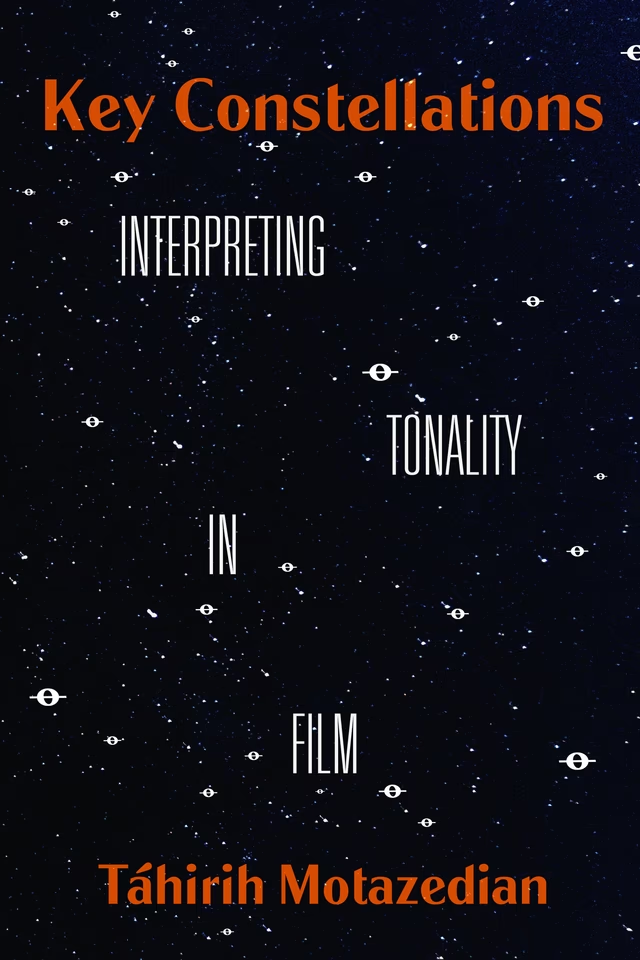
Key Constellations: Interpreting Tonality in Film
Táhirih Motazedian
University of California Press, 2024, 198pp
Table of Contents
Once suffering from a paucity of music-theoretical writings and relegated to interest-group conference sessions, film music theory has recently achieved a mature body of wonderful writings. The past decade alone has offered book-length treatments from Frank Lehman (2018), James Buhler (2019), and David Neumeyer (2015), among others; substantial inclusion of film music in book-length works on leitmotifs and cognition; numerous edited collections; awards from the Society for Music Theory and other professional societies; dozens of articles showcasing a diversity of approaches that largely mirror the discipline as a whole; and a recent edited volume dedicated to highlighting current modes of inquiry. Lehman (2024) discusses the field’s history and development in the book’s foreword, while the broader edited volume features theoretical approaches around analytical parameters drawn from the discipline’s current discourse: timbre, tempo, pitch design, theme, meter, form, key, thematic transformation, post-tonality, serialism, and underscore. As Lehman notes, “By the time an official ‘Film Music and Multimedia’ interest group was founded by the Society for Music Theory in 2013, it was clear that film music analysis—as practiced and promulgated by self-identified music theorists—had attained disciplinary stability as a vigorous and firmly established field of inquiry” (2024, xi). In addition to numerous presentations and publications in other scholarly venues, each of the Society for Music Theory’s flagship journals (Music Theory Spectrum, Music Theory Online, and SMT-V) has published at least one article on film music during the last three years. Historically familiar topics—pitch, form, harmony, tonality, theme, and extramusical associations—are being reimagined to illuminate the nuances and complexities of film scores, and numerous scholars have intricately adapted techniques developed for Western art music to film music in ways that highlight theoretical synergies and historical influences while also engaging film music on its own intrinsic terms.
Motazedian’s Key Constellations: Interpreting Tonality in Film is an intellectually stimulating and musically compelling addition to the discipline that singles out the role of key associations and tonal design in film scores. The fourth installment in the California Studies in Music, Sound, and Media Series (edited by James Buhler and Jean Ma), the book’s subtitle communicates its focus on analytically rich relationships between tonality and global- and local-level filmic narratives. Motazedian opens with an evocative invitation to “imagine a two-hour-long work in which keys hold rich associative meanings, related to one another in hermeneutically significant harmonic relationships, and are temporally deployed in a symmetrical formation that reflects a programmatic theme within the narrative. This isn’t a Wagner opera I’m describing—it’s a contemporary, mainstream Hollywood film.” She positions her work as creating a similarly meaningful space for long-range tonality in film, one thought “to be irrelevant and unfeasible in the context of film music” (xi). Motazedian (2016, 2) summarizes this account with a quote from Lehman (2012, 9): “Analysis of pitch-design in film scores has been something of a taboo subject for many theorists; this is due to presumptions about tonal memory, composer-intention, and the coherence of film scores as ‘works.’” Lehman’s discussion attributes this state of affairs in part to “Hans Keller’s [2006] insistence on cohesive key relationships across cues” and “Adorno and Eisler’s [1947/2007] contention that such relationships run contrary to the extra-musical demands of the medium.”
Throughout the book, Motazedian combats the idea of tonality as incidental or an afterthought by providing glimpses into the habits and methods of the many people working on soundtracks and how they conceive of tonality and tonal areas more broadly. She does not, however, limit her analytical approach to solely intentional efforts but instead situates the act of connecting keys and narratives as a reader-centered undertaking. This priority is informed by reader-response criticism, wherein “meaning is not created by the author or embedded within the text but generated by the reader upon interaction with the text” (9). As a result, Motazedian offers a dynamic theoretical ethos that invites the analyst to “allow the particulars of each film and its narrative to determine the most fitting analytical methodology” (11).
In terms of its analytical tools and its repertoire, the book is designed to be accessible to readers with only basic musical literacy. Motazedian provides flexible and useful notational and analytical tools for a variety of students, from those in more traditional music majors to those in sound production and design, media studies, and more. The repertoire, comprising nearly entirely mainstream Hollywood films, emerged organically from Motazedian’s experience and illustrates the wide applicability of her approach. As she describes, “I specifically did not make any attempt to limit my corpus to ‘the best’ films or composers because I want to demonstrate that meaningful tonal features can be found in any type of film setting” (xii).
Key Constellations is organized into six chapters, preceded by a brief preface and followed by an appendix. Chapter 1 sets out motivating questions on the nature of film tonality, then describes her analytical approach and defines the tonal design elements used in the book. Chapters 2–4 deploy each of Motazedian’s elements in examples ranging from jump cuts in TV scenes to overall key design spanning entire films; chapter 5 explores the role of sound effects in film tonality. Chapter 6 looks back at the question of intentionality in light of the book’s analytical journey, then discusses tonal design in other media, soundtracks that resist tonal design analysis, and concluding thoughts.
Chapter 1, “The Theoretical Groundwork for Film Tonality,” defines film tonality as “the large-scale arrangement of keys of all musical entities in a film soundtrack—including original scoring, preexisting music, and pitched sound effects and dialogue” (3). Motazedian organizes the chapter’s theoretical foundations around five theoretical issues, framed as questions. Addressing the first, “What Does Film Tonality Entail?,” Motazedian emphasizes the poor fit of tonal and key models derived from Western art music when applied to film soundtracks. In arguing for a different approach, she foregrounds David Beach’s (1993, 2–3) distinction between tonal structure, wherein tonality is articulated within the overarching form of a single work, and tonal design, a more adaptable and descriptive category that can include open-ended layouts and progressive tonality. Using the example of a work that begins in C major and ends in F♯ major, Motazedian posits that prescriptive models of tonal structure may read such progressive tonality and distantly related keys as harmonically and dramatically anomalous, while the descriptive framework of tonal design allows space for work-specific methodologies and narrative-driven key association. She notes that “imposing the structural value judgment of I–V–I onto a system that is not operating under the requirement of I–V–I is like using a German grammar book to grade an English paper: different system, different rules. There may be shared elements and origins and traceable influence, but the two systems nevertheless function in fundamentally different ways” (4). Thankfully, cautions about misusing tonal rules from common practice repertoire—while perhaps necessary a decade ago—seem less urgent now, given the growing body of film-music writings about non-functional harmony. Examples include Murphy (2006) and Lehman (2013). Additionally, Blim (2013) incorporates non-functional key relationships and associative tonal motion in discussion of musical and dramatic design in Bernard Herrmann’s prelude to Vertigo (1958), and Yorgason and Lyon (2020) examine non-functional and dissonant resolutions in Max Steiner’s Warner Bros. fanfares. Likewise, attitudes toward progressive tonality may finally have caught up to a young Charles Ives, who opined that beginning and ending a piece in the same key is “as silly as dying in the same house you were born in” (quoted in Moor [1948] 1996, 410–11). Nonetheless, Motazedian’s distinction is fitting for film-music analysis and serves to loosen the grip of a priori key expectations that may hinder the analyst from following their instincts.
Motazedian’s framing questions create a musical and ethical framework that prioritizes exploration and interpretive license without discarding the complexities of perception, intention, and authorship inherent in film music analysis. Motazedian’s second question, “Must We Hear It for It to Be Valid?,” draws on Carolyn Abbate (2004) to argue for gnostic perception as especially fitting for analyzing soundtracks, where discontinuity and variety are near-constant features. For a full explication of drastic versus gnostic epistemologies, see Abbate (2004). Questions three and four (“How Can a Soundtrack Be a Composition?” and “Who Is the ‘Composer’ of a Soundtrack?”) reconcile historical notions of a single creator with collaborative processes. Soundtracks are examples of mises-en-bande, or unified compositional wholes comprising music, speech, and sound effects, and the “composer” has become “a synecdoche of the entire group of artists responsible for creating a film soundtrack” (8). Lastly, “Did They Do It on Purpose?” positions the inherent subjectivity of analysis as an asset: “The analyst’s task is not to uncover the artist’s intentions or reveal the one ‘correct’ interpretation but to create a reading—one of many possible readings—that will be compelling and engaging to other readers” (10). The chapter’s second half, titled “Logistics,” addresses more practical issues, including how to display theoretical findings with and without musical notation. It also presents an overview of the book’s tonal elements, categorized into three groups: assigned meaning, harmonic relationships, and abstract key relationships.
With this chapter’s focus on tonal design and associative tonality, I was surprised by one missed opportunity for more in-depth consideration. Motazedian characterizes Neumeyer (1998) and Lehman (2012) as generally dismissive of overarching tonal design; however, both do treat tonal design and associative tonality in some detail. As associative tonality appears in all but two of Motazedian’s examples (excluding jump cuts), I would have welcomed her thoughts on Lehman’s (2012, 74–112) discussion of associative tonality and tonal design, specifically his admonitions to over-designate teleological events and his inclusion of monotonal and non-monotonal designs as carriers of associative meaning. Although perhaps beyond the scope of this more streamlined volume, a more robust exploration of these ideas and their complications would cast new light on Motazedian’s discussion of directional tonality in chapter 3 and resistant soundtracks in chapter 6. It would also further assist readers in exploring differences between associative and incidental keys; conflicts between levels or tonal elements; interactions among key, tonality, harmony, form, and topic; and complex cases that might elide functional levels. Given the strengths in this chapter, Motazedian is well positioned to delve into these theoretical complexities.
Chapter 2 illustrates the tonal elements outlined at the end of the first chapter with analyses of five films and several television episodes. Beginning with The English Patient (1996) and concluding with season 2, episode 8, of Friends (1995), Motazedian connects each analysis to the next by maintaining one tonal element as a link to the subsequent film. The analytical payoffs are manifold: in particular, Motazedian’s analyses of The Darjeeling Limited (2007), Gabriel Yared’s score to The English Patient (1996), and Amadeus (1984) highlight the use of pre-existing musical cues as central players both associatively and functionally. While The Darjeeling Limited and The English Patient explore associative tonality, Amadeus leans into the role of common-practice expectations and cadential attainment in expressing the film’s narrative events. The analyses are clear, convincing, and illustrate the myriad possibilities made possible by Motazedian’s approach.
Tonal design’s analytical utility is most compellingly demonstrated in the book’s single-topic middle chapters. Chapter 3, spanning seven films and fifty years, focuses on a single tonal-design technique: how directional tonality, or beginning and ending musical works in different keys, is used alongside transposition to reflect the narrative. For more background on directional and progressive tonality, see Kinderman and Krebs (1996). Compelling examples abound in this chapter: the analysis of Nicholas Britell’s score to Moonlight (2016) presents the downward trajectory of the main theme’s tonal statements—from D major, through B major, then to A major—as a reflection of the main character’s coming-of-age journey. Whole-step rising tonality at local and global levels signifies the protagonist’s forging of an independent life path in Jeremy Sams’s score to Persuasion (1995), while Alexandre Desplat’s soundtrack to Fantastic Mr. Fox (2009) features intertextual key and theme relationships to Ennio Morricone’s “For a Few Dollars More,” the main title theme from the eponymous 1965 spaghetti Western. Additional analyses feature peripatetic tonality signifying the search for love in Rachel Portman’s score to Emma (1996), transpositional and directional tonality as a symbol of triumph in Hidden Figures (2016), and a minor-major enveloping tonal shift with internal step-up directional tonality representing individual growth in The Royal Tenenbaums (2001).
One potential addition to this chapter would be further discussion of associative teleology and the tonal coda. The G-major appearance of Van Morrison’s “Everyone” in the final scene of The Royal Tenenbaums is framed as an additional directional signifier (E–F♯–G) of the narrative F-minor-to-major arc toward healing. This example is a rare case in the book where the proposed tonal enactment of a narrative trajectory is less convincing, perhaps due to a lack of foreshadowing or preparatory references. Lehman frames this hazard as a result of “the propensity of teleological thinking to treat music as if it were proposing and realizing future events [as] a natural method of introducing a dynamic, chronology-dependent component to music analysis.” He goes on, “It is all too easy, however, to assert the operation of some long-range teleological plan by assuming that significant events late in the score are necessarily a ‘goal,’ and extracting a cumulative musical narrative out of previous material to generate that goal. Such a question-begging approach is especially inappropriate in film music, where the temptation to inflate the importance of foregrounded, climactic cues is strong.” His resultant requirements for such teloses include “ample foreshadowing of the eventual telos. This is achieved through repeated references or allusions to the goal-key, or by means of a clear and smoothly running musical process (such as a harmonic cycle or robust monotonal framework) to generate it” (2012, 92). Several related questions come to mind: As there are multiple tonal trajectories at work (parallel relationship and directional tonality, as well as associative tonality), does “Everyone” function differently than the score’s global parallel relationship because of its novel key? If it is presenting a novel key as a tonal coda in the end credits, is its identity as a tonal coda tenuous? Additional discussion here would also potentially apply to the analyses of The Talented Mr. Ripley, The English Patient, The Graduate, and Emma, whose protagonists also ride off into tonal coda sunsets.
Chapter 4 centers on how symmetrical tonal and formal design “can enable the soundtrack to function as a cohesive entity” (82). Motazedian provides two case studies: the film soundtracks for The Talented Mr. Ripley (1999) and The Grand Budapest Hotel (2014). For Ripley, she notes that Gabriel Yared’s score features a near-exclusive focus on D minor (seven of its nine themes) and is situated in the film’s palindromic narrative (all a continuous flashback in Tom’s mind) as a self-obsessed recollection. The analysis outlines D minor’s association with Tom’s murderous side, then traces the expressive roles of F major and D minor cues—including Bach’s Italian Concerto, Tchaikovsky’s Eugene Onegin, and others—in emphasizing the film’s emotional and narrative trajectory. In Grand Budapest Hotel, Alexander Desplat’s score features five keys that outline a palindromic journey toward and away from the film’s F-major climax, and Motazedian makes the case for considering the distribution of Budapest’s key appearances in correspondence to the golden ratio, as well as the placement of the score’s apex of tonal symmetry specifically at the golden ratio point.
This chapter allows the reader the luxury of a lengthier acquaintance with its films, including numerous tonal and positional graphs, discussions of key areas vis-à-vis the use of preexisting music, and considerations of overall formal proportions and symmetrical design. Narrative arcs often—one might say always—afford such trajectories (rotations, arcs, palindromes, teloses, etc.), and film tonality is well suited to illuminate and dramatize these structures. Motazedian also highlights the sometimes ambivalent yet ultimately productive relationship she ultimately forges with classical music’s “different system, different rules” (4). She notes that these soundtracks stand out in a productive (and perhaps legitimizing) manner: “While large-scale tonal symmetry might be unremarkable in a piano sonata by Liszt or Beethoven, analyzing the use of common-practice techniques in the uncommon-practice setting of film broadens our conception of the soundtrack qua ‘composition’ (while also broadening our notions of the techniques themselves)” (107; emphasis original). These analyses thus offer examples not only of the deeply meaningful connections between musical and narrative designs, but also of the potential for creative interplay among historical music frameworks, film music tonality, and narrative structures.
Chapter 5, “Unheard Sound Effects,” is a nod to Claudia Gorbman’s Unheard Melodies (1987) and highlights sound effects as key players in a film’s tonal design. Perhaps no topic can exemplify intentionality more directly than the manipulation of sound effects to support or confirm specific tonalities. This particular intervention—largely overlooked in most mainstream film music texts—stands out as a novel, robust, and potentially impactful contribution to integrating the pitched soundtrack as a whole. See Buhler, Neumeyer, and Deemer (2010) for a thorough discussion of sound effects in film music analysis. Motazedian’s examples are grouped into associative, stepwise, tonally functional, musicalized, transposed, and simply concordant categories, and include pitched vehicle horns in The English Patient, heroic F-major and villainous B♭-minor sound effects in The Grand Budapest Hotel, and C-pitched clock chimes as a sonic foreshadowing of Mrs. Robinson’s tonal and narrative oppression in The Graduate (1967). Each example is clearly presented and underlines the untapped potential for analyzing similar, as-yet-unnoticed effects. Finally, a detailed analysis of Baby Driver (2017) drives home the analytical payoff of engaging with tonalized sound effects. Its soundtrack—organized around a D-minor-to-D-major triumphal arc—includes a large-scale symmetrical design wherein sound effects, transposition of preexisting music, and Baby’s high-D tinnitus literally set the tone of the film: D pitch centricity blossoms into a key-based modal arc reflecting Baby’s redemptive ending.
Chapter 6, titled “Happy Accidents: Intentionality and Other Closing Thoughts,” references the brief commentary regarding intentionality from chapter 1 as it makes a full-throated and convincing case for why tonal analysis of film music is artistically and theoretically sound. This chapter is refreshing for its taut and affirmative argument for key-centered analysis, and its second half features a range of examples—from diegetic noise to app sound design—that cement the strength of this contention. Motazedian juxtaposes the image of the purposeful, music-savvy (or at least music-interested) director with the image of director Edgar Wright’s “happy accidents,” or serendipitous and “unpremeditated phenomena [that] contribute to the narrative in unexpected but fortuitous ways” (147; paraphrasing Wright 2017). Using Wright’s framework, Motazedian asserts that the finely crafted, multi-artist finished soundtrack unfolds as a conglomeration of choices made each step along the way, and deliberateness need not be considered a “metric of legitimacy for analytical interpretation” (149). While the latter is familiar territory for music analysis, multi-artist compositions remain an unfamiliar concept to those accustomed to single-author classical music.
Near its end, chapter 6 presents a brief section, titled “Films That Don’t Respond Well to Tonal Analysis,” and engages films that resist some or all of the techniques used in the book. Motazedian refers to scores with fluctuating keys that “make it difficult to define a ‘tonic’” and claims, in reference to two monotonal scores by Morricone, that “the sole use of a single key does not allow us to interpret key relationships.” This comment again raises several fascinating questions about Motazedian’s conception of key and tonal motion. Is tonal motion between keys the only reflection of narrative responsiveness in tonal design, eclipsing the effects of other (perhaps local) harmonic events? Are key, tonality, and pitch centricity interchangeable, or must key always mean both an established tonality and tonal motion? To Motazedian, monotonality means that “we cannot locate any means (associativity, directionality, transposition, etc.) by which to interpret tonality in terms of the filmic narrative” (154). It would be highly rewarding to see how Motazedian’s conception of film tonality might encompass expanded tonality categories, especially associative monotonality and other forms of pitch centricity. Lehman (2012, 112) discusses monotonal examples, including The Red Violin (1998), within a taxonomy of two pairs: monotonal and non-monotonal, and keys that signify absolutely versus keys that signify through interactions and processes.
The appendix, “Working Method for Creating a ‘Tonal Score,’” supplies an outline for gathering and organizing information from entire film scores. It provides practical information about using software to detect and confirm pitch, as well as offers concrete steps for creating detail-heavy spreadsheets of tonal information. Likewise, the book’s companion website features annotated film clips, musical and graphic examples, manuscripts of selected cues, and diagrams displaying cues coordinated to specific shots. The companion website can be accessed at https://www.motazedian.net/keyconstellations. Online examples are referenced in the text with stars, a user-friendly choice that makes it clear when a visit to the website is indicated. These materials not only flesh out the examples in the book, but also make for excellent pedagogical resources, as students have instant access to high-quality supporting materials.
A couple of minor issues are situated in Motazedian’s eagerness to demonstrate her variety of approaches in both prose and graphic forms. Chapter 1 delves into the potential advantages of charts, notations, and diagrams, and it would be helpful to have more of them accompany the shorter analyses, especially those that list two or more featured elements. Since this book is ready for adoption by undergraduate, graduate, and general readers, these additional graphs would provide excellent models for short assignments and offer additional accessibility for learners more reliant on visual aids. Complementing discrete graphs and illustrations, it would also be beneficial for some analyses to include comprehensive graphs that integrate all of the relevant analytical information. Such examples could also assist readers in understanding how various strands of each film’s analysis intersect.
The closing of Key Constellations notes that “we certainly can continue to navigate films without considering their key constellations—but to adapt the incomparable Carl Sagan, it seems like an awful waste of keys” (156; emphasis original). Motazedian’s work makes such a waste seem profoundly disappointing and presents a compelling case for putting her analytical tools into action. This book is a welcome contribution that opens the door to what I hope is a rush of additional engagement with tonality in film.
Works Cited
Abbate, Carolyn. 2004. “Music—Drastic or Gnostic?” Critical Inquiry 30 (3): 505–36.
Adorno, Theodor W., and Hanns Eisler. [1947] 2007. Composing for the Films. Continuum.
Beach, David. 1993. “Schubert’s Experiments with Sonata Form: Formal-Tonal Design Versus Underlying Structure.” Music Theory Spectrum 15 (1): 1–18.
Blim, Dan. 2013. “Musical and Dramatic Design in Bernard Herrmann’s Prelude to Vertigo (1958).” Music and the Moving Image 6 (2): 21–31.
Buhler, James. 2019. Theories of the Soundtrack. Oxford University Press.
Buhler, James, David Neumeyer, and Rob Deemer. 2010. Hearing the Movies: Music and Sound in Film History. Oxford University Press.
Gorbman, Claudia. 1987. Unheard Melodies: Narrative Film Music. Indiana University Press.
Keller, Hans. 2006. Film Music and Beyond: Writings on Music and the Screen, 1946–59. Edited by Christopher Wintle. Plumbago.
Kinderman, William, and Harald Krebs, eds. 1996. The Second Practice of Nineteenth-Century Tonality. University of Nebraska Press.
Lehman, Frank. 2012. “Reading Tonality Through Film: Transformational Hermeneutics and the Music of Hollywood.” PhD diss., Harvard University.
Lehman, Frank. 2013. “Hollywood Cadences: Music and the Structure of Cinematic Expectation.” Music Theory Online 19 (4).
Lehman, Frank. 2018. Hollywood Harmony: Musical Wonder and the Sound of Cinema. Oxford University Press.
Lehman, Frank, ed. 2024. Film Music Analysis: Studying the Score. Routledge.
Moor, Paul. [1948] 1996. “On Horseback to Heaven: Charles Ives.” In Charles Ives and His World, edited by J. Peter Burkholder, 408–22. Princeton University Press.
Motazedian, Táhirih. 2016. “To Key or Not to Key: Tonal Design in Film Music.” PhD diss., Yale University.
Murphy, Scott, 2006. “The Major Tritone Progression in Recent Hollywood Science Fiction Films.” Music Theory Online 12 (2).
Neumeyer, David. 1998. “Tonal Design and Narrative in Film Music: Bernard Herrmann’s A Portrait of Hitch and The Trouble with Harry.” Indiana Theory Review 19: 87–123.
Neumeyer, David. 2015. Meaning and Interpretation of Music in Cinema. With contributions by James Buhler. Indiana University Press.
Wright, Edgar. 2017. “Edgar Wright on the Origins of ‘Baby Driver’ and Setting Car Chases to a Pop Soundtrack.” Interview by Jacob Hall. /Film, June 28. www.slashfilm.com/baby-driver-edgar-wright-interview/.
Yorgason, Brent, and Jeff Lyon. 2020. “Fanfare as Fulcrum: A Pivotal Event in Max Steiner’s Theme for Warner Brothers.” Music Theory Online 26 (2).