Table of Contents
Introduction: Danced Songs and Medieval Meter
For my daughter, Virelai
Guillaume de Machaut (1300–1377) composed dozens of songs in each of the formes fixes of his day; the classic collection edited by Friedrich Ludwig (1926) contains 40 ballades, 20 rondeaux, and 33 virelais. See Earp (1995, 241–43) on the difficulty of enumerating Machaut’s lyrical output by genre given the variety of manuscript sources. Rather than “virelais,” however, Machaut was conscious and persistent in his use of the alternative term chansons baladées (“danced songs”). In the poet’s words: “I began this virelai / which is called a danced song; / thus it should be proclaimed” (Remede de Fortune, lines 3448–50; translation from Peraino 2011, 236). Machaut’s preference suggests an effort to cling to the genre’s dance origins. Peraino (2011, 236) points out the same terminological insistence in Machaut’s Prologue, section V, lines 14–15. She attributes Machaut’s connection of the virelai with dance to French refrain songs called rondets de carole and ballettes and to the Occitan dansa (248). According to Earp (1991, 115), “It appears that Machaut was quite self-consciously preserving this genre [virelai] for the dance.” He traces the development of the danced song genre in Machaut as a generic mixing of high courtly poetry with low metrical dance. Leach (2011, 159) notes that the virelai was, for Machaut, “very specifically a social dance form.” It is generally accepted that fourteenth-century dance song exhibits simple, consistent metrical groupings. Lawrence Earp, for example, states that “we hardly need to mention that the rhythmic projection of such a song would have been strictly metrical, something to move the feet to” (1991, 124). David Maw observes that “metrical organization is a necessity for dance music, as the coordination of bodily movements requires audible marking of the bar in the construction of the music” (2004, 61). This paper examines what that metrical organization might be, especially when the notation admits various metrical interpretations. I build upon Maw’s work in probing hierarchical layers of meter from surface to large (hypermetrical) spans, in construing relationships between tonal and metrical structure, in considering how repeats can upend (and sometimes reset) an established metrical environment in the formes fixes, in interpreting motivic development against metrical regularity, and in speculating how certain notated rests may be an artifact of a dance tradition. The great majority of Machaut’s “danced songs” are notated in binary mensurations, but their tonal organization does not always conform to a fixed binary pattern throughout. The means of rhythmic notation, that is, does not necessarily elicit the sense of metrical grouping in a work. In the analyses to follow, mensural division is regarded not as the ultimate arbiter of metrical grouping but rather as a notational background against which independent metrical play can emerge as a song unfolds. Maw (2002, 76, table 1) lists mensurations and cadential plans in the 88% of Machaut’s virelais that are set in imperfect modus and tempus. The small subset of triple time works, to be considered below, are not represented there. It is possible, in other words, for entirely regular mensural notation to be interpreted in flexibly irregular metrical groupings when prompted by divergent parameters of musical articulation. Examples of the flexible metrical interpretation of regular mensural notation can be found throughout Maw (2004, 2013), including transcriptions in mixed meters. Yet it is because of an operative norm that the metrical play I discuss in these songs becomes particularly salient and ripe for interpretation.
Meter is not explicitly indicated by the fourteenth-century French system of notating discrete lengths of pitch and rest. A brief review follows in order to distinguish the production of medieval mensuration from the modern reception of meter in Machaut’s music. Boone (2000) investigates regular rhythmic punctuation in the layered mensural pulses of medieval and Renaissance music. Maw (2002) furthermore contrasts mensuration as a temporal framework with common-practice meter: “While the theory of mensuration supplied a quantitative understanding of musical time sufficient to make sense of rhythm for the purposes of notation, metrical thought provided a supplementary qualitative understanding of musical time necessary in practice to make sense of rhythm for the purposes of musical effect” (70). Each duration of the mensural system can be subdivided into (or is comprised of) some number of the next lesser duration: three when perfect, two when imperfect. The largest of the three common mensural levels is called modus, the subdivision of longs by breves. The central mensural level is called tempus, defined as the subdivision of breves by semibreves. In my transcriptions, the measure is a breve’s duration, and the semibreve beat is represented by a quarter note (dotted when perfect). Prolatio is the subdivision of semibreves by minims, transcribed as eighths per (dotted) quarter. The metrical grouping of mensural rhythm is a qualitative interpretation that accrues from the regular, hierarchical grouping of pulses. Once established, a metrical grouping can be felt to remain in effect until its pattern of accentuation is contradicted by some alternative pattern. Following Maw’s foundational work on meter in Machaut’s songs, I identify the sense of medieval meter as a combination of motivic initiation and termination, rhythmic grouping (especially when recurrent), melodic phrasing, formal boundaries, agogic accent, text alignment, simultaneous articulation (in polyphony), tonal accent, contrapuntal resolution, and harmonic change. Maw (2004, 62) addresses the methodologies and inconsistencies of modus barring in the complete editions of Machaut’s secular songs (Ludwig 1926; Schrade 1956). See Maw (2002) for a systematic investigation of modus in Machaut’s virelais, a flexible mensural level that requires analytical interpretation of musical groupings, and Maw (2013) for a supplemental study on text setting and meter. A complementary analytical account of flexible modus barring in Machaut’s motets is undertaken in Lavacek (2022).
As a prefatory example consider “Tres douche dame,” a refrain interpolated into Jacquemart Gielée’s romance Renart le Nouvel (1291–97). A modern transcription follows as Example 1. My transcription of F-Pn fr. 25566, f. 129r. In Mullally’s (2011, 119) translation: “My very sweet lively lady, listen to my heart beseeching you.” While thirteenth-century musical interpolations may not always represent functional dance songs, Dillon (2015, 615) is clear that music interpolations “were not texts inviting performance or demanding connection with a specific melody, but rather were literary representations that transferred the medium of performance into the medium of writing, where sonic associations fade.” For Rimmer (1991, 64), dance interpolations cue a “combination of particular kinds of spatial pattern and particular kinds of group-to-individual relationships in music and text, with particular kinds of social function.” See Butterfield (2002, 42–71) on the sourcing and function of dance song in thirteenth-century romance and the narrative ramifications of evoking a certain performance practice through such interpolations. Boulton (1993, 285) discusses the function of some interpolated rondets de carole as music to convey the “ease and gaiety of the imperial court.” The same interpolations also participate in the important nostalgic project of preserving a corpus of songs through literary record (275), perhaps especially for unicum refrains like this one. Huot (1987) details a shift from orality to literacy in the fourteenth century as manifested by a greater focus on the genesis of interpolated lyrics than on their performance, satisfying a growing demand for visually appealing books for reading, less as repositories of words to be spoken aloud. Of primary interest, then, is not the performance of an interpolated song. Rather, the illuminated manuscript itself has the performative quality of staging its own events (4). For this Huot draws due attention to the medieval scribe, compiler, and illuminator as metteur-en-scène of all the visual elements of a book. For an introduction to the medieval romance with musical interpolations see Coldwell (1981). this refrain’s musical structure well embodies Johannes de Grocheio’s (ca. 1300) description of the dance song known as the carole [ductia]. For Grocheio, the carole is “a light dance song, rapid in its ascent and descent, which is sung in carol [choreis]” and has regular metrical stress and pairs open and closed endings (McGee 1989, 506, 509–10). Nicolaas H. J. van den Boogaard (1969) lists the purpose of this refrain (vdB 1797) as caroling, establishing an association continued in the dance scholarship of Robert Mullally (1986, 230; 2011, 119). McGee (1989, 506–11) equates the musical genre named the “vocal ductia” with the carole, a connection he furthers by citing poems of the same form called “carols” in fifteenth-century England. Peraino (2011, 248) attributes Machaut’s connection of the virelai with dance to French refrain songs called rondets de carole and ballettes, and to the Occitan dansa (248). Chaganti (2018, 196) is clear that “song in virelai form came to replace the rondeau as an accompaniment to carole.” Machaut himself makes the connection between dance and the virelai in the Remede de Fortune, discussed below. The melody’s steady trochees (methodically embellished), its melodic pattern, and its predictable cadential plan contribute to a regular metrical grouping, indicated here through unobtrusive bar lines. This love song is comprised of two parallel phrases, both essentially stepwise. The antecedent, mm. 1–3, is a series of tumbling cascades to an open (ouvert) cadence on E. An open (ouvert) cadence is identified with reference to a song’s terminal pitch and implies future resolution in a closed (clos) cadence. Scale degrees , , and are customary sites of open cadence, all ultimately seeking . The consequent, mm. 4–6, is exactly parallel, finishing one note sooner with a closed (clos) cadence on F.

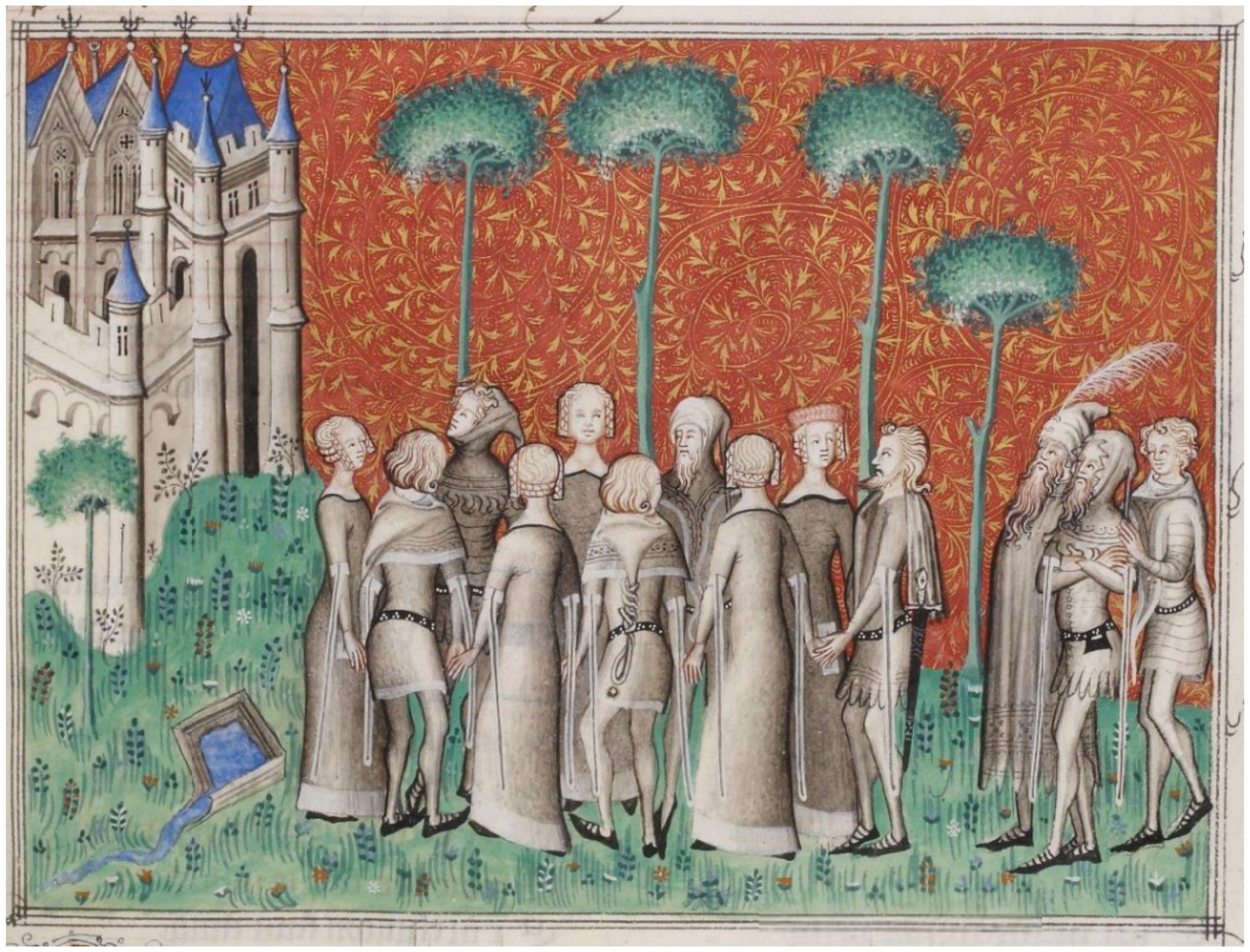
The simple periodicity of this song contrasts with the musical complexity of Machaut’s chansons baladées a generation later. Modern scholars have pointed to Machaut’s metrical ingenuity in the genre. Maw, for instance, finds the irregular (modus) metrical schemes of Machaut’s virelais “unsuitable for dancing except of a stylized nature” (2002, 71), while Lawrence Earp points out the “fashionable ars nova rhythms” of their surface (1991, 125). Judith Peraino similarly finds the relatively “off-kilter rhythmic environment” of Machaut’s virelais to result in “a lively tune that dances itself, though it may not be itself fit for dancing” (2011, 356). And Daniel Leech-Wilkinson notes that “hardly any have the regular metrical structures one would expect of a dance accompaniment” (1991, 16). Although he named the genre for its dance origins, Machaut developed the chanson baladée through polyphonic accompaniment and a metrical ingenuity that overflowed the modest cup of public round dancing. Earp (1991, 113–14) credits the infiltration of ars nova motet rhythmic innovations into secular song with the disassociation of the chanson baladée from dance. Earp (2005, 106) “believe[s] that the early virelais of Machaut are better understood as highly artistic works that merely evoke characteristics of the old dance genre.” Even if the chanson baladée transitioned from dance song to art song in Machaut’s hands, we have the composer’s word paired with an illustration in the earliest complete works manuscript overseen by the composer (Mach C) that this genre was connected with round dancing; at least he wanted it represented that way. Nevile (2008a, 30) and Dickason (2021, 177) describe caroling in the round. Morrison (2021) extrapolates the carole’s circular movement to a choreographic structuring of Sir Gawain and the Green Knight’s (14th c.) strophic form. That the carole could also be a line dance progressing through the streets of town is noted by Eustace and King (2011, 52–56), Page (1989, 115), and McGee (1989, 507). Dance formation has no bearing on my speculation here. Set beside the other songs of Remede in Mach C are depictions of people holding a scroll and sometimes a pen to illustrate reading and composing. On issues of class, gender, and social adhesion in the iconography of round dancing in Machaut’s Remede and other medieval narratives, see Alexander (1996, esp. 151–53).
Consider the danced song “Dame, a vous sans retollir,” from Machaut’s Remede de Fortune (ca. 1340s). See Peraino (2011, 239–42) for detailed elucidation of this song’s lyrics and function within the Remede. While the musical interpolations of the Remede include all of the formes fixes, Machaut associated dancing with the chanson baladée alone by setting an illustration of danced performance beside the score (Example 2). Earp (1991, 126) claims that the storyline of the Remede was contrived to demonstrate each type of song then current, whereas Peraino (2011, 235) calls the Remede “in effect a musical summa.” See also Earp (2005, 105–6) on the virelai as danced song in the Remede. Dickason (2021, 174ff.) explores the carole dance’s role in sacralizing courtly love in the medieval romance Roman de la Rose. See Butterfield (2002) for the generic characteristics of romans à chansons and Stokes (2014) for the didactic undertones of Machaut’s Remede, particularly regarding medieval rhetoric. Leach (2011, 139–64) provides an excellent summary of the Remede and analysis of its lyric interpolations in the context of the poetic functions of Hope and Desire. Boulton (1993, 188–92) defines various functions of lyric insertions into medieval French literary works, including Machaut’s Remede. Here, carolers sing and dance a virelai led by its composer. According to Peraino (2011, 285), “There we see the singer Machaut hand in hand with women in the dance. His voice in the virelai enables the carole.” See also Leach (2011, 159) on Machaut’s identity in this song and its depiction. Leo (2005, 66–68) explores iconographic relationships between Machaut’s manuscripts and those of Le Roman de la Rose, including scenes of caroling in the Remede. Straple-Sovers (2023, 597) cautions that we not read too much into medieval illustrations of dance, “since these sources were not created with the intent to accurately record physical movements, relationships of dancers to one another, or their movement through space.” The Machaut manuscripts are artistic objects formed in a tradition of presentation copies, in other words, and not photographic representations of actual practice.
The modern transcription in Example 3 includes metrical beat counts at the tempus level and formal labels A and B. My transcriptions of Machaut are based upon Ludwig (1926) unless otherwise noted, differing sometimes in suggested ficta and barline placement. In the case of “Dame, a vous sans retollir,” I prefer the anacrustic transcription of Maw (2002, 82) for its benefit of situating the cadences on downbeats, contra Ludwig and Schrade. My beats 1 and 2 correspond Earp’s (1991, 129) “metrical units” 1 and 2, adjusted for the anacrusis. Earp (2005, 106–7) uses the same song as an example of conventional text declamation. His bold-numbered syllables correspond to my numbered beats 1 and 2. The A section (refrain) opens with tonal articulation of G (m. 2 and m. 5), which becomes subordinate to the final cadence one step lower on F (m. 11). The B section floats around C, an open in reference to the final.
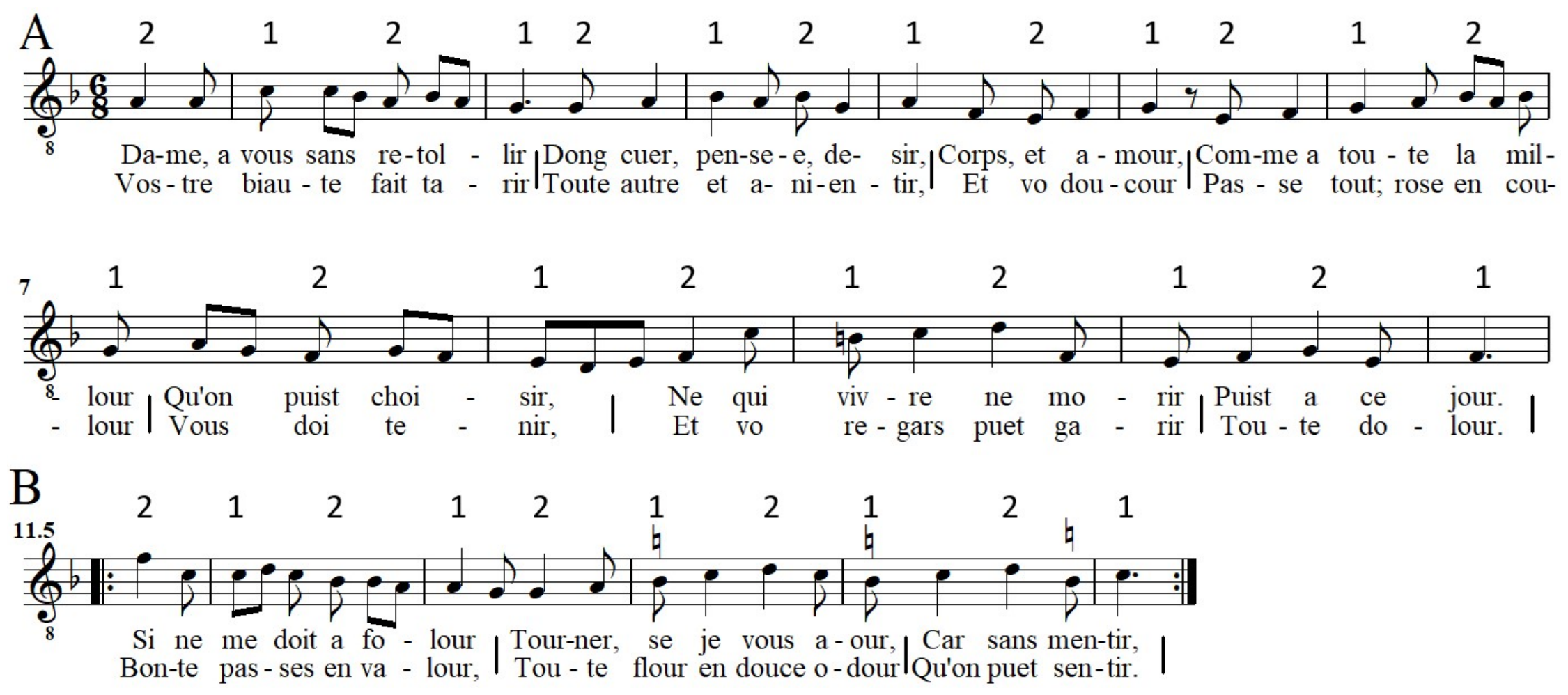
Compared to the Renart chanson (Example 1), Machaut’s dance song is longer, traverses a wider range, dabbles in chromaticism, and freely mixes trochaic and iambic subdivisions. For Earp (1991, 138), “Machaut’s early dance virelais . . . are already far more refined than a popular dance song.” In support of my anacrustic transcription, the song’s metrical layout is representative of the genre in that cadential arrivals, text line endings, and moments of formal closure are associated with a single semibreve location in imperfect tempus. What I call beat 1—the site of metrical accent—emerges as the stronger beat in a song that does not begin with it. Metrical accent, then, is a property ascribed to the (mensural) notation of undifferentiated pulses. These accents demarcate grouping structures through the coincidence of musical and textual parameters. Emphasis on beat 1 is a strong and characteristic correlation in medieval dance music. Of the 120 cadences in Machaut’s virelais, 91% cadence on beat 1. Cadence here refers to arrival on a pitch stressed by alignment with the end of a poetic line, agogic accent, being followed by a rest, modal relationship to the last note of the song, and perfect consonance with other voices in polyphonic cases. Moll (1998, 32) defines cadence accordingly for fourteenth-century French masses. My result may seem inevitable since I rely upon cadential placement (among other features) to mark instances of beat 1 in the first place. The correspondence of cadential arrival with emphasis of other kinds—modal weight, agogic stress, lyric alignment, rest position—allays the danger of tautology here.
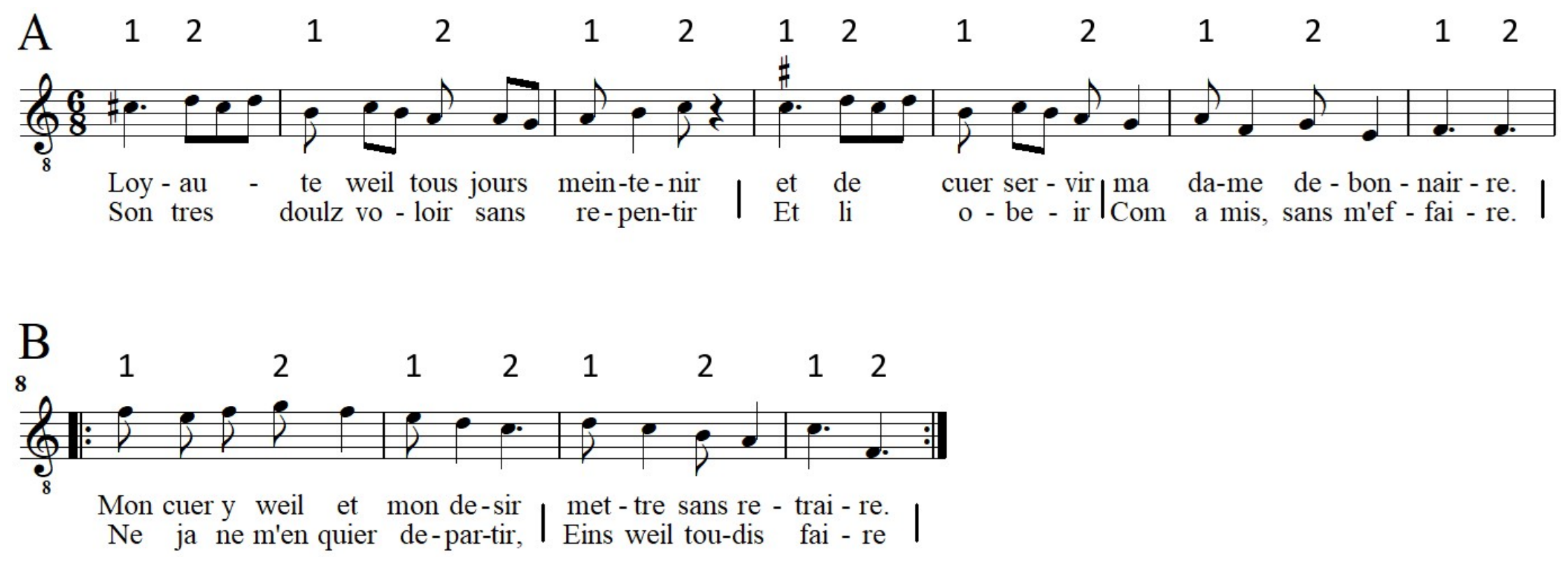
The generic linking of a particular metrical beat to tonal emphasis provides an illuminating tool for analysis. For example, consider the unusual conclusion of the B section (m. 11) in Machaut’s danced song “Loyaute weil tous jours” (Virelai 2), given as Example 4. Machaut’s virelais are numbered as in the editions of Ludwig and Schrade, separated by a slash when Ludwig/Schrade begin to diverge at V23/21. The pitch center of this song is F, ratified by the refrain’s final cadence (m. 7). The unequal line lengths of the poetry are distributed by the melody to end mainly on tonal pillars F and C, once touching on A (m. 5) on the descent through the lydian pentachord. Singing three times through the refrain of this virelai establishes F (, the modal final) as a beat 1 kind of note. Notice, then, that the verses also end on F (m. 11), but situated on beat 2. In a typical forme fixe, the B section terminates on an ouvert scale degree, a pitch that calls for tonal closure later with the return of A. The B sections in some of Machaut’s longer virelais have paired open/closed endings in which the second ending, that which closes the B section, does end on the final. The same open/closed tonal relationship plays out across the A and B sections of V2, rather than within the B section itself. The regular metrical grouping 1–2 / 1–2 provides a medium through which to interpret weakness in the B section’s hop down to the final F. This weak-beat F is further attenuated by the poetic declamation, as the penultimate syllable of “re-TRAI-re” is stressed (beat 1) and the final syllable unstressed (beat 2). What appears melodically astylistic in “Loyaute weil tous jours”—a short verse ending on the final—is redeemed metrically because is relegated to the conventionally weak beat 2. In other words, a pitch that is melodically clos is positioned as metrically ouvert.
Metrical Organization in the Danced Songs
In Machaut’s chansons baladées, irregular groupings, subverted metrical entrainment, and off-kilter metrical organization evince development of a dance genre originally rooted in steady metrical procession. As with other dance songs in imperfect major mensuration, the virelai “J’aim sans penser laidure” (V14) can be transcribed in 6/8. Example 5 assigns a metrical identity to each beat.
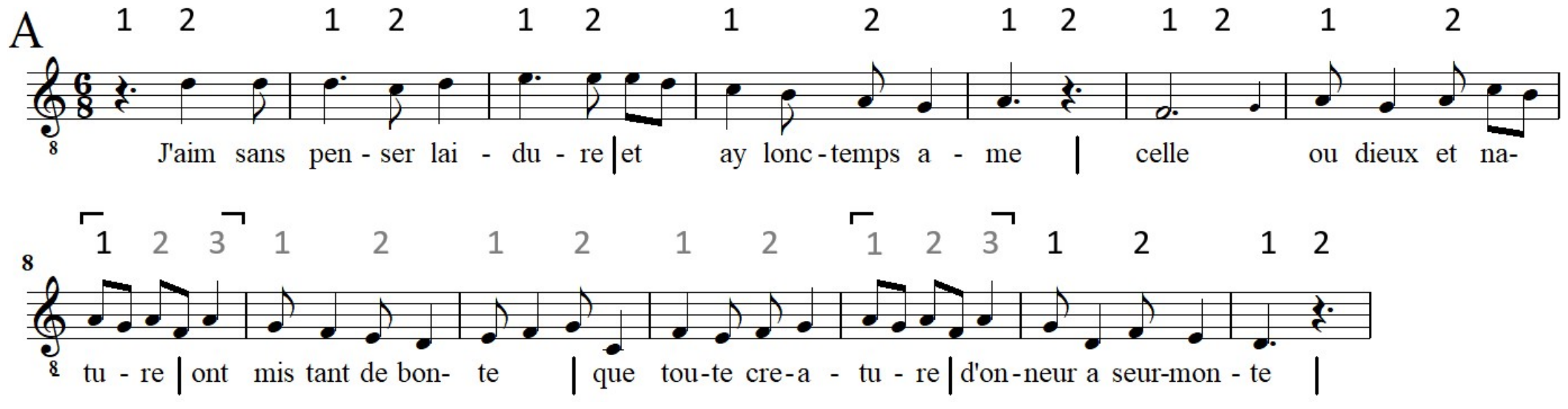
The recurrent trochees and iambs, regular agogic accents (mm. 1–6 especially), and tonal articulations (m. 5 and m. 14) contribute to a steady binary metrical grouping in this song. Relatively long strings of eighth notes, such as in m. 8, however, having no dependence upon a neighboring quarter to capture them as trochees or iambs, can be susceptible to alternative metrical groupings if pitch and lyric articulation reorganize them. Example 5 follows Leguy (1977) in rendering one syllable on each of three equal beats in m. 8 and again in m. 12, which feature the same motive with textual assonance. Following Earp (1991, 130), “There are no extended melismas, and thus the ear hears the text syllables themselves as providing the musical rhythms.” The syncopated “pitch accents” marked in Maw (2002, 72, example 1) occasionally insinuate a perfect minor grouping that rubs against the prevailing imperfect major metrical and declamatory accents of “He! Dame de vaillance” (V1). Maw (2002, 91, example 14c) explicitly renotates “Helas! et comment” (V18) along the same lines, switching to 3/4 to capture the grouping change. Maw (2013, 397, example 8) likewise transcribes the same V18 in 6/8 (mm. 1–6) then 3/4 (mm. 7–11) based upon the syllabification of those phrases. Peraino (2011, 242) mentions a similar “metrical ambiguity (toggling between 6/8 and 3/4)” in Machaut’s “Dame, a vous sans retollir,” examined above, without further specification. Leguy’s edition (from Mach G) is particularly distinct from Ludwig and Schrade in its flexible approach to metric grouping, freely beaming groups of twos and threes in order to capture different “rhythmic cells” (see foreword, vi). V14 is one of ten virelais to which she assigns the dual time signatures 6/8 and 3/4, in addition to others with multiple time signatures. Although Machaut’s notation does not indicate a change in mensuration, the grouping of these rhythms—the question of meter—is open to interpretation. The opposing groupings 2×3 and 3×2 are of equivalent duration, a condition medieval mensural theorists called equipollence. On equating various rhythmic groupings, the Quatour principalia (mid-fourteenth century) is particularly clear. See the translation in Aluas (1996, 685). This single breve of disruption represents a bump in the road, not a change of path. Whereas Ludwig (1926) and Schrade (1956) both beam m. 8 and m. 12 as continued iambs in 6/8, I explore the ramifications of flexible metrical grouping , a trend gaining modern currency. In his recent work, Maw (2002, 2004, 2013) explores a similar responsiveness to irregular metrical and textual groupings in Machaut’s songs, and his transcriptions of some chansons baladées also feature rebarrings and changes of time signature such as I have ventured here.
The original notation, tonal articulation, and text declamation provide evidence for metrical regrouping in the refrain of V14. All manuscript sources show a tight spacing of the consecutive eighth notes in m. 8 and m. 12, followed by a generous gap before the final quarter note—demarcating beat 3 of 3/4 rather than breaking up an iamb of 6/8—suggesting the grouping change I am pursuing. But this spacing, the system breaks (Mach C), and even the page breaks (Mach A) that occur in some manuscripts between the last F and A of m. 8 and m. 12 could simply reflect the line break in the poem (indicated by vertical stroke in the examples), inked in before the music notation was added. However, the way that Machaut repeats the structural pitch A in mm. 7–8, as well as details of text declamation, can define logical metric groupings. Earp (2005, 2012) documents the conventional relationship between metrical pulses and rate of text declamation in Machaut, regarding irregularity (“declamatory dissonance”) as a strategy of poetic expression. In the melody, the initial D, the modal final, is decorated with lower and upper neighbors before descending through the dorian tetrachord D–A, closing on in an ouvert cadence (m. 5). In m. 7, A marks the onset of each of two beats (in 6/8), while in m. 8 the same A can mark each of three beats (a change to 3/4); the same duration is thereby segmented differently. The word “na-TU-re” ends the third line of the poem. In Machaut’s rhythmic setting, “na-” is set as a pickup note to the stressed “-TU-” on the metrically accented beat 1 (m. 8). The weak syllable “-re” follows naturally on a weak beat—beat 2 in both Leguy’s 3/4 reading and in Ludwig’s and Schrade’s 6/8 readings, but aligned one eighth note later (as suggested by the manuscript spacing)—which could have ended the measure. Yet Machaut sets another weak syllable, “ont” (beginning the fourth line of the poem) in a way that acts as a pickup into m. 9, suggesting a third beat in m. 8 that initiates a descent through the dorian pentachord A–D. This dorian pentachordal descent is balanced either by the dorian tetrachordal descent D–A described above (mm. 1–5) or by the pentachordal descent E–A defined by the poetic line breaks, in the latter case linking the two locations of dorian pentachord. Measures 11–12 are slightly different. F marks the two beats of m. 11 before A returns to mark the three beats of m. 12, where the last A is again detached to initiate the final dorian descent A–D.
I use an open bracket above each anomalous triple count to signify a change from an entrained meter. My use of the open bracket is adapted from the modern transcription of medieval coloration, in which a change of ink color or style of notehead in a source manuscript indicates a change of mensural reckoning. Open brackets in modern transcription are distinguished from closed brackets, which usually represent ligated neumes that convey the rhythmic values of a set of pitches. The switch to triple grouping occurs again in m. 12, bookending a passage marked by tonal tension (rendered in gray). This is the first time the song’s final, D, is broached in its proper register (m. 9); yet while the song has until now steadily descended the dorian octave, this low D is not the refrain’s conclusion. Instead, the descent continues to a low C in the following measure. Set as a pickup note at the end of m. 10, low C portends resolution to a more conclusive final D in a dorian context. Following the second triple group at m. 12, which I hear as metrically restorative rather than initiating a second process of destabilization, successful closure is attained in m. 14 through another descending pentachord to the final D. The drama of metrical disturbance in this song resonates with Machaut’s courtly love poetry found throughout the chanson baladée genre, in which the lyric voice often professes being at great pains to maintain steadfast loyalty to a beloved paragon. In setting his poetry to music, Machaut allows for higher-level meanings to emerge as one medium reflects upon the other. Re-evaluating the genre through a lens of metric flexibility, I propose that grouping disruptions can suggest a departure from, or trial of, the beloved’s professed steadfastness, which, in the case of V14, is ultimately overcome as metric normativity is restored together with tonal closure.
Equipollent metrical swaps can also be found in “En ma cuer” (V27/24), only in reverse. In this song, the prevailing meter is triple and the disruptions duple. Besides its triple meter, this virelai is also atypical in being polyphonic. The inclusion of counterpoint likely represents further evolution beyond the genre’s practical dance origins. In Example 6, striking pairs of iambs on the surface are notated in 6/8 (imperfect major) on a separate staff above the score set in 3/4 (perfect minor). In the iambs’ first instance (m. 3), the accompanying tenor reinforces the cantus’ lilt for a single measure. An iambic reading yields only two beats per measure, and I again interpret the interruption of an entrained pattern as heralding a passage of metric uncertainty (in gray above, compare to 1–2–3 in black below). Just as in V14, metric uncertainty is coordinated with tonal tension. The modal final, F, is broached for the first time within this metrically uncertain passage (m. 4), but the finality of F is quickly undercut by the accompanying tenor’s skip up to A, forming an imperfect sixth that pulls weakly toward G. The cantus then leaps a tritone, abandoning closure on F to begin again on B (m. 5). Another equipollent grouping change in m. 7 (in the cantus alone) restores a sense of metric normalcy, defining again a parenthetical passage (mm. 3–7) in which tonal closure is attempted but not yet fully realized. Immediately following this restoration of metrical normalcy the song cadences definitively on octave Cs (), the lydian mode’s tenor.
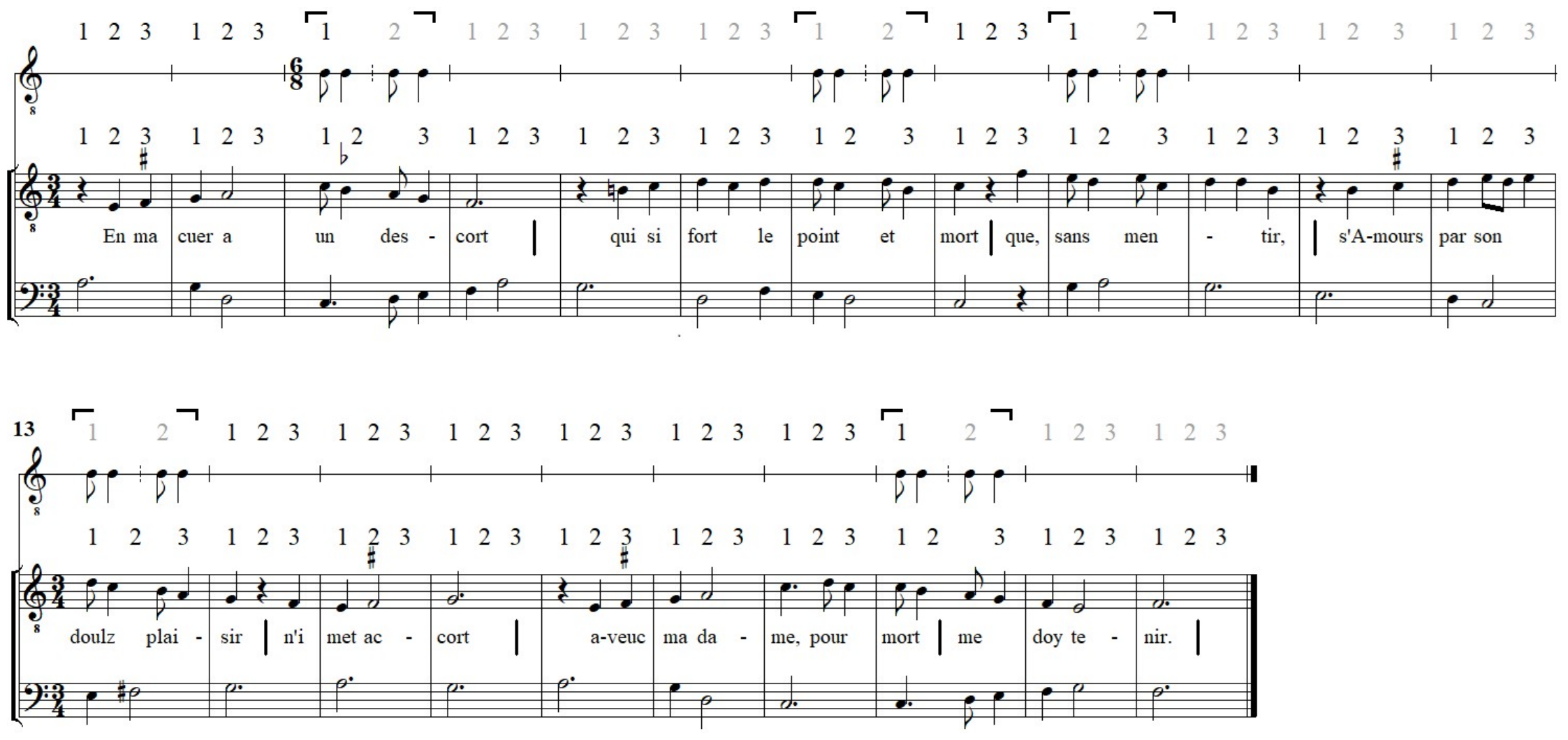
Another metrical swap in m. 9 denies comfortable entrainment in the overarching grouping pattern, marking off a passage (mm. 9–13) that again concludes with a cadence to an ouvert scale degree. Arrival this time is on a tonicized G () in m. 14, echoed quite strongly in m. 16. The regularity of preparing cadential articulation with equipollent metrical play suggests a formal device, in this song at least. The dyad A–F(♯) appears at the beginning of a new phrase in m. 17, but its target G, as , is subordinate to the final F that closes the refrain (m. 22). The descending lydian pentachord C–F in the cantus aligns with the ascending lydian tetrachord C–F in the tenor (mm. 19–22) to affirm the hegemony of F, hinted at only once before in the uncertain pocket of m. 4. These are highlights of a larger tonal arch fashioned by the poetry’s line lengths. Set in groups of 7 and 4 syllables, as marked with vertical strokes in the example, the lyric endings define an orderly plan initially rising in fifths F–C–G (mm. 4, 8, 10), pausing on G (m. 14) as an open neighbor to final F, then descending back through fifths G–C–F to close (mm. 16, 20, 22).
Metrical ambiguity looms, however. In the approach to the final F, m. 20 yields a pattern of iambs identical to those of m. 3, interpreted above as destabilizing. There are five such measures of ambiguous iambs in the cantus, and if they are read consistently across the virelai’s repeats, the song ends on uncertainty. The refrain is repeated three times in the standard fixed form AbbaA: uppercase letters A and B represent different music (refrain and verse) and lowercase letters indicate new lyrics set to the same music. When the refrain is set to new lyrics (lowercase a), the passages of uncertainty discussed previously swap places with what was stable the first time through. Fittingly, the refrain then reverts to its original orientation upon the third and final statement (uppercase A), in which the original lyrics are restored and the piece ends, but does so with uncertainty. Rather than being a dissatisfying conclusion, however, such a reading pairs honestly with the protagonist’s closing sentiment: if the dame remains unmoved by Love, it will be the death of him (s’Amours par son doulz plaisir n’i met accort aveuc ma dame, pour mort me doy tenir).
The examples so far have been analyzed at the tempus level of mensuration by counting each semibreve, most often two beats per measure of 6/8. In my analysis of “Se d’amer me repentoie” (V20), I will group measures (of 2/4) at the broader modus level of mensuration, akin to hypermeter in later European music. The parsing of modus, the number of breves per long, requires an act of analytical interpretation when longs are not present in a melody’s notation (Maw 2004, 60; cf. Hoppin 1960). This study continues modern analytical work on medieval meter by reckoning mensural levels not only by discrete notated rhythms but also by free rhythm that adds up to a given mensural unit. For example, a song may start with two semibreves that can be grouped as one (imperfect) breve’s duration: a beat at the modus level, but a measure in transcription. So too can one semibreve and three minims be grouped as one modus beat, the three minims together equaling a second semibreve of that measure.
When grouping free rhythm into larger durations, the analyst is often guided by melodic units that express consonant intervals through neighbor or passing motions, text alignment, cadential pull and resolution, and, in polyphony, blocks of harmonic identity. In Example 7, barlines alternate between dotted and solid. Each measure lasts for one breve; pairs of measures, demarcated by solid barlines, show longs. The grouping complications found at the tempus level in earlier examples can also be found at the modus and maximodus levels. Interpretive preferences like locating cadential arrivals on strong beats—or secondarily, on any beat rather than off the beat—and situating stressed syllables on metrically strong positions while relegating final mute vowels to weak ones guide my analytical decisions. Maw (2013) provides a thorough analysis of text setting in the Machaut sources, including the alignment of lyric and metric stress, and reconstructs some principles for fitting words to music in his songs.
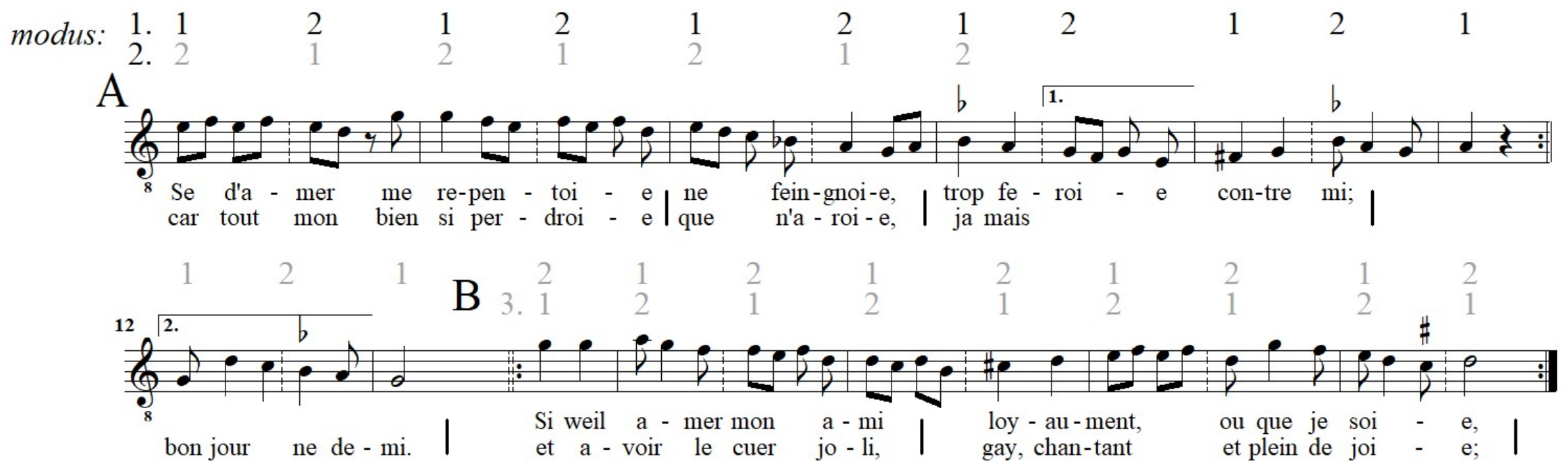
Chansons baladées that do not feature grouping play can still be shaped by metrical organization. The form of “Se d’amer me repentoie” is enlivened by a metrical narrative that plays out across its repeats. Machaut generally sets his poem in units of two or four bars, neatly expressing imperfect modus. But the regular pace of declamation established in the refrain, two syllables per measure, is disrupted by the first ending’s protracted two bars per syllable. The melody opens with an octave’s cascade from high to low G, whereupon an inflected F♯ overshoots the final G to land open A () on a strong modus beat in m. 11. If this F♯ leading tone had resolved to G in m. 10, rather than pass through it to A in the following measure, the refrain would take the balanced shape of 4+2+4 bars. As a result of the first ending’s melodic elongation to five bars (4+2+5), the strong-weak relationship of the refrain’s metrical organization is inverted when repeated. The refrain’s second ending, however, is shorter than the first by one measure and, with balance now restored, the closed cadence on final G (m. 14) also falls on a strong modus beat 1. If both refrain endings were of the same length, the final cadence would have landed on a weak beat.
The B section begins on a weak beat (m. 15), recalling the refrain by opening again on high G, but winding downward this time to an open cadence on D () in m. 23. As in the refrain, the beat strengths are reversed when B repeats owing to a musical setting of 4+5, but with the “extra” measure occurring at the front of the group of five rather than the end. There is an incipient melodic return of the refrain’s opening four bars in mm. 20–23, the extra measure being the anacrustic m. 19. The way that the C♯ leading tone overshoots D recalls how F♯ overshot G at the end of the A section. It seems fitting that only in the final return of the refrain, where a (same music, new text) is succeeded by A (same music, same text), should V20 return the same music and same text to their original metrical disposition, thus tying together the musical threads of the song. My transcription of V20 conforms with all but one Machaut manuscript in which this song is represented (Mach B, C, E, G, and Vg). It differs from Mach A, which appends a breve (half) rest after the ouvert cadence on A in m. 11. If this rest is a measured duration and not merely a section marker, it represents a significant metrical change insofar as it provides a new measure for another modus beat. This extra measure would realign the repeat of the refrain on the same metrical footing—that is, m. 1 would return on beat 1 as before—correcting what I characterized as a mismatch. However, I take this phantom breve to be a section marker, because it is not present when the refrain is renotated with new text later in Mach A (after “oubli,” not shown in the example).
In addition to equipollent changes of metric grouping and off-kilter formal repeats, Machaut’s polyphonic virelai “De tout sui si confortee” (V38/32) explores metrical novelty in connection with phrase organization. Example 8 interprets the song’s refrain, with beats labeled above the score at the modus level. This initial example contains only the cantus part, in order to discuss its structure in isolation; a full discussion of cantus and tenor together follows. My transcription follows Schrade (1956) in maintaining duple time throughout; Ludwig (1926), by contrast, alternates 2/4 frequently with quadruple time (notated 4/4) and includes a single measure of 3/2.
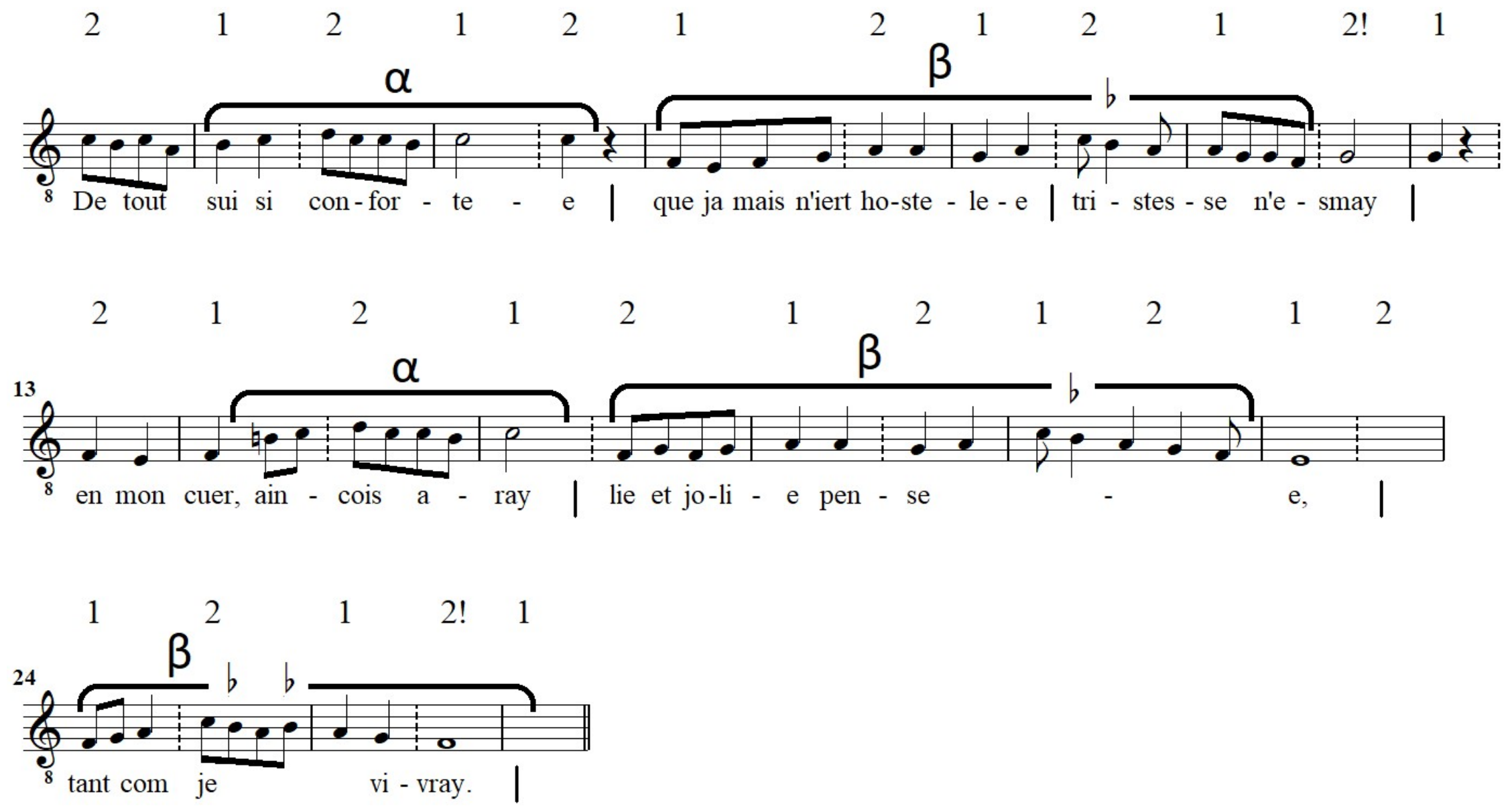
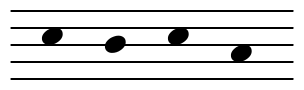
The refrain of “De tout sui si confortee” is essentially comprised of two phrases—labeled α and β in the example to distinguish them from formal labels A and B—varied melodically, rhythmically, and metrically in their repetitions. Simple beat counting foregrounds Machaut’s elastic approach to repetition, as the same melodic skeleton is realized across longer and shorter time spans. Phrase α circulates upper and lower neighbors around the pitch C, ultimately cadencing on that same open (mm. 4–5). Phrase α is prepared by what I consider a pickup (m. 1) before the first downbeat (m. 2). First, this proposed pickup ensures that the melodic, textual, and agogic accent on the cadential C in m. 4 coincides with the strong beat. Second, a very close repeat of phrase α occurs without the pickup in mm. 14–16. Third, when the refrain is repeated, the pickup falls appropriately on weak beat 2, preserving m. 2 as a strong downbeat. Fourth, the transposable motive shown in Example 9 recurs throughout Machaut’s songs. From the virelais alone, see examples of this motive in V5 (mm. 4–5), V6 (mm. 15–16), V10 (mm. 14–15), V11 (mm. 4–5, 10–11, and 14–15), V12 (mm. 8–11 and 18–21, second endings), V15 (m. 18), V17 (mm. 8–9), V18 (mm. 9–10), V23/21 (m. 9), V26/23 (mm. 12–14), V29/26 (mm. 4–5), V31/28 (mm. 14–16, 25–26, and 31–32), and V37/31 (mm. 10–11 and 19–20), not to mention the innumerable variants of this pattern. In this danced song, it is used as an anacrustic windup targeting the C of m. 2, a modally structural pitch (the tenor) made sweeter by the prior accented passing tone B. While emphasis of the pitch C enjoys a modal rationale here, the modern analyst of medieval music must always beware the pitfalls of creating the tonal emphases they wish to find through the creative act of transcription, such as the metrical fitting of barlines and deploying of musica ficta as leading tones. Leach (2000, 45–46) reviews these issues in reference to fourteenth-century song. As speculated upon later in this study, dance provides another parameter of medieval performance that may regulate meter—and thus tempt the modern analyst into placing this or that note on or off the beat. Caveat saltator.
Phrase β consists of an essentially stepwise ascent from the song’s final, F, to C and back down again. Although it is logical that the tonally open phrase α would be followed by the closure of phrase β, the detail of V38/32’s melodic shape is more complex. In its first occurrence, phrase β’s F–C–F motive is followed by an ouvert termination on (mm. 11–12), postponing tonal closure for a later phrase. The return of phrase α (mm. 14–16) restarts the same melodic trajectory and is again followed by phrase β, to which is now appended a different ouvert ending on (mm. 22–23). The refrain’s final phrase comprises β alone, which finally comes to rest conclusively on its final F (mm. 27–28). The tonal closure achieved only upon the repeat of phrase β (mm. 24–28) could have been achieved the first time (m. 22) by simply landing on F () instead of on E (). The necessity of the repeat, in that case, may be attributable to text painting. Throughout the poem Machaut’s protagonist scorns despair and, in mm. 18–22, dwells willfully upon happy thoughts across an extraordinary melisma of four measures. If the rate of text declamation here paralleled the first phrase β instead (mm. 6–12), the appendage of a third phrase β would be superfluous.
Because the initial measure was interpreted as a pickup, the first cadence lands on a downbeat (m. 4), and the following upbeat contains a final mute vowel (m. 5). If this is fitting for the first phrase of the song, the remainder is more ambiguous. The other four cadences of the refrain are evenly split as to landing on the strong or weak beat, with the ultimate close arriving against convention on a weak beat (m. 27). However one regards the opening measure, the melodic repetitions that represent the heart of the song are metrically inconsistent.
Probing broader metrical levels, beyond even the long of mensural notation, continues to reveal tonal congruences and irregularities. Just as beat 1 accrues a sense of thesis and beat 2 of arsis as a song unfolds, every other downbeat (or every third downbeat, in perfect mensuration) can feel weightier still and parse the pitch structure into ever larger units. As before, tonal articulation and formal boundaries point to larger metrical divisions, establishing hyperdownbeats that are more weighty than those that occur merely out of alternation with upbeats. Example 10 depicts these deeper kinds of downbeats, which in mensural terms reflect the difference between modus (breves per long, or pairs of measures separated by a dotted barline) and maximodus (longs per maxima, only the unbroken bar lines). The layered interpretation of strong and stronger beats, as well as weak and weaker ones, is analogous to Lerdahl and Jackendoff’s (1983) metrical hierarchies and Graeme Boone’s (2000) pulse frameworks, and one could imagine smaller sub-beats 1 and 2 below the tempus level shown here. Lerdahl and Jackendoff (1983, 19) associate undifferentiated beats with strong-weak alternation, so that beats 1 and 3 of 4/4 meter are strong while 2 and 4 are weak. In the transcription of Machaut’s virelais here, this corresponds to two measures of imperfect tempus counted 1 2 / 1 2. Counting mensural units at the modus level reveals the first beat 1 to be stronger than the second—parallel to beat 1’s comparative strength over beat 3—because it is also strong at the modus level while the second tempus beat 1 falls under a weak beat in modus reckoning. See also Lerdahl and Jackendoff (1983, 18–30) on metrical hierarchy. Boone (2000, 4) presents a similar “grid of pulse classes and pulse levels” in a medieval repertory. The expectation of strong-weak alternation at the deepest layers of metrical organization in Machaut’s danced songs is extrapolated from norms of composition at local levels. For example, Machaut is much more likely to provide intervallic consonance on the beat at the prolatio level (eighths per quarter). In V38/32’s substantial refrain, eighth-note positions 1 and 3 set consonant intervals 86% of the time (42/49, omitting rests), enough to regard strong-beat dissonances as decorative of some underlying consonance. At the tempus level (each measure of the transcription), every downbeat is consonant. The more revealing distinction at this level is whether the consonances are perfect (67%) or imperfect (33%), a distinction that I will pursue below. This generic connection between strong beats and consonance thus provides a backdrop against which to interpret relationships between metrical organization, tonal articulation, and formal boundaries.
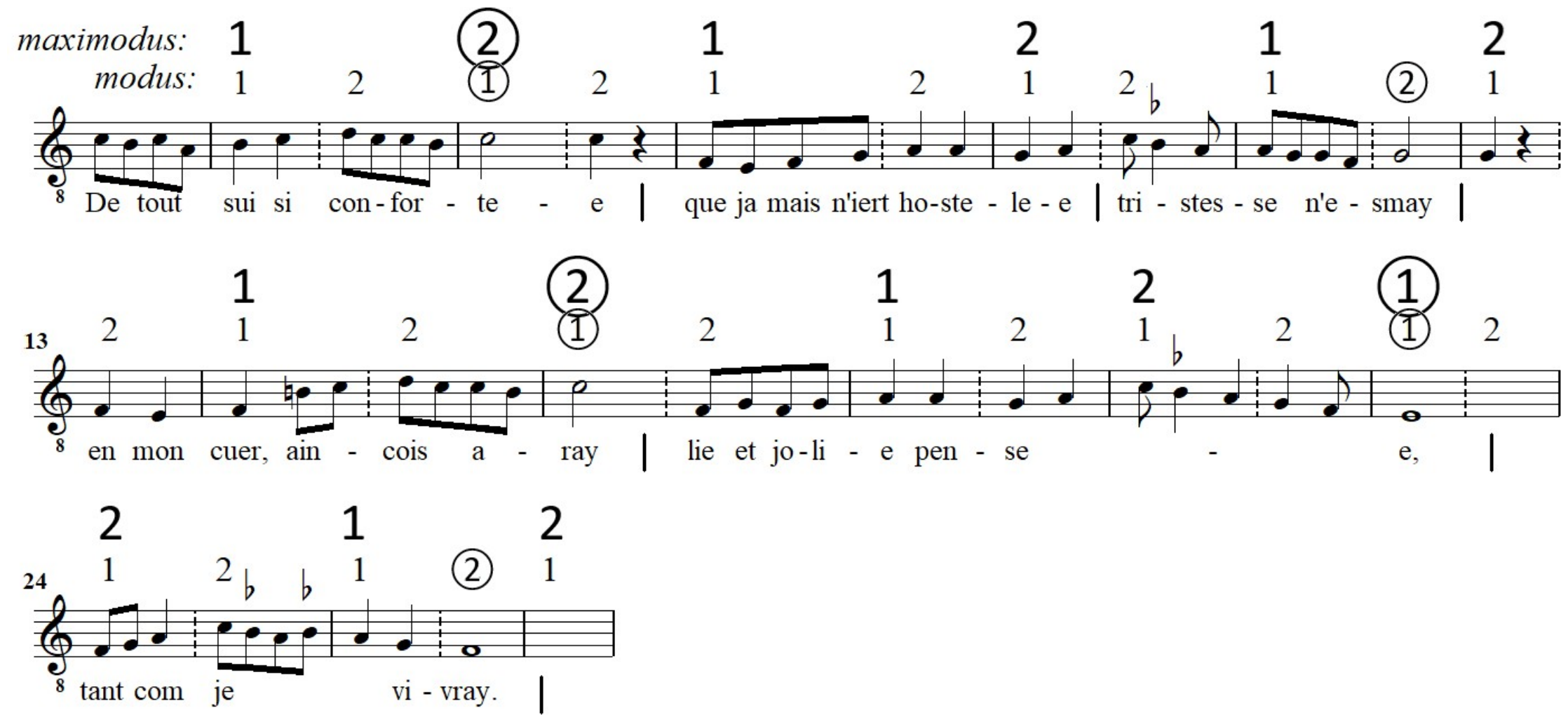
It is especially at the deeper levels of Machaut’s music where metrical irregularity is most prominent. On flexible metrical grouping as a valued characteristic of deep mensural levels in Machaut, see Boone (2000), Maw (2004), and Lavacek (2022). The flexible metrical interpretations of modus and maximodus here resonate with Lerdahl and Jackendoff (1983, 22): “This large level of metrical analysis [at 4 bars] is open to interpretation, whereas smaller levels are not.” An initial assumption of imperfect subdivision, normative of the genre at lower levels, does not meaningfully parse the tonal content of V38/32 at the maximodus level. As shown in boxes in Example 10, two cadences, including the final one, fall between beats at this summary analytical level. Example 11 provides an alternative reading that permits occasional maximodus-level expansions (perfections) in order to align tonal accent more closely with metric pulses. In this interpretation, all five cadences fall on a beat, still more often a weak beat, but never in between beats. Mensural expansion occurs via triple grouping inserted into the regular duple entrainment, and it thus stands against the normative backdrop of duple mensuration in Machaut’s virelais. Although such an effect could conceivably occur anywhere, it is most stylistic either just before a cadence (as in mm. 8–10, 13–15, and 24–26, effecting a written-out ritardando) or in capturing a pickup measure before a prominent downbeat (as in mm. 27–29). Other modern scholars have noted how broadening the mensuration can realize a ritardando effect before a cadence. Adjusting modus and larger mensural groupings to align harmonic units and cadences is central to the analysis of Machaut’s motets in Lavacek (2022). Kohn (1981, 41–42) comments upon a cadential retardation effected through mixed meters in the Dunstable motet “Sancta Maria.” Desmond (2018, 217) shows a change in all voices from imperfect to perfect modus, which acts like a cadential retardation, at the conclusion of each talea of the Fauvel motet “Garrit/In nova.” Maw (2004, esp. 64–65) locates modus perfections in an imperfect context leading up to cadences in Machaut’s ballade “Gais et jolis” (B35), among other examples. He later calls this effect “a reverse hemiola at the cadence” (86). Further examples from Machaut’s virelais are found in Maw (2002, 84). In this way, Example 11 offers a more flexible metric analysis that better aligns the phrase structure with the song’s tonal articulations. By interpreting perfections at the modus level, I achieve the same effect as Ludwig’s single bar of 3/2 (breves 22–24), with the benefit of placing the final F on a downbeat (breve 27). Closely allied to cadences, the two oxytonic rhymes on -ay (m. 11 and m. 27) are brought into alignment with strong metrical positions. The final pitch of the paroxytonic pen-SE-e, an ouvert E pointing towards the final F to come, also falls on a downbeat (m. 22), with the longest melisma in the song (mm. 19–21) bestowing ample stress upon its penultimate syllable.
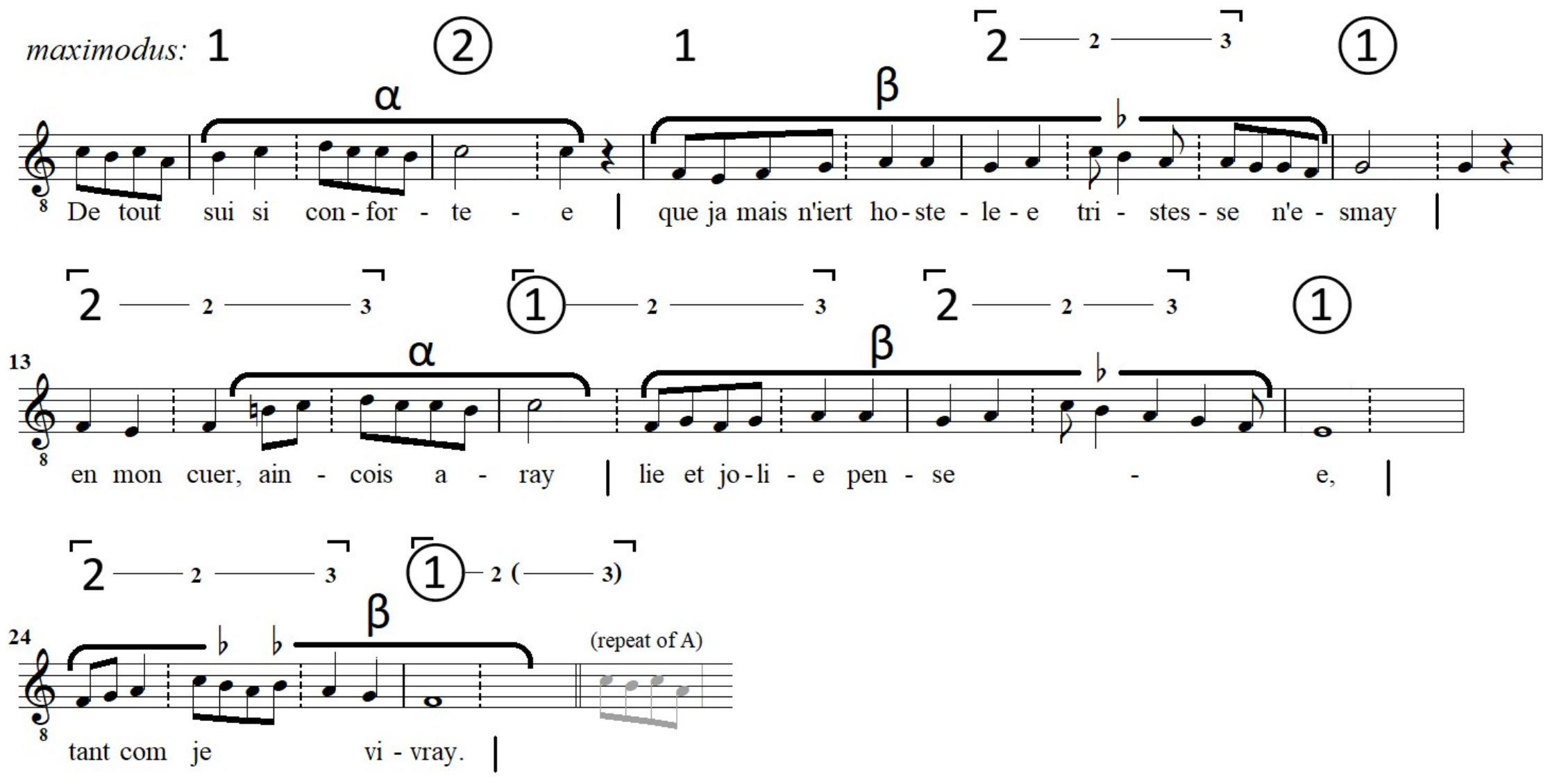
I have interpreted metrical expansions six times in this refrain. The first occasion is in mm. 8–10, where beat 2 is extended for three counts (notated 2–2–3) before a downbeat marks the cadence on G in m. 11, a strong point of articulation that fell between beats in Example 10. This perfection has the effect of phrase broadening before a significant arrival, opposite of the hurried little hemiolas on a much smaller scale in V14 (recall m. 8 and m. 12 of Example 5; three beats in the place of two). The next metrical perfection is interpreted across mm. 13–15 for the same end, to unite the beat 1 thesis with a melodic arrival point, the cadence on C in m. 16. Measures 19–21 and 24–26 similarly prepare their cadences, the first an open ending on E () and the last closing the refrain on the song’s final, F, both now tied to downbeats. The perfection interpreted in mm. 16–18 is an expedient that sets up the usual cadential broadening in mm. 19–21, which preferably begins on a weak beat so as to land the cadence on a strong beat. Finally, the repeat of V38/32’s refrain prompts another modus perfection (mm. 27–28–1), wrapping around to m. 1’s anacrusis. The guiding intent for all these interpretive adjustments is for the metrical structure to correspond with the tonal organization more agreeably, providing consistency in cadential approach and arrival.
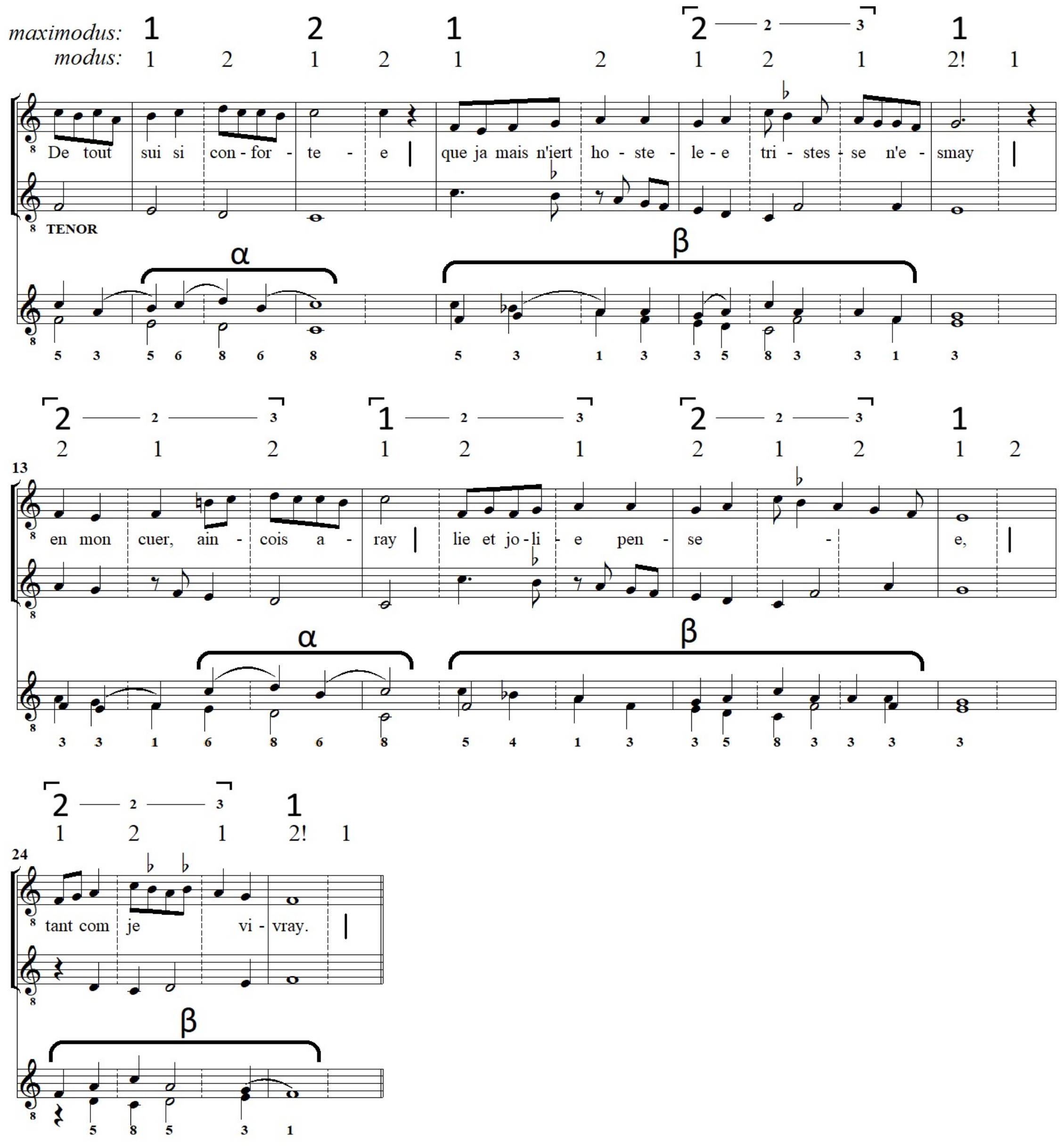
The cantus may carry the melody here, but it is not the complete song. The polyphonic analysis of Example 12 shows a strong correlation between counterpoint and my flexible metrical grouping above. The note-against-note discant reduction at the bottom of the example highlights relationships between pitch and metrical grouping. My discant reduction was largely produced by the simple omission of dissonances against the tenor, especially when such notes occur off the beat in passing or neighboring melodic motion. Leach (2000) provides an instructive example of modern reductive analysis grounded in medieval theory. For example, Machaut consistently employs imperfect consonances on (modus) downbeats only when approaching cadences; the strong resolution tendency of imperfect to perfect consonances joins contrapuntal propulsion to the metrical broadening (maximodus perfections) I have suggested at mm. 8–10, 13–15, and 19–21. On the crucial concept of directed progressions in fourteenth-century polyphony, the classic source is Fuller (1992). Essentially, imperfect consonances drive toward the greater stability of perfect consonances through stepwise contrary motion, especially M3🡪P5, M6🡪P8, and m3🡪P1. As a foundation for Machaut’s ars nova practice, polyphonic simultaneity is tightly linked to consonance/dissonance placement in the ars antiqua mensural theories of John Garland, Franco of Cologne, and Anonymous IV, as detailed in Fuller (1981). Machaut’s counterpoint against recurring phrases α and βalso shows a high degree of consistency. In Machaut’s polyphonic chansons, a free tenor voice is composed against the fundamental cantus, the reverse of his sacred cantus firmus style. In both occurrences, phrase α begins with a stable fifth expanding into an unstable sixth, which drives outward by stepwise contrary motion to the nearest stable interval, the perfect octave. This 6–8 directed progression occurs twice in descending sequence in each statement of phrase α, while dissonant passing sevenths provide even greater drive for resolution on C (m. 4 and m. 16). The modern formulation of the directed progression, stepwise contrary motion from imperfect to perfect consonance, was introduced in Fuller 1986 and further developed in Fuller 1992. The first two occurrences of phrase β are likewise similar, terminating each time on the same open dyad E–G that yearns for resolution on F (m. 11 and m. 22). The final iteration of β (mm. 24–27) appears in compressed form and is harmonized differently. Replete with perfect consonance, a judicious third is employed only at the final cadence (3–1). Note the special contrapuntal strength of this final arrival, converging in contrary motion through a catalog of the intervallic consonances: 8–5–3–1 (mm. 25–28). This more solid setting of phrase β perhaps represents the singer’s resolve to remain loyal “as long as I live” (tant com je vivray). With all its polyphonic and metrical subtlety, Machaut’s V38/32 stands out as an art song evolved from a dance tradition it no longer exemplifies.
Danced Songs in Triple Time
Among Machaut’s chansons baladées, there exist only four (12%) in perfect tempus: V26/23, V27/24, V31/28, and V32/29. Insofar as Mullally (1998, 19) insists that “social dance of the period requires music in duple time,” these few songs in triple time may be further evidence of Machaut’s artistic extension of a genre with ancestry in dance. The foregoing analyses made special interpretation of modus perfections within an imperfect norm, and the converse principle will apply to danced songs in triple time. While perfect groupings at the tempus level will go without remark, considerable flexibility will be called for at the modus level and beyond.
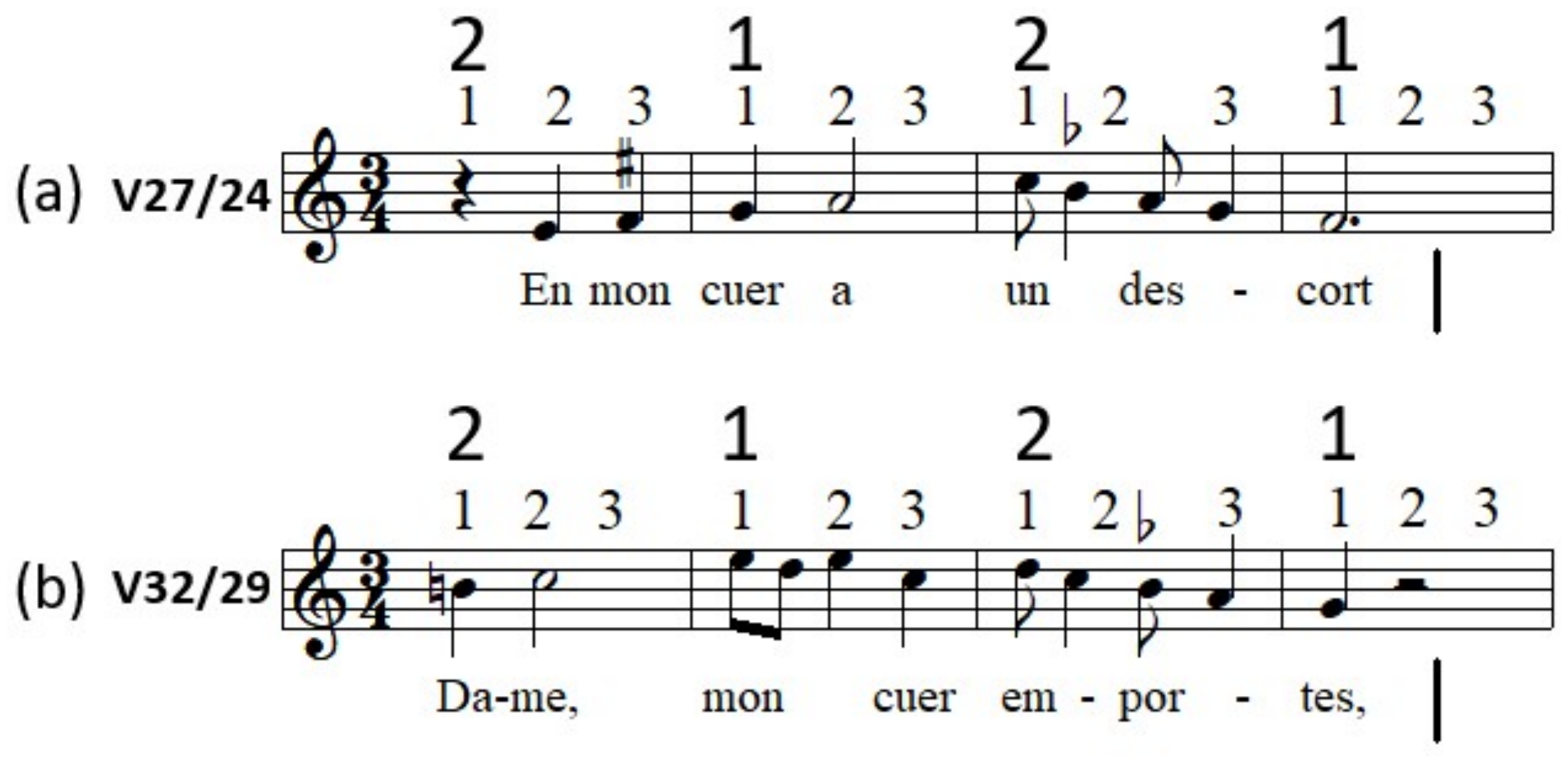
Example 13 presents the opening phrases (i.e., to the first cadence) of two virelais in triple time with metric interpretation at two levels, tempus and modus. The cadential layout of these songs—aided by the opening rest, in the first case, and ascending iambs, in both cases—strongly prompts an anacrustic metrical interpretation at the modus level. Maw (2004, 94–95, table 7) provides a detailed list of modus organization in Machaut’s formes fixes, including flexible readings of perfect/imperfect alternation.
All directed progressions in V32/39 and V27/24, with one exception, fall conventionally on a downbeat. Example 14 provides an annotated score of the cantus line of V27/24, omitting tenor accompaniment. The metrical level of analysis is now modus, compared to Example 6’s tempus reading of the same song. The beats of directed-progression arrivals are circled. The only directed progression that falls on beat 2 is a contrapuntally weak inverted one (m3🡪P1) in m. 21, which provides an anticipatory taste of the final F. The F of m. 21 is contrapuntally, metrically, lyrically, and formally subordinate to the M6🡪P8 directed progression that closes the A section on beat 1 of the following measure. Each section of this song, A and B, closes conventionally on beat 1. Cadencing on a strong beat prepares both of this chanson baladée’s formal junctures to begin with an upbeat, further reason to prefer an anacrustic opening for the song as a whole.
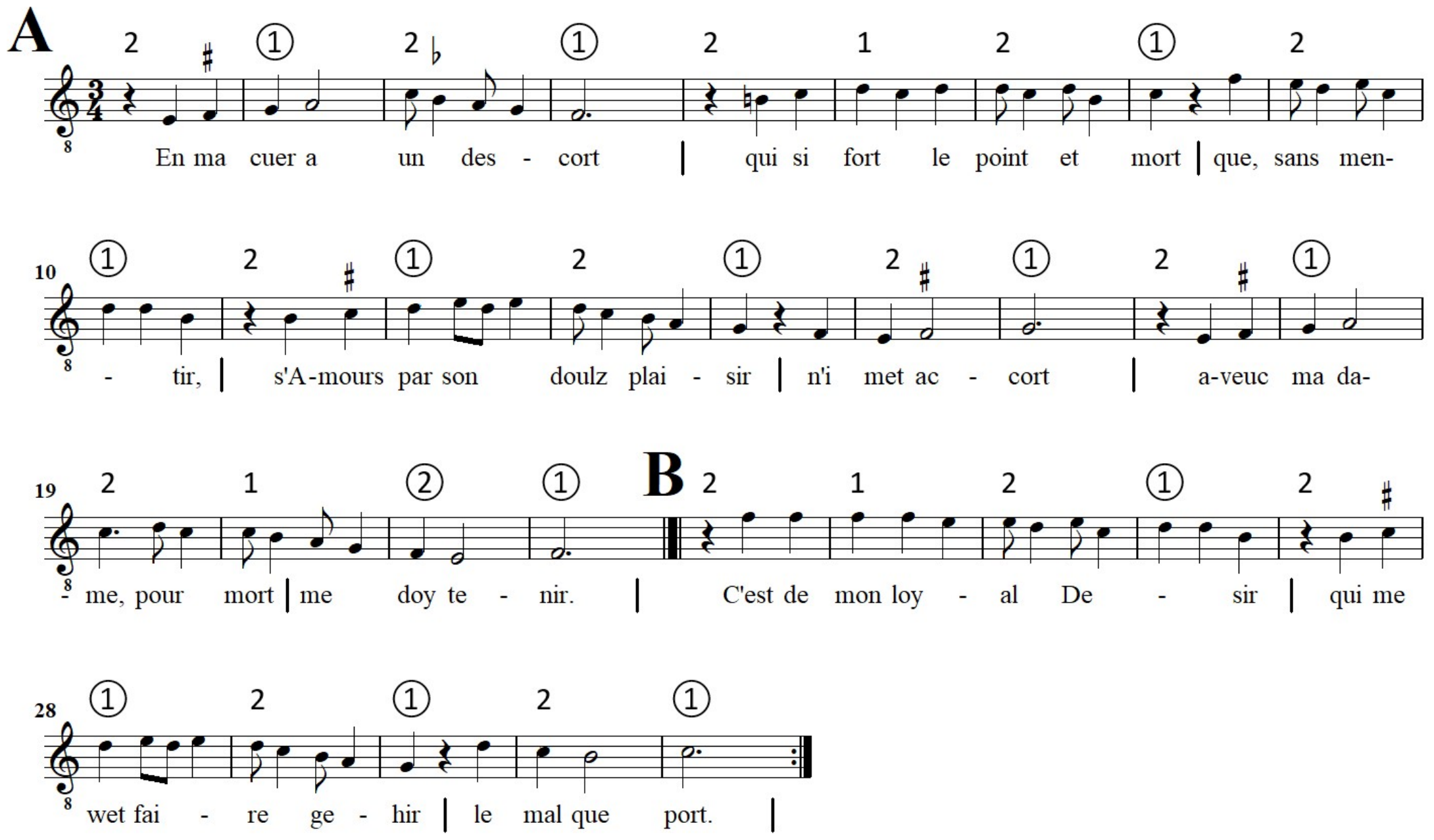
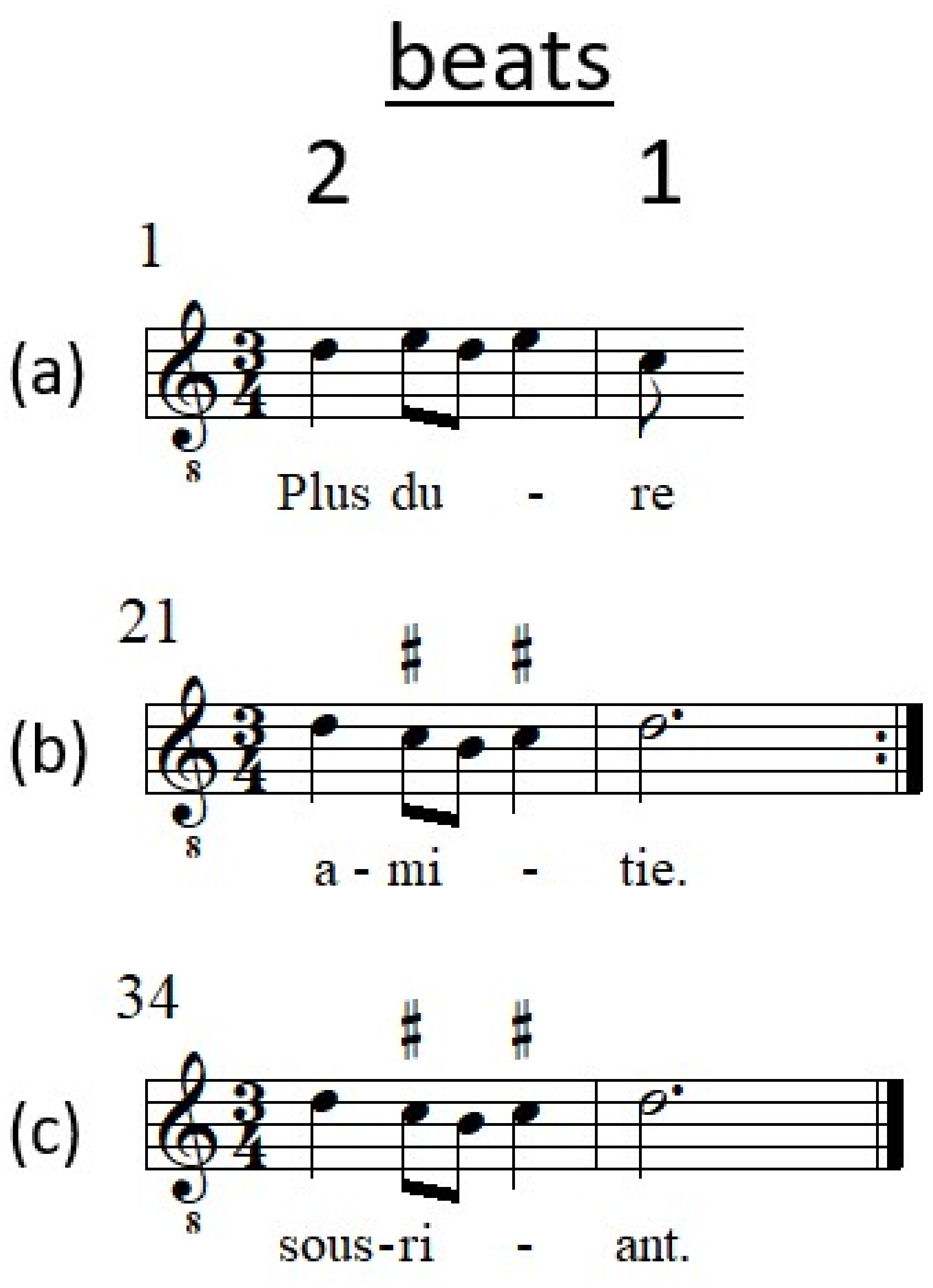
The consistent placement of preparatory gestures can provide a musical cue for metric interpretation, not only at the beginning but as found throughout a danced song. In V27/24, the same gesture in m. 1, identified above for its melodic and rhythmic directedness, returns often throughout the song, as at mm. 5, 11, 17, and 27, and in varied form at m. 15 and m. 23. The fact that in every instance this melodic preparation falls on a weak beat, where the strong beat is consistently defined by the directed counterpoint of imperfect to perfect consonant arrivals, assigns a subordinate role to that beat in the emergence of duple meter and argues strongly for beginning this virelai with an anacrusis. A related case arises in V31/28 (Example 15). In V31/28, the opening figure of m. 1 does not appear so melodically driven as the ascending leading tone of V27/24 and V32/29. Its function, rather, becomes clear through consistent usage as cadential preparation. The formal cadences that close both the A and B sections (Examples 15b and 15c) are motivic repetitions of m. 1 (beat labels 2 and 1 apply vertically for all staves). Insofar as cadential arrivals are conventionally marked by a strong beat, the gesture that prepares them should be interpreted as weak: this norm can be retrospectively applied to the beginning of the song.
The final danced song in triple time, “Tres bonne et belle” (V26/23), is irregular at the modus level regardless of how it begins. The cantus melody opens with the descending pentachord G–C, decorates that C () with both upper and lower neighbors (D in m. 2 and B in m. 3), then descends again toward G (mm. 4–5) to start the following phrase (Example 16a). A compressed variation of this melodic framework returns later in the A section (Example 16b), reflecting the poetry’s rhyme scheme (-ueil). But this melodic return comes against the prevailing metrical (modus) entrainment: not only is the melody now metrically unstable—strong and weak beats are reversed—but it is also recontextualized by a different accompaniment in the two lower voices. The metric disturbance here may reflect Machaut’s courtly love lyrics. While the lover’s eyes are smitten with the beloved in the first phrase (Tres bonne et belle, mi oueil joyeuse pasture prennent en vostre figure), the heart of the second phrase will be stung by the pains of unrequited love rather than enjoy any sweet nurturing (et mes cuers en vostre accueil vie et douce norreture).
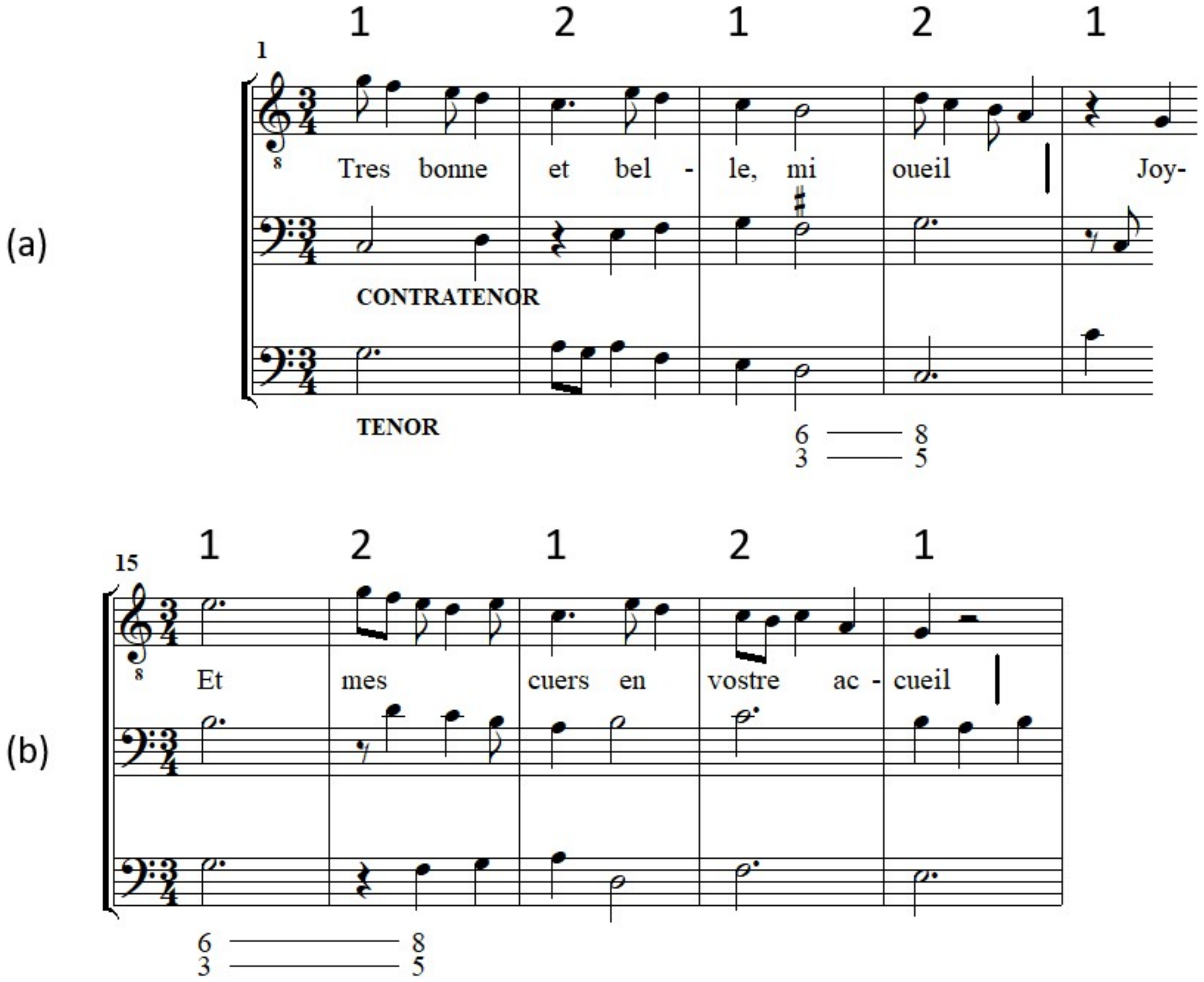
My proposed metrical setting rests on the norm of imperfect modus groupings (tempus being what it may). The directed intervals harmonizing the preparatory word “et” that begins the second phrase (imperfect sixth and third in m. 15) suggest a weak beat rather than a strong one. If a strong beat were to follow in m. 16, the phrase’s metrical organization would parallel that of the first. The analyst may thus be tempted to interpret a modus perfection of mm. 13–15 to prepare a proper downbeat at m. 16. Measures 13–14, however, form a clear cadence (E6/3 to D8/5) which ought to proceed weak–strong. This cadence, in turn, pushes back an initiating downbeat to m. 12 and the modus perfection somewhere within mm. 9–12 (an exercise left to the reader’s discretion). In any event, the entire refrain cannot repeat on the same metrical footing when it returns at the end of the virelai form because it comprises an odd number of measures. If the final cadence (m. 23) is to be a strong beat, respecting this as the very strongest metrical convention in the style, m. 1 ought to occur on a weak beat, and a metric grouping somewhere in between will have to be perfected.
Some Speculation About Dancing Machaut's "Danced Songs"
Social dancing “was ever-present in the lives of western Europeans from the late Medieval period to the middle of the eighteenth century” (Nevile 2008a, 2). For a rich and broad exploration of dance’s artistic, political, and intellectual importance to western European society during 1250–1750, see Nevile (2008a, 2008b). Renberg (2022) recounts the falling status of dance in early medieval texts from worshipful to sinful (as gendered bodies in motion), while Dickason (2021) explores the reclamation of dance from a transgression to an integral part of medieval religious practice. Chaganti (2018) details how the central position of dance in late medieval society informed the creation and reception of lyric poetry. Page (1989, 110–33) views the French carole’s social context from the perspective of an evolving clergy. Straple-Sovers (2023) is instructive on the challenges and authenticity of recreating medieval dance practice, given the dearth of sources; see also Straple-Sovers (2021) on reading bodily movement—with caroling as cautionary example—in medieval literature. Arcangeli (1994) reviews the colorful denunciation of dance by medieval clergy and moralists, not limited to claims of adultery, gluttony, paganism, lechery, and disregard for the Sabbath. The carole—after the Old French verb caroler, to dance—was the simplest and most common type of dance, and well established in France by the mid-twelfth century (Mullally 1986, 224). Also karole and querole. Latin: chorea. The term refers both to the dance itself and to the music that accompanied dancing. McGee (2012, 399) notes that “scholars in all fields use the term [carole] with a vague and sometimes contradictory understanding of exactly to what it refers.” Stevens (1986, 175) calls the carole “a dance-idea waiting to be realized in various forms.” Dickason (2021, 5) points to the array of activities inseparably connoted by Latin terms for dancing, including not only bodily movement but also singing and exalting God. Mullally (2011) discusses the etymology, choreography, and social participation of this simple dance without detailed analysis of musical structure. In a highly critical review, McGee (2012) casts doubt on Mullally’s dismissal of commonly accepted views of caroling, his biased selection and weighing of evidence on the dance and its accompanying music, and his specific application of the hypothetical dance steps he posits for the carole. Medieval French writings on a wide range of topics mention the carole, and illuminated romances provide numerous depictions of it (such as Example 2). Alas, no European dance manuals exist before the fifteenth century (Nevile 2008a, 7; Dickason 2021, 4). Ward (1976) and Dean Smith (1937) provide accounts of a fifteenth-century handbook on the basse danse that introduces step patterns. Little (1975) discusses a Baroque dance manual more closely matched to the given music, including implications for analysis and musical performance. Authoritatively matching fourteenth-century music to dance steps thus remains elusive, and is not something I will attempt in this article. Rimmer (1985) makes a speculative attempt to match specific dance step patterns with medieval trouvère repertory. Her choreography rests upon the anachronistic assumption that the steps of fifteenth-century branles can be applied to “chain and round dances [caroles] of which we know practically nothing” yet which are presumed to have “identical step elements” (26). I endeavor instead to articulate some considerations for coordinating rhythmic movement (whatever it may be) with Machaut’s “danced songs.” By engaging in such speculation, I do not claim that these works were danced in Machaut’s time. Though dance cannot be seen in manuscript, modern score, or concert performance today, the interplay of movement and song may have been a primary concern to the medieval composer, singer, and dancer. It seems logical for a dance and its accompanying music to evolve together in subtle ways that we lack evidence to recreate authentically.
There is one element of numerable “danced songs” that indicates the possibility of dance awareness. According to Aristotelian doctrine, “Time was only rendered sensible as a description or quantification of enacted motions or changes” (Grant 2014, 15). Recall that the first musical event of V14 (Example 5) is a dotted quarter rest. That rest is a transcription of the semibreve rest in all sources (Mach A, C, G, and Vg), omitted by Ludwig (1926) and restored by Schrade (1956). V14 joins V4, V27/24, and V36/30 to form a small set of virelais that begin with a semibreve rest in all manuscripts. Ludwig (1926) reproduces the rest only in V27/24, likely to counterpoint the tenor’s entrance, whereas Schrade (1956) begins both V27/24 and V36/30 (both polyphonic) with a beat of rest, but not V4 (monophonic). The first sung pitch occurs on the weak beat after the rest. Little (1975, 114, 119) discusses a French Baroque dance manual, one of the first to inlay music notation with dance steps, in which pickup notes are danced with an introductory plié before the steps proper begin. Example 17 shows this song’s opening in the clear notation of Mach C.
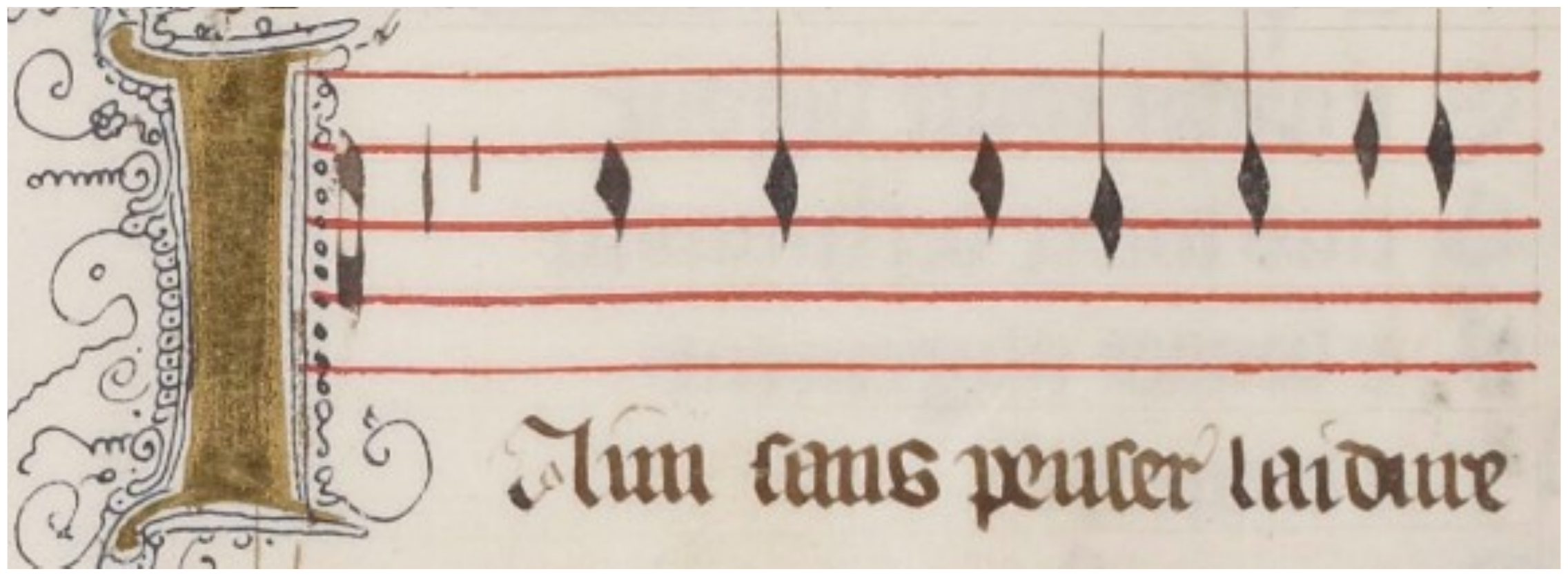
While an opening rest may make little difference to singing alone, its semibreve duration joins with the first note to complete the characteristic mensural unit of imperfect breves in Machaut’s “danced songs.” More importantly, the opening rest establishes an entrainment by which the first sung pitch is felt as metrically weak in a notation lacking barlines or other explicit metrical reference. I further speculate that a rest may also reserve metered space for dancers to begin motion before a pickup note is sung on the offbeat. Even more remarkable is the breve rest preceding the semibreve rest, the breve representing a full measure in transcription (omitted from my Example 5, following Ludwig, because it did not affect beat counts at the tempus level). Because both these opening rests appear consistently in all sources, the empty breve (measure) would appear to serve an important function in the modus organization of this song. If m. 1 of my transcription is taken as a hypermetrical upbeat, thereby adopting the empty breve as the downbeat of a hypothetical m. 0, then all formal sections will cadence emphatically on modus downbeats. If, on the other hand, m. 1 is felt to start the song on a modus downbeat, all formal boundaries—including the very end of the song—close on a weak beat at that level.
Four chansons baladées (V5, V9, V28/25, and V36/30) begin with a single eighth-note pickup preceded by rests. Lacking a full breve of preparation, as in V14, these single minims are perhaps brief enough not to confuse mensural reckoning and, relatedly, to be sung before dancing commences on the ensuing downbeat. In all manuscripts, V5, V9, and V28/25 begin with one or two minim rests (in imperfect and perfect time respectively), enough to complete a full semibreve beat together with their single minim pickup note (excepting Mach E’s notation of V28/25). Excepting Mach E’s of notation of V28/25, which begins on the sung pickup note itself without preparatory rests to begin dancing. V36/30 begins with one semibreve rest and then a minim rest in all sources (Mach A, G, and Vg): that is, a full beat of rest followed by enough rest to complete a second beat of imperfect time with the single pickup note, a duration of silence approaching that of V14. Ludwig (1926) represents none of these rests, whereas Schrade (1956) restores them all.
Intriguingly, beginning on a weak beat is a trait peculiar to the chansons baladées among Machaut’s entries in the formes fixes. There are no examples among the ballades or rondeaux. His other song genres—the lais, a complainte, and a chanson royale—include just one other song that potentially begins with a pickup. Ludwig (1926) transcribes Lai 1, “Loyaute, que point ne delay,” in 6/4 and begins the song on weak beat 2, without the guide of an initiating rest in any manuscript source. This issue does not arise in Schrade (1956), who sets the same song in 3/4, dividing each of Ludwig’s measures in two and beginning immediately on the first downbeat, thus bringing Machaut’s older modus notation in line with the tempus beats of other genres. Concerning mensural notation in the ars nova, Jacques de Liège (1320s) observes that “the perfect breve has the same value as had the perfect long for the Ancients,” with consequences for modern transcription; see Maw (2004, 47). The prospect of dance may suggest why measured silences, a special feature of about 10% of Machaut’s danced songs, were worth notating. Opening rests were crucial not only for mensural reckoning, but also, I propose, for dancing, insofar as they created space for movement when chanson and balader commenced separately. Yet because Machaut’s virelais include polyphonic examples, a complexity that likely excluded social dancing, offbeat pickups may have figured as a generic artifact of dance music at this point.
Even if Machaut’s chansons baladées grew beyond their practical dance origins, Seeta Chaganti (2018, 2–4) argues that social dancing so permeated medieval French society that lyrics like Machaut’s were both crafted and read through the virtual embodiment of dance. When Chaganti (2018, 17) notes that “Machaut and Deschamps wrote lyrics that were mindful of the aesthetics of dance and dance accompaniment,” this does not mean that these lyrics were necessarily danced, but rather that they embrace certain markers of that tradition, analogous to a bourrée by Bach or, still further removed, the ballades of Chopin. The virtual embodiment of dance is the sense in which poets took on the norms and limitations of dance music as a scaffolding for the creation of new lyrics, and it is not a far leap to suppose that the genre Machaut proclaimed the “danced song” could encode features of dance music known to him. Judith Peraino similarly claims that whether a lyric was actually sung or just read “has less to do with a change in the formal properties of the poetry than with a change in concept, namely, that a lyrical poem with a refrain and an origin in public dance songs could be a complete expression as read—without musical performance” (2011, 259). Whether a given work was destined to be danced or not, its metrical grouping structure may nonetheless bear the generic footprint of dance.
The metrical flexibility explored in this study attests to a highly developed style rooted in dance. Ars nova notation’s potential for constant changes of grouping raises questions of whether and how dancers might have interpreted and embodied flexible groupings and metrical inconsistencies, to which we have no sure medieval answers. The primacy of binary grouping in Machaut’s chansons baladées, taken as a stylistic norm, prompts special interpretation of triple groupings. In this study I have extended this simple principle to any change of entrained grouping pattern at any level of metrical grouping. I proposed connections between passages of metrical ambiguity, marked off by such changes, and strategic tonal articulation. Both large-scale formal repetition and small-scale motivic restatement involve a similar off-kilter status when set in opposing metric positions as a given song unfolds. The subtle complexity of these issues and the occasional presence of polyphonic accompaniment in the corpus likely testify to a shift from physical to virtual embodiment of dance in the chansons baladées. While enlarging the possibilities for the danced song as a genre, Machaut clung to a nomenclature that foregrounded dance for performers and listeners of his era and for scholars today. Further research on the interconnections among dance, music, and medieval meter can guide vital interpretation of these works in our own time.
MANUSCRIPTS
A: Paris, Bibliothèque nationale de France, fonds français 1584.
B: Paris, Bibliothèque nationale de France, fonds français 1585.
C: Paris, Bibliothèque nationale de France, fonds français 1586.
E: Paris, Bibliothèque nationale de France, fonds français 9221.
F–G: Paris, Bibliothèque nationale de France, fonds français 22545–46.
Vg: Ferrell-Vogüé, private ownership of James E. Ferrell and Elizabeth J. Ferrell.
WORKS CITED
Alexander, Jonathan J. G. 1996. “Dancing in the Streets.” Journal of the Walters Art Gallery 54: 147–62.
Aluas, Luminita Florea. 1996. “The Quatuor Principalia Musicae: A Critical Edition and Translation, with Introduction and Commentary.” PhD diss., Indiana University.
Arcangeli, Alessandro. 1994. “Dance Under Trial: The Moral Debate 1200–1600.” Dance Research 12 (2): 127–55.
Boone, Graeme M. 2000. “Marking Mensural Time.” Music Theory Spectrum 22 (1): 1–43.
Boulton, Maureen Barry McCann. 1993. The Song in the Story: Lyric Insertions in French Narrative Fiction, 1200–1400. University of Pennsylvania Press.
Butterfield, Ardis. 2002. Poetry and Music in Medieval France: From Jean Renart to Guillaume de Machaut. Cambridge University Press.
Chaganti, Seeta. 2018. Strange Footing: Poetic Form and Dance in the Late Middle Ages. University of Chicago Press.
Coldwell, Maria V. 1981. “Guillaume de Dole and Medieval Romances with Musical Interpolations.” Musica Disciplina 35: 55–86.
Dean Smith, Margaret. 1937. “A Fifteenth Century Dancing Book.” Journal of the English Folk Dance and Song Society 3 (2): 100–109.
Desmond, Karen. 2018. Music and the “Moderni,” 1300–1350: The “Ars Nova” in Theory and Practice. Cambridge University Press.
Dickason, Kathryn. 2021. Ringleaders of Redemption: How Medieval Dance Became Sacred. Oxford University Press.
Dillon, Emma. 2015. “Unwriting Medieval Song.” New Literary History 46 (4): 595–622.
Earp, Lawrence M. 1991. “Lyrics for Reading and Lyrics for Singing in Late Medieval France: The Development of the Dance Lyric from Adam de la Halle to Guillaume de Machaut.” In The Union of Words and Music in Medieval Poetry, ed. Rebecca A. Baltzer, Thomas Cable, and James I. Wimsatt, 101–31. University of Texas Press.
Earp, Lawrence M. 1995. Guillaume de Machaut: A Guide to Research. Garland.
Earp, Lawrence M. 2005. “Declamatory Dissonance in Machaut.” In Citation and Authority in Medieval and Renaissance Musical Culture: Learning from the Learned, ed. Suzannah Clark and Elizabeth Eva Leach, 102–22. Boydell.
Earp, Lawrence M. 2012. “Declamation as Expression in Machaut’s Music.” In A Companion to Guillaume de Machaut, ed. Deborah McGrady and Jennifer Bain, 209–38. Brill.
Eustace, Frances, and Pamela King. 2011. “Dances of the Living and the Dead: A Study of Danse Macabre Imagery Within the Context of Late-Medieval Dance Culture.” In Mixed Metaphors: The “Danse Macabre” in Medieval and Early Modern Europe, ed. Sophie Oosterwijk and Stefanie Knöll, 43–72. Cambridge Scholars Publishing.
Fuller, Sarah. 1981. “Theoretical Foundations of Early Organum Theory.” Acta Musicologica 53 (1): 52–84.
Fuller, Sarah. 1986. “On Sonority in Fourteenth-Century Polyphony: Some Preliminary Reflections.” Journal of Music Theory 30 (1): 35–70.
Fuller, Sarah. 1992. “Tendencies and Resolutions: The Directed Progression in Ars Nova Music.” Journal of Music Theory 36 (2): 229–58.
Grant, Roger Mathew. 2014. Beating Time and Measuring Music in the Early Modern Era. Oxford University Press.
Hoppin, Richard H. 1960. “Notational Licences of Guillaume de Machaut.” Musica Disciplina 14: 13–27.
Huot, Sylvia. 1987. From Song to Book: The Poetics of Writing in Old French Lyric and Lyrical Narrative Poetry. Cornell University Press.
Kohn, Karl. 1981. “The Renotation of Polyphonic Music.” Musical Quarterly 67 (1): 29–49.
Lavacek, Justin. 2022. “Hidden Colouration: Deep Metrical Flexibility in Machaut.” Plainsong and Medieval Music 31 (2): 143–67.
Leach, Elizabeth Eva. 2000. “Counterpoint and Analysis in Fourteenth-Century Song.” Journal of Music Theory 44 (1): 45–79.
Leach, Elizabeth Eva. 2011. Guillaume de Machaut: Secretary, Poet, Musician. Cornell University Press.
Leech-Wilkinson, Daniel. 1991. “Not Just a Pretty Tune: Structuring Devices in Four Machaut Virelais.” Sonus 12 (1): 16–31.
Leguy, Sylvette, ed. 1977. Œuvres complètes, vol. 1. By Guillaume de Machaut. Le Droict Chemin de Musique.
Leo, Domenic. 2005. “Authorial Presence in the Illuminated Machaut Manuscripts.” PhD diss., New York University.
Lerdahl, Fred, and Ray Jackendoff. 1983. A Generative Theory of Tonal Music. MIT Press.
Little, Meredith Ellis. 1975. “The Contribution of Dance Steps to Musical Analysis and Performance: La Bourgogne.” Journal of the American Musicological Society 28 (1): 112–24.
Ludwig, Friedrich, ed. 1926. Musikalische Werke Vol. 1: Balladen, Rondeaux und Virelais. By Guillaume de Machaut. Breitkopf und Härtel.
Maw, David. 2002. “Meter and Word Setting: Revising Machaut’s Monophonic Virelais.” Current Musicology 74: 69–102.
Maw, David. 2004. “‘Trespasser mesure’: Meter in Machaut’s Polyphonic Songs.” Journal of Musicology 21 (1): 46–126.
Maw, David. 2013. “‘Bona cadentia dictaminum’: Reconstructing Word Setting in Machaut’s Songs.” Music and Letters 94 (3): 383–432.
McGee, Timothy J. 1989. “Medieval Dances: Matching the Repertory with Grocheio’s Descriptions.” Journal of Musicology 7 (4): 498–517.
McGee, Timothy J. 2012. Review of The “Carole”: A Study of a Medieval Dance, by Robert Mullally. Music and Letters 93 (3): 399–401.
Moll, Kevin N. 1998. “Voice Function, Sonority, and Contrapuntal Procedure in Late Medieval Polyphony.” Current Musicology 64: 26–72.
Morrison, Clint, Jr. 2021. “Choreographic Description: Carole Dancing in Sir Gawain and the Green Knight.” Arthuriana 31 (3): 21–39.
Mullally, Robert. 1986. “Cançon de Carole.” Acta Musicologica 58 (2): 224–31.
Mullally, Robert. 1998. “Johannes de Grocheo’s ‘Musica vulgaris.’” Music and Letters 79 (1): 1–26.
Mullally, Robert. 2011. The “Carole”: A Study of a Medieval Dance. Routledge.
Nevile, Jennifer. 2008a. “Dance in Europe 1250–1750.” In Dance, Spectacle, and the Body Politick, 1250–1750, ed. Jennifer Nevile, 7–64. Indiana University Press.
Nevile, Jennifer. 2008b. ”Dance Performance in the Late Middle Ages: A Contested Space.” In Visualizing Medieval Performance: Perspectives, Histories, Contexts, ed. Elina Gertsman, 295–310. Ashgate.
Page, Christopher. 1989. The Owl and the Nightingale: Musical Life and Ideas in France 1100–1300. University of California Press.
Peraino, Judith A. 2011. Giving Voice to Love: Song and Self-Expression from the Troubadours to Guillaume de Machaut. Oxford University Press.
Renberg, Lynneth Miller. 2022. Women, Dance and Parish Religion in England, 1300–1640: Negotiating the Steps of Faith. Boydell.
Rimmer, Joan. 1985. “Dance Elements in Trouvère Repertory.” Dance Research 3 (2): 23–34.
Rimmer, Joan. 1991. “Medieval Instrumental Dance Music.” Music and Letters 72 (1): 61–68.
Saltzstein, Jennifer. 2010. “Relocating the Thirteenth-Century Refrain: Intertextuality, Authority and Origins.” Journal of the Royal Musical Association 135 (2): 245–79.
Schrade, Leo, ed. 1956. The Works of Guillaume de Machaut: Second Part. By Guillaume de Machaut. L’Oiseau-Lyre.
Stevens, John. 1986. Words and Music in the Middle Ages: Song, Narrative, Dance and Drama, 1050–1350. Cambridge University Press.
Stokes, Jordan. 2014. “In Search of Machaut’s Poietics: Music and Rhetoric in Le Remede de Fortune.” Journal of Musicology 31 (4): 395–430.
Straple-Sovers, Rebecca. 2021. “Kinesic Analysis: A Theoretical Approach to Reading Bodily Movement in Literature.” In The Cursed Carolers in Context, ed. Lynneth Miller Renberg and Bradley Phillis, 21–38. Routledge.
Straple-Sovers, Rebecca. 2023. “‘A Feather on the Breath of God’: Medieval Legacies in Modern Choreography.” Postmedieval 14: 593–619.
Van den Boogaard, Nicolaas Hendricus Johannes, ed. 1969. Rondeaux et refrains du XIIe siècle au début du XIVe. Éditions Klincksieck.
Ward, John M. 1976. “The Maner of Dauncying.” Early Music 4 (2): 127–42.