Table of Contents
for William Rothstein
The title of this article alludes to Andrew Imbrie’s “Extra Measures and Metrical Ambiguity in Beethoven” (1973). In that essay, Imbrie argues that in the first movement of the Fifth Symphony, after many regular four-bar hypermeasures, Beethoven adds an extra bar toward the end of the development, such that the performer and the listener need to switch to a new hypermetrical pattern—from even-strong to odd-strong. These terms refer to strong even-numbered measures and strong odd-numbered ones (Temperley 2008). Beethoven’s notated measures remain the same throughout, but the perceived hypermetric accent shifts. Justin London (2012, 100–115) also discusses metric processes in this movement.
The situation in Rachmaninoff’s G-Minor Prelude, op. 23, no. 5 (1901, published in 1904), is different. Here, the notated measure changes from 4/4 to 2/4 twice over the course of the piece. Measures 9 and 16, the 2/4 measures, contain the two cadential points within the opening section in the form of a half cadence (HC) and perfect authentic cadence (PAC) (Example 1). The purpose of this paper is to show that, like the tip of an iceberg, this seemingly innocuous change of time signature is connected to a set of interrelated phrase-rhythmic and formal processes, the importance of which is invisible at first sight. As in Beethoven’s symphony, there exists an extra unit (here, a half note) at one metrical level. Its location and function reveal much about the piece, particularly the first and last sections: how the measure is perceived, as opposed to notated; how phrase-structural asymmetry engenders multiple ways to hear metrical shifts; and how these shifts relate to formal functionality and formal becoming. The idea of becoming (Schmalfeldt 2011) refers to a reinterpretation of function (for example, main theme⇒transition) within a formal unit, often thanks to conflicting functional cues that suggest more than one interpretation simultaneously.
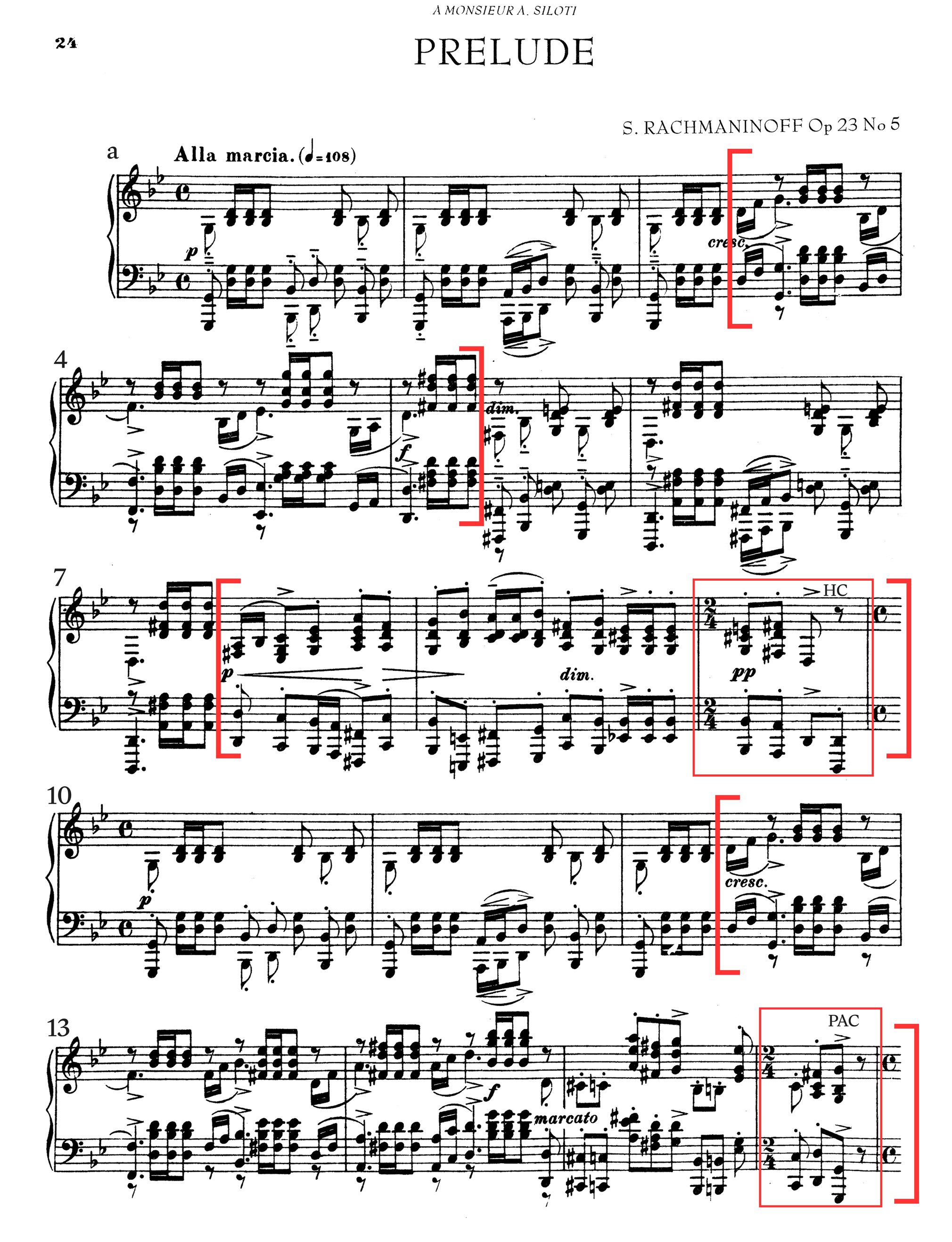
I offer one possible reading of the opening section—four-square phrases framed by non-thematic material—and what happens to it in the recapitulation, which simultaneously resolves metrical ambiguities posed earlier and creates new ambiguities with respect to formal function. Form-functional terminology derives from William Caplin (1998, 2013). I also suggest a possible re-notation of bar lines as an alternative reading of the metrical irregularity. Attempting to find the origin of this metrical anomaly, I argue, leads to a deeper understanding of the piece’s internal metric workings. I thus reinforce the urge within metrical theory to think beyond ostensible bar lines and not take them at face value as simple and indisputable facts (Lerdahl and Jackendoff 1983; Rothstein 1995, 2008). A secondary objective is to explore how Rachmaninoff creatively transforms formal structures and principles that originate in late eighteenth-century practice, principles he internalized during his studies at the Moscow Conservatory (1888–92). This task continues scholarly efforts to explore the application of Classical formal taxonomies to post-Classical music (Vande Moortele 2013, Horton 2015).
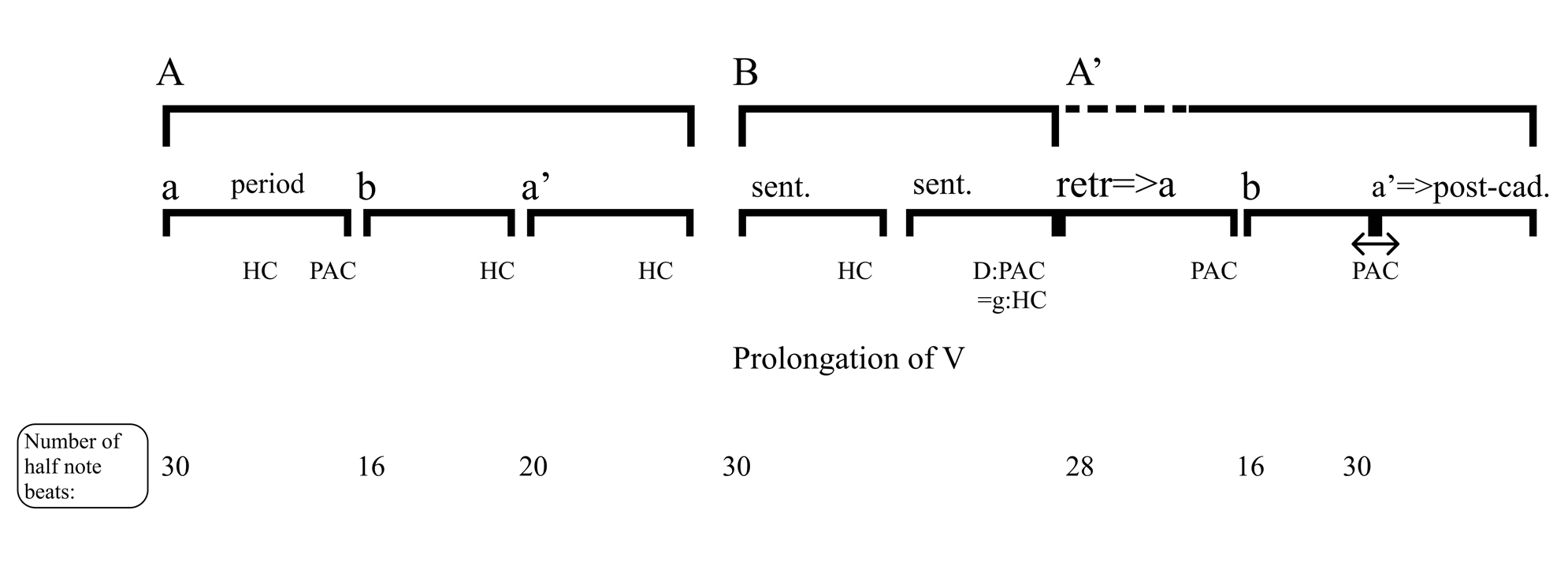
First, a brief overview of the prelude’s form is in order. The prelude is cast in ternary form, or ABA′, where the large-scale A section is itself in small ternary (aba′) with a truncated recapitulation (Example 2). Henceforth, I will refer to the different levels of form as A and B at the large scale and a and b at the small scale.
The two anomalous 2/4 measures are confined to the a section, on which I will now focus. As a first step, I want to discern the length of the perceived measure. The very fact that a 2/4 bar occurs within a 4/4 piece suggests that the half note might be the dominant metrical unit in the A and A′ sections, which therefore could have been notated in 2/4 throughout. This hearing is confirmed in the notated mm. 3–4, where the repeated rhythmic motive sixteenth–sixteenth–dotted quarter takes exactly one half-note. In other words, the real measure equals one-half of the notated measure: R = ½N (Caplin 2013, 63–64). This suggests the eighteenth-century notion of compound measure (Grave 1985), where the notated measure represents two perceived measures. While I do not insist that R = ½N represents the “right” hearing, I do encourage the reader to focus on the half note as a basic metrical beat.
With the basic half-note beat in mind, I turn to phrase structure and form. The two anomalous 2/4 measures signify an uneven number of half-note beats. This, in turn, suggests two possibilities: either some phrases are inherently asymmetrical, or symmetrical phrases have been shifted with respect to an underlying regularity. The former option is not uncommon in Rachmaninoff: examples of his most asymmetrical phrases and most unpredictable time-signature changes come in pieces that stylistically reference Russian folk or church music. Examples include “Uzh ty niva moya,” op. 4 no. 5; Prelude in E Minor, op. 32, no. 4; and the All-Night Vigil, op. 37, on which see Bakulina (2015, 28–30). But the G-minor prelude’s march topic (indexed by the alla marcia marking) and rhythmically repetitive character suggest the second possibility—that the piece might have an underlying symmetrical structure. Another piece that plays with an eighteenth-century topic, in this case the minuet, is Rachmaninoff’s Prelude in D Minor, op. 23, no. 3. To pursue this idea, we first need to determine the phrase structure of the opening sixteen measures. The overall form is clearly a period: antecedent in mm. 1–9 (HC) and consequent in mm. 10–16 (PAC). Strictly speaking, m. 9 does not qualify as an HC in Caplin’s taxonomy, since he requires the cadential dominant to enter in root-position form, whereas this V first occurs in a 6/4 position. This is one of the departures from Classical formal conventions. One solution to this problem is to consider the V6/4 on the second eighth note of m. 9 as an anticipation of the “real” V on the second quarter note. The bass line is E♭–D, a half-cadential motion, with the B♭–A understood to be inner-voice material. I will continue to refer to m. 9 as an HC, with the understanding that an HC may be a looser concept in early twentieth-century music than in music around 1800. But how are the antecedent and the consequent organized internally?
The question yields no automatic answer, and the reason for this lies in the curious lack of melodic material per se. This becomes clear if one attempts to sing the beginning: it is not easy to understand which melodic idea defines the prelude. It is, however, very clear which textural and rhythmic patterns define it: the low arpeggiated bass segment and the mid-register chords with two sixteenths and an eighth. And yet, to analyze form, one needs to decide on the local form-functional beginning—that is, the basic idea (and this decision impacts performance as much as analysis). There are two options: the basic idea enters either in m. 1 (with the melodic line in the lowest register) or in the middle of m. 3 (with the melodic line D–F–G in the middle register). I choose the latter option, thus rendering the preceding music a local introduction. This is equivalent to Caplin’s (2013, 133–34) “thematic introduction” and Rothstein’s ([1989] 2007, 68) “prefix.”
Since my overall argument depends on the form of this section, the relative advantages of the two readings deserve closer attention. The advantages of locating the basic idea in m. 3 include phrase-rhythmic symmetry and form-functional efficiency of the a section, the line’s relative “singability,” the register, and the presence of an actual harmonic progression, I–P64–iiø43–V with striking outer-voice counterpoint (Example 3a, mm. 6–9). (The passing 6/4 suggests a weak beat, supporting the beginning-accented hearing of the antecedent.) The alternative reading—with the basic idea in m. 1—suggests a local sentence: basic idea in m. 1, its repetition in m. 2, and fragmentation in mm. 3–4. This sentential reading supports the R = ½N idea, since the succession of “real” half-note measures is 2+2+1+1+1+1. The disadvantage is primarily form-functional: while the sentence works internally, the following music is harder to explain, especially mm. 5–9. It is possible to regard mm. 5–9 as a loose consequent with a reharmonized basic idea, after an “antecedent” in mm. 1–5, but the HC in m. 9 disqualifies this reading. Moreover, in this version both statements of the basic idea would be harmonically static, which is not typical for Classical or Romantic sentences. The fragmentation starting in m. 3 is somewhat unusual in a sentence, but there are Classical presentations consisting of two one-measure motives, too: the first movement of Beethoven’s Piano Sonata op. 14, no. 2, for instance.
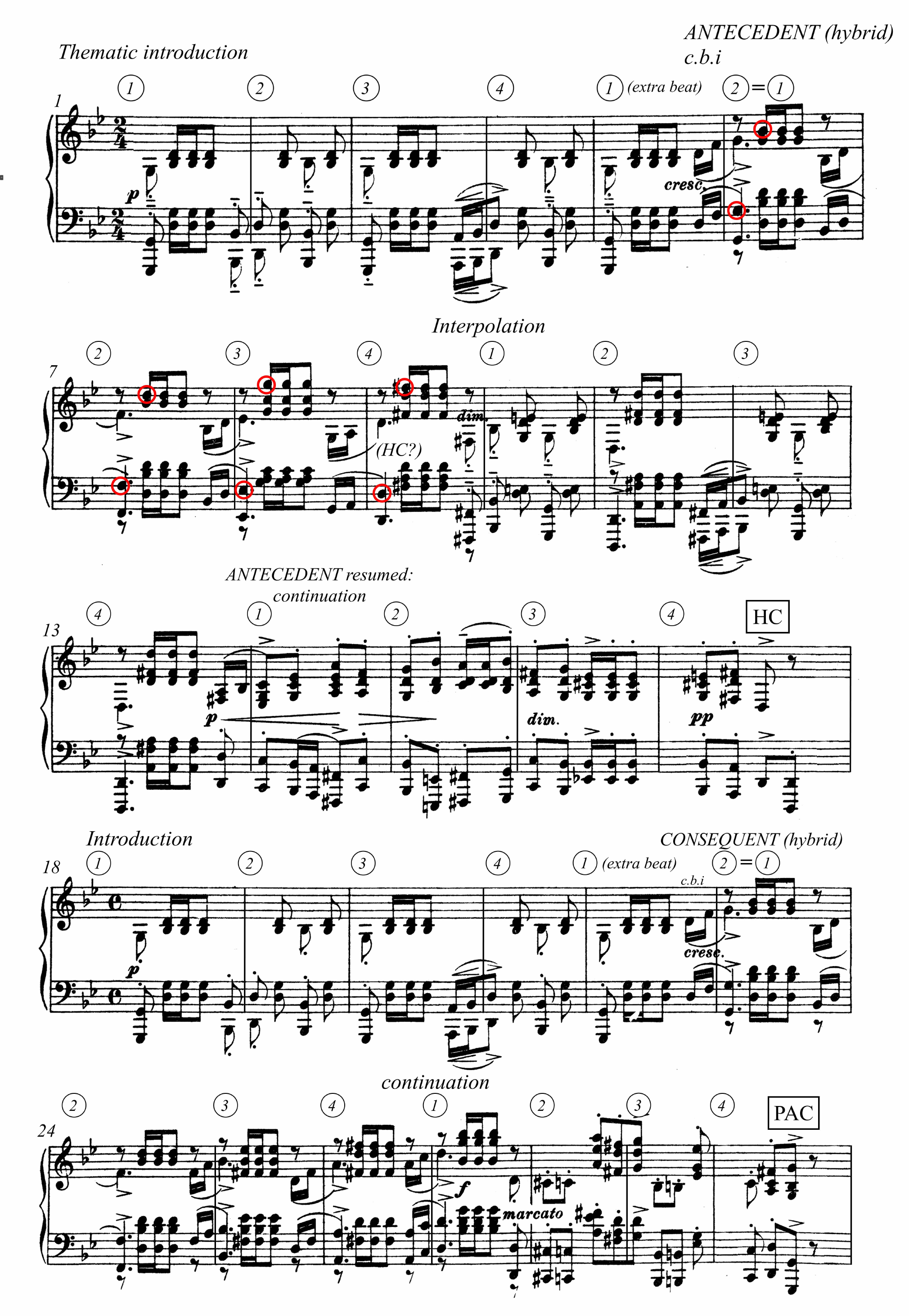
Renotation in 2/4.
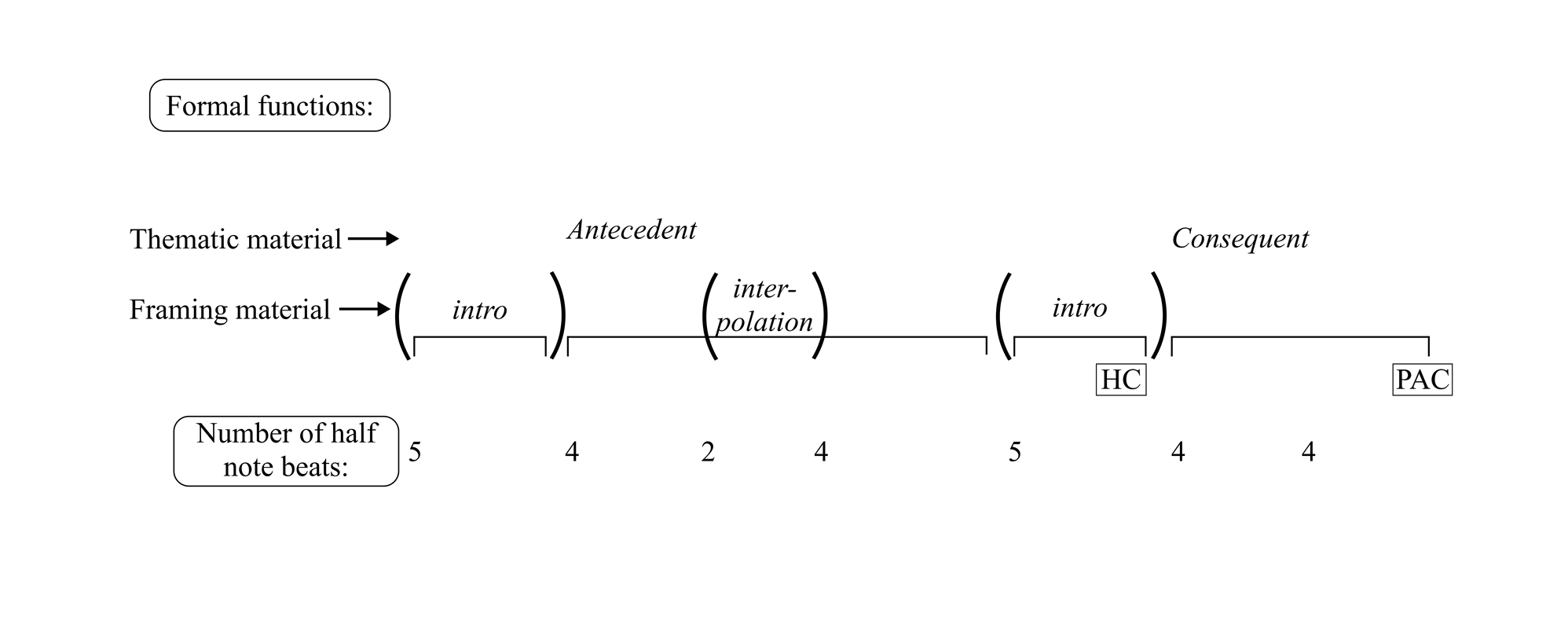
Formal diagram.
Sergei Rachmaninoff, Prelude in G Minor, op. 23, no. 5, section a.
The choice to hear the basic idea in m. 3 allows for a distinction between two types of material: melodic, which begins with the D–F–G line, and accompanimental, which may be called framing material, to adapt Caplin’s “framing function.” One might also think in terms of thematic and non-thematic, or essential and non-essential material. “Essential” and “non-essential” refer to an eighteenth-century distinction (Burstein, Nguyen, and Roderer 2024). The thematic material forms four symmetrical phrases, marked with brackets in Example 1, each of which has a structure of 4+4+4+4 half notes. This indicates the “basic length” (Rothstein [1989] 2007, 65) of the a section, the length to which the music can be reasonably reduced and still sound coherent. It is also the form-functional body of section a, a compound period I call the “structural period.” Both antecedent and consequent represent hybrid forms. Each hybrid consists of a compound basic idea (c.b.i., mm. 3–5) and continuation. The c.b.i. resembles a sentential presentation (which might render the eight-measure phrase a sentence) due to the rhythmic equivalence of the two ideas, but the harmonic progression does not fit Classical sentential presentation schemes. (One might argue for an additional HC in m. 5, but its cadential status is undermined by the consequent, where the corresponding point, m. 14, is decidedly non-cadential, as well as by the ascending melodic gesture, typical for initial functionality more than cadential. See, in this connection, Hutchinson and Poon (2022). )
It is this four-square construction and its Classical formal efficiency (relevant especially in light of the march topic) that ultimately disqualifies the alternative reading of a sentence starting in m. 1. The symmetry of the four phrases also explains the anomalous 2/4 measures in terms of shifts with respect to the structural period’s underlying regularity. Example 3 focuses on the interaction of the structural period and the framing material. The half note is notated as the real measure here, so the time signature is 2/4. The insertions of framing material are asymmetrical, and they also constitute a significant departure from Classical norms: five half-note beats in the thematic introduction (formally conventional), another four beats interpolated between the two halves of the antecedent (a form-functional surprise!), and another five beats in an introduction to the consequent (an uncommon placement). That makes for fourteen half notes outside of the structural period, but they are unevenly distributed. It is this uneven distribution of framing material that necessitates the anomalous measures in two separate places. It is not difficult to see which beat is “extra”: the one that creates five-beat units, the fifth half note in both thematic introductions. One could remove these two beats and have a more regular four-beat introduction without any harmonic discontinuity. If the half-note is the real measure, then there are, after all, extra “measures” in this piece!
But while phrase structure determines which half note is “extra,” only metrical analysis can determine which 4/4 measure is “too short”—in other words, at which specific point the metrical disturbance takes place, and which beats are strong. So far, I have considered the music in terms of half-note beats. But what about the 4/4 time signature—the composer’s notational choice—and a two-bar hypermetrical unit for those who prefer to hear the 2/4 bar as the real measure?
There are two answers depending on how one hears the structural period—as beginning-accented or end-accented. A third option would be a hypermetrical transition (Temperley 2008) between the odd-strong beginning and the even-strong ending of the antecedent. The consequent would then do the opposite: transition from even-strong to odd-strong hypermeter. Both Example 3 (2/4 time signature) and Example 4 (4/4 time signature) suggest a beginning-accented pattern at the level of four half notes. Example 4 rearranges the bar lines to emphasize beginning-accent within the structural period. Examples of re-barring existing music can be found in historical treatises such as Hugo Riemann’s Musikalische Dynamik und Agogik (1884) (Rothstein 2008, 120–21). In each phrase of four half notes, the first half note is strong and is notated as a downbeat. The energetic opening of the antecedent supports this reading. The tonic chords at the first beat of the antecedent and the consequent likewise suggest a beginning accent (following Lerdahl and Jackendoff’s metrical preference rules or Rothstein’s “stability rule”). Since the introduction is clearly beginning-accented (the first and third half notes are strong owing to the low bass notes), the extra beat just before the antecedent results in two consecutive strong beats at the junction of the introduction and the antecedent, producing a metrical reinterpretation or “deletion” (Lerdahl and Jackendoff 1983, 70). In the alternative, sentential reading of mm. 1–5, the extra beat would fit within a third, incomplete statement of the basic idea (based on m. 1) and the beginning of the continuation (mm. 3–5). Thus the re-notated version in Example 4 transfers the anomalous 2/4 measure immediately prior to the antecedent and the consequent. Another temporary complication is introduced in the interpolation. The low bass Ds suggest an accent on the odd-numbered measures 11 and 13 of Example 3a; the accent subsequently returns to its previous position.

But this, of course, is not how Rachmaninoff chooses to notate it. Instead, he implies an end-accented pattern, notating time signature changes in m. 9 and m. 16, and placing the second and fourth half notes in the structural period on downbeats. This forces a metrical reinterpretation of the beat directly following the two cadences. The visual markedness of the cadences as the anomalous 2/4 measures suggests that their downbeats are the very strongest in the passage, hypermetrical accents at the four-half-note level and maybe even the eight-half-note level. (A later re-composition of this material, however, undermines this impression; see analysis of the recapitulation, below.)
Regardless of which metrical reading one prefers, the phrase-rhythmic irregularities—including the five-beat introduction and unexpected interpolation—create an impression of discontinuity and even reluctance, a quality that stands out in Rachmaninoff’s own performance as he slows down and briefly softens the dynamic in the middle of m. 5. Sergei Rachmaninoff, A Window in Time: Rachmaninoff Performs His Solo Piano Works, recorded 1919–29 (Telarc, 1998). This observation is important to the last part of my analysis—the large-scale form (Example 2), to which I now return.
The metric discontinuity of the a section is entirely absent from the rest of the piece, and the anomalous 2/4 measures never return. This happens for a different reason in each formal area. First, within the large A, the b section is phrase-rhythmically regular; its medial character is defined primarily by its sequential progression (chord roots E♭–B♭–D; F–C–E♭). The a′ section is truncated and preserves only the first of the four phrases in the original compound period. Framing material is still present, but in a different form this time. The section is twenty half notes long, arranged as 5+4+11 (the last eleven are post-cadential, a standing on the dominant after an HC). Although asymmetrical, this section has an even number of beats, and no extra half note is needed. The large-scale B section is mostly metrically regular. It brings new thematic material, lyrical and—unlike the melodically fragmentary A section—with a real melody, completely eschewing any eighteenth-century references. The slower melodic development and broader sweeps of the accompaniment suggest alla breve measures (a whole note long, rather than a de facto 2/4). The theme consists of two sentence-like phrases, both of which begin and end on the dominant harmony, D. There is a single hypermetrical shift (or reinterpretation) at m. 42, right after the first sentence has been compressed by a measure.
Finally, the prelude’s large-scale recapitulation contains some striking features. We might initially expect a return of the opening small ternary from section A. Instead, only remnants of the opening theme appear. The a section is replaced with a new passage, 14 notated measures long (equal to 28 half notes, thus without requiring a change of time signature). The symmetrical b section remains the same as before. Finally, a′ is omitted entirely, replaced with a lengthy post-cadential passage prolonging the G-minor tonic. The post-cadential function of the final section comes from a lengthy tonic harmony (sustained for either four or seven measures depending on individual reading), followed by repeated cadential progressions—a typical post-cadential technique (Caplin 2013, 135). This dissolution of the former ternary theme suggests a process of becoming (Schmalfeldt 2011): retransition⇒a, unmodified b, and a new a′ prolonging the tonic and becoming a post-cadential unit, or a′⇒post-cadential. The becoming, or transformation, of formal functions is perhaps the most Romantic formal feature in this work.
The retransition⇒a requires some comment. The anomalous 2/4 measures disappear on account of the near absence of thematic material in the recapitulation. At the prelude’s beginning, each extra half note occurs at the form-functional junction of framing and thematic material. In the recapitulation, however, the distinction between these two types of material collapses. When the opening arpeggiated motive returns after the B section, one may expect this material to fulfill an introductory function with respect to the structural period. This passage is also retransitional, since it begins on the B section’s last harmony (V), first with a post-cadential phrase and then sequentially proceeding toward the tonic. But neither antecedent nor consequent of the initial period ever recurs, and we reinterpret the arpeggiated framing material as essential to the recapitulation. In the alternative (sentential) reading of the opening measures, the recapitulatory passage I read as retransition⇒a′ would consist of a series of presentation-like phrases, what Rothstein ([1989] 2007, 296) calls a “Stollen process.” Russian theorist Valentina Kholopova (1979) would identify this as “thematized texture” (tematezirovannaya faktura), a textural pattern made prominent enough to sound thematic. The extra beat no longer occurs because its original form-functional context—the collision of essential and non-essential material—is gone. Example 5 shows the moment where the “framing material” continues past its original length, suppressing any return of the former antecedent. This formal surprise removes all the phrase-rhythmic surprises.
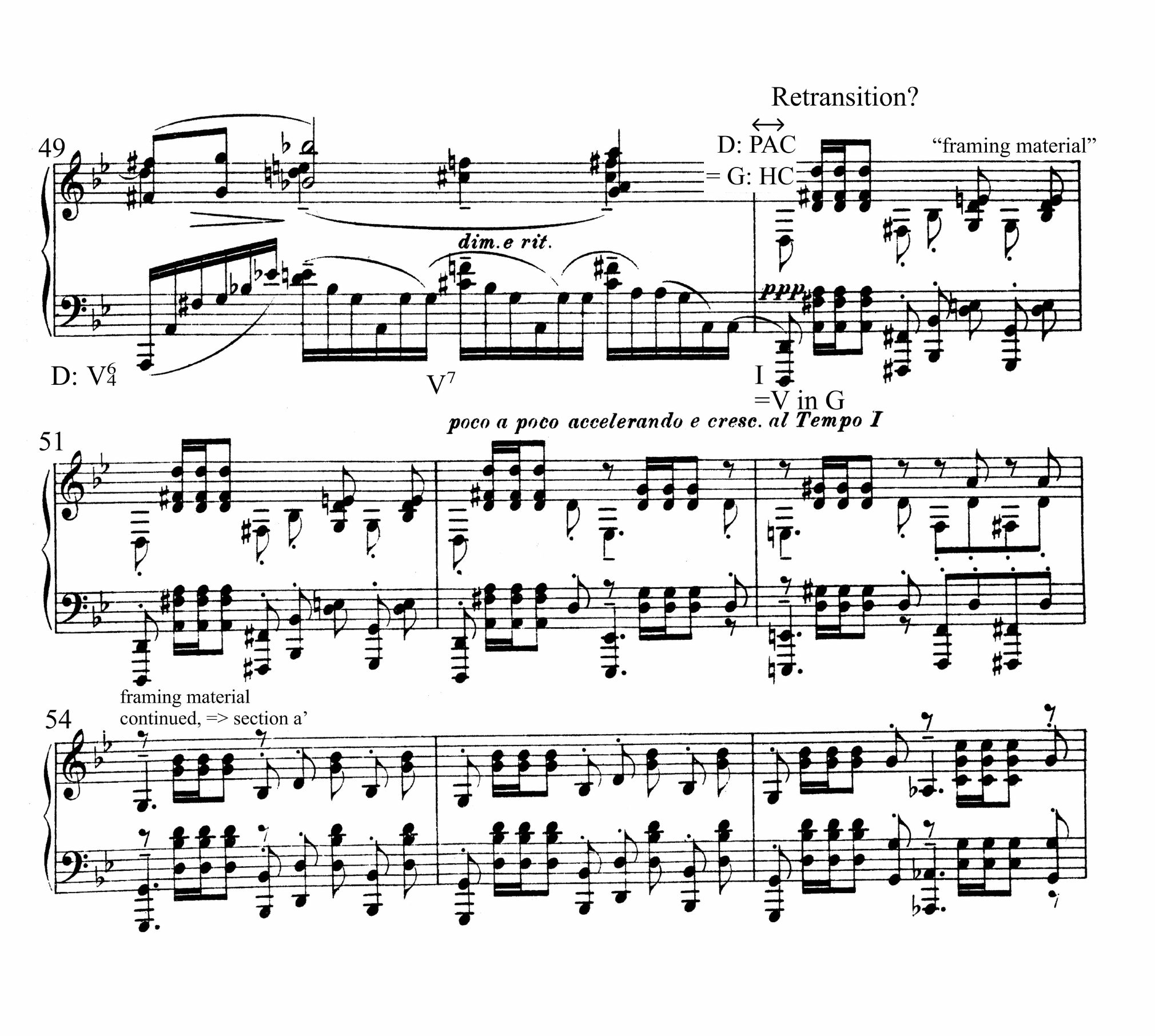
The recapitulation is completely regular at the level of four half notes, an inexorable, rhythmically undisturbed drive toward the tonic arrival at m. 72. The final cadence constitutes another formal conundrum. Measure 70 is analogous to m. 25 in the A section; both suggest an HC before a′ begins on the tonic. Although it is possible to read a PAC in m. 72 through reinterpretation, retrospectively denying the HC in m. 70, The a′⇒post-cadential is a “dissolving recapitulation” (Bakulina 2020, 72), which involves hearing the final PAC only through retrospective reinterpretation. m. 80 is a stronger candidate for the final cadence in the final a′ section. This point is preceded by a –– bass line after seven measures of relative stasis, and it is followed by more harmonic stasis and by a recessive dynamic.
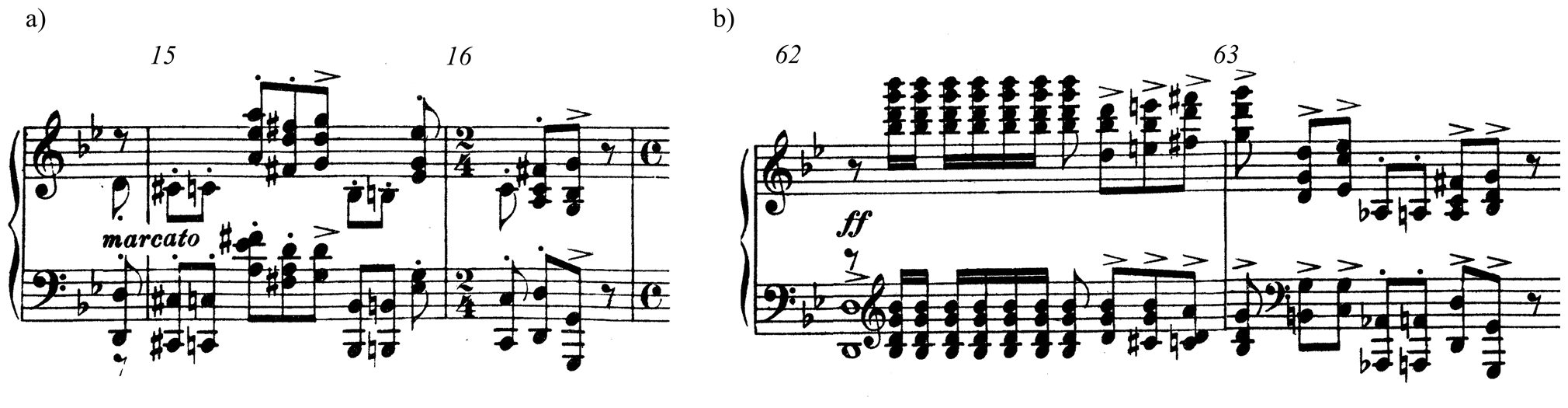
A final observation about the recapitulation ties into the metrical questions of the beginning. The cadence of the retransition⇒a section, a PAC in m. 63, corresponds to the PAC in m. 16 in the exposition, the focus of the phrase-rhythmic mysteries discussed earlier. Example 6 juxtaposes the two cadences for comparison. In m. 16, the half-note unit that contains the V–I cadential progression is notated as a strong beat, suggesting an end-accent. In the recapitulatory m. 63, the corresponding unit falls on the weak part of the 4/4 measure, thus suggesting a beginning-accent. True, the recapitulation contains enough changes to possibly hear these two a sections as largely unrelated. And yet, the PACs in m. 16 and m. 63 are associated by their analogous formal placement and rhythmic and harmonic similarity. This suggests that, after all, Rachmaninoff might have meant both these cadential segments as metrically weak, and their corresponding phrase beginnings as strong, in spite of his bar-line placement in the opening section. This, in turn, supports my contention that the “real” anomalous 2/4 measure should occur at the end of the brief thematic introduction, around notated m. 3 and m. 12, and not where the composer notates them! One might perhaps see m. 63 as the answer to the questions posed by the initial section: how the accents are arranged within the structural period, and how they interact with the extra beat, the resulting metrical reinterpretations, and the anomalous 2/4 measure.
In summary, I have argued that the opening of the G-Minor Prelude contains a regular period, partially concealed; that the extra half note occurs in the two local introductions within this period; that the comparison of sections A and A′ suggests a change of perceived time signature in m. 3 and m. 11, as opposed to m. 9 and m. 16; and that this metrical disturbance disappears in the recapitulation because of the dissolution of the initial structural period. In conclusion, I wish to emphasize that, in many cases, form, phrase rhythm, and meter cannot be fully understood without each other, and Rachmaninoff’s prelude is a good illustration of this interconnection. This interconnection also foregrounds the various interpretive possibilities: where to place the primary metrical accent; what is the essential thematic material, and which criteria determine this; what role symmetry plays at deeper levels of the formal hierarchy; and how all these aspects change over the large form of the prelude. Ultimately, the complexity of these interpretations impart expressive depth to the music, which at first glance may be perceived as the result of the sheer pianistic energy of the material.
Works Cited
Bakulina, Ellen. 2015. “The Problem of Tonal Disunity in Sergeĭ Rachmaninoff’s All-Night Vigil, Op. 37.” PhD diss., City University of New York.
Bakulina, Ellen. 2020. “The Loosening of Closure: A Form-Functional Study of Sergei Rachmaninoff’s Solo Songs.” Theory and Practice 45: 51–92.
Burstein, L. Poundie, Quynh Nguyen, and Jennifer Roderer. 2024. “The Best Laid Plans . . . and Others: An 18th-Century Compositional Outline.” SMT-V 10 (1).
Caplin, William E. 1998. Classical Form: A Theory of Formal Functions for the Instrumental Music of Haydn, Mozart, and Beethoven. Oxford University Press.
Caplin, William E. 2013. Analyzing Classical Form: An Approach for the Classroom. Oxford University Press.
Grave, Floyd K. 1985. “Metrical Displacement and the Compound Measure in Eighteenth-Century Theory and Practice.” Theoria 1: 25–60.
Horton, Julian. 2015. “Formal Type and Formal Function in the Postclassical Piano Concerto.” In Formal Functions in Perspective: Essays on Music Form from Haydn to Adorno, edited by Steven Vande Moortele, Julie Pedneault-Deslauriers, and Nathan John Martin, 77–122. University of Rochester Press.
Hutchinson, Kyle, and Matthew Poon. 2022. “Cadential Melodies: Form-Functional Taxonomy and the Role of the Upper Voice.” Music Theory Online 28 (2). https://www.mtosmt.org/issues/mto.22.28.2/mto.22.28.2.hutchinsonpoon.html
Imbrie, Andrew. 1973. “Extra Measures and Metrical Ambiguity in Beethoven.” In Beethoven Studies, edited by Alan Tyson, 45–66. Norton.
Kholopova, Valentina. 1979. Faktura. Sovetskiy kompozitor.
Lerdahl, Fred, and Ray Jackendoff. 1983. A Generative Theory of Tonal Music. MIT Press.
London, Justin. 2012. Hearing in Time: Psychological Aspects of Musical Meter. 2nd edition. Oxford University Press.
Rothstein, William. [1989] 2007. Phrase Rhythm in Tonal Music. Musicalia.
Rothstein, William. 1995. “Beethoven With and Without Kunstgepräng’: Metrical Ambiguity Reconsidered.” In Beethoven Forum 4, edited by Lewis Lockwood and James Webster, 165–93. University of Nebraska Press.
Rothstein, William. 2008. “National Metrical Types in Music of the Eighteenth and Early Nineteenth Centuries.” In Communication in Eighteenth-Century Music, edited by Danuta Mirka and Kofi Agawu, 112–59. Cambridge University Press.
Schmalfeldt, Janet. 2011. In the Process of Becoming: Analytic and Philosophical Perspectives on Form in Early Nineteenth-Century Music. Oxford University Press.
Temperley, David. 2008. “Hypermetrical Transitions.” Music Theory Spectrum 30 (2): 305–25.
Vande Moortele, Steven. 2013. “In Search of Romantic Form.” Music Analysis 32 (3): 404–31.